7. One the British had ensured that the Armed Forces consisted primarily of Muslim soldiers and that too from the North West, the area that is modern day Pakistan. They sought to justify this predominance by saying that men of the North-West belonged to the Martial Classes.
Mr. Chaudhari (see his articles on ‘The martial Races of India’ published in the modern Review of July-September 1930, Jan-Feb 1931) study shows that the predominance of the men of the Northwest took place as early as the Mutiny of 1857 some 20 years before the theory of martial and non-martial classes were projected in a distinct form in 1879. Their predominance had nothing to do with their alleged fighting qualities but was due to the fact that they had helped the British suppress the Mutiny in which the Bengal Army was completely involved. The Mutiny blew up the old Bengal army and brought into existence a Punjabized army. This table shows how the British changed the composition of the Indian Army between 1914 and 1930.
Changes in the Communal Composition of the Indian Army| No | Area & Communities | % in 1914 | % in 1930 |
| 1. | Punjab, NW.F.P & Kashmir | 47 | 58.5 |
| Of which Punjabi Muslims & Pathans | 17.3 | 28.95 | |
| Of which Sikhs | 19.2 | 13.58 | |
| 2. | Nepal. Kumaon, Garwhal | 15 |
22 |
| 3. | Upper India | 22 | 11 |
| Of which Hindustani Muslims | 4.1 | 0 | |
| 4. | South India | 16 | 5.5 |
| 5. | Burma | 0 | 3 |
Note that the Sikhs are reduced from first to third place.
After 1930 there is no information available on the communal composition of the Indian Army. This obstinacy on the part of the British to provide this vital point gave rise to all sorts of speculation as to the proportion of Muslims in the Indian army. Some believed it was between 60-70 %. Obviously it was high enough to cause alarm to the Hindus.
Veer Savarkar was probably one of the few leaders who kept exhorting Hindus to join the Indian Army in large numbers. He said in 1940, “Since the days of the First War of Independence in 1857, it has been the policy of the British to keep the army out of politics. Our politics must be to carry politics into the Indian army and once we succeed the battle of freedom would be won. Till the day of Savarkar’s whirlwind propaganda for Hindu militarization, military career was the monopoly of the Muslims, who formed three fourths of the Indian army. The effect of this propaganda was seen everywhere. The Muslim plans for preponderance was effectively checkmated and brought down and the % of the Hindus in the army went up as high as seventy”’. Life of Veer Savarkar by Dhananjay Keer.
Therefore, how could the Hindus feel protected against foreign invasion when the Army was predominantly Muslim from Punjab and N.W.F.P.? More so if the invaders were Afghans singly or in combination with other Muslim states!
The only way for Hindus to get rid of a predominantly Muslim army was by the creation of Pakistan.
Dr Ambedkar buttressed his argument by stating that the Pakistan area which is the main recruiting ground for the then Indian army contributed very little to the Indian exchequer.
Revenue Contribution to Exchequer – Pakistan area and Hindustan| No | Province | Rs crs |
Rs crs |
| Pakistan Area | 7.13 | ||
| 1. | Punjab, N.W.F.P. & Baluchistan | 1.27 | |
| 2. | Sind | 5.86 | |
| Hindustan | 51.91 | ||
| 1. | Bombay | 22.53 | |
| 2. | Madras | 9.53 | |
| 3. | Bengal (only ½ revenue shown based on population) | 12.00 | |
| 4. | Others | 7.85 |
The main contribution comes from the provinces of Hindustan. Not only do the Pakistani provinces contribute very little to the Central Government but they receive a great deal. Out of the total central government revenues of Rs 121 crs Rs 52 crs is spent on the army annually. The bulk of this amount which is spent on the army is spent over the Muslim army drawn from the Pakistan area. The bulk of the Rs 52 crs is contributed by the Hindu provinces and is spent on an army, from which the Hindus, who pay for it, are excluded!”
The best way for Hindustan to stop taking this risk was the creation of Pakistan. A safe army is better than a safe border.
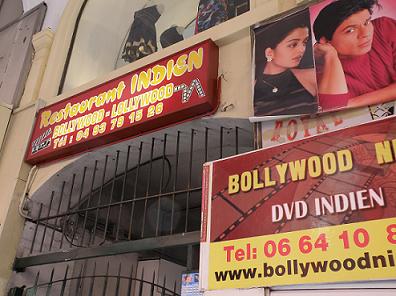
If you consider the size of the Indian and Pakistani economies today the above argument makes eminent sense. Brand India is used by Pakistani and Bangladeshis for their benefit for e.g. most so called Indian restaurants in London are run by Bangladeshis. We went to an Indian restaurant in Nice South France whose main theme was Indian food and Bollywood; it is run by a Pakistani who kept on saying Our India tell told him we are Indians and asked if he was a Pakistani. (See photo below).
While these arguments were well founded, a series of events between 1940 and 1947 including Direct Action Day and the inability of the Congress/Muslim League to work as part of one government, probably forced the Congress to accept partition.
| |
| 'Indian restaurant in Nice ie run by a Pakistani' |