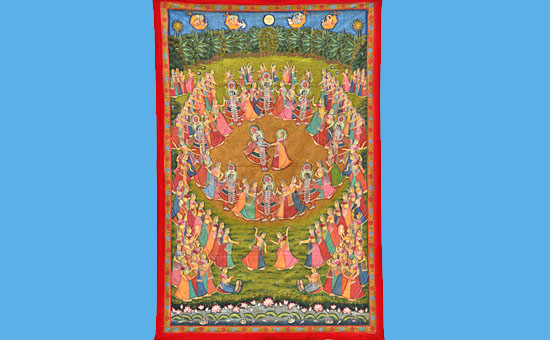
Pichwai or ‘pichvai’ is one of the most spectacular and ancient forms of art with its origin being the land of culture ie India. Pichwai paintings have their roots in Nathdwara Rajasthan. The stunning art form is a 400-year-old art one which was created depicting the beautiful life of Lord Krishna.
The wall art is created by depicting the story of Shrinathji, another form of Lord Krishna holding the hill Govardhan. The story contains a beautiful history which represents the power of one of the most significant incarnations of Lord Vishnu. When Lord Indra, showcased his control over the inhabitants of Vrindavan, with steady rains and thunderstorms; Lord Krishna lifted the hill named Govardhan on his little finger and the people of Vrindavan took refuge under the mountain. With this Indira realized failure to disturb the people and his ego was broken. Since then people are worshipping Govardhan hill.
The contemporary paintings are used to embellish the walls of the temples located in Nathdwara district, specialising as a backdrop for the temples of Shrinathji. The making of a traditional painting takes a considerable amount of time, ranging from a couple of weeks to months. Great artists first sketch this conventional art on hand spun starched cloth, and then the beautiful image is created, painted and printed in brilliant colours or woven with hand blocks. The classic styles are generally made with natural colours and even natural brushes. The base is mostly red woven with yellow or any bright coloured embroidery. The focus is mainly on using intense and bright colours such as red, yellow, green, black along with a border beautified with a goat, dabka work or Swarovski. The most beautiful ones are mainly filled with pure gold.
The most exciting part about this contemporary wall art is that they can be modified easily depending on the occasion. With a significant focus on large eyes, big nose and fat belly; the paintings symbolise different festivals of India. For example, the one consisting of pink lotuses signify summers. On the contrary winters are represented by jamawar patter. Raas Leela (dance form of Lord Krishna) is made on the festival of Holi and Annakut is made during the time of Govardhan puja.
This unique word Pichwai comes from the Sanskrit words, ‘pitch’ meaning back and ‘wais’ meaning hanging. It therefore means traditional paintings are hanging behind the idol of Shrinathji.
The ‘not-so-famous’ art form is not only found in temples but also in homes and across the world. Some interesting facts about these paintings are:
Pichwai was a forgotten art until it was noticed by the devotees of Vallabhacharya sect for whom it has great importance. These came into prominence when the Sect Vallabhacharya created 24 iconic poses of Lord Krishna against the backdrop of Nathdwara (about one hour drive from Udaipur). Every Pichwai painting relates to a specific celebration of a festival.
Note that Shri Vallabhacharya is the founder of ‘Pushtimarg’, belongs to the Vaishnav tradition and involves worship of Shri Krishna. ShriNath Ji is the principal deity in Pushtimarg.
Every art form of India has emerged from its history, independent of any connection except the ones that are another form of reincarnation of great Indian Gods. They focus on their lives and work.
Pictures provided by author are courtesy and copyright
Author is a content marketer. A writer by day and reader by night, he is loathed to discuss himself in the third person but can be persuaded to do so from time to time.
Also read