Abstract
Bee's honey is one of the most valued and appreciated natural substances known to mankind since ancient times. There are many types of bee's honey mentioned in Ayurveda. Their effects differ and 'Makshika' is considered medicinally the best. According to modern scientific view, the best bee's honey is made by Apis mellifera (Family: Apidae). In Sri Lanka, the predominant honey-maker bee is Apis cerana. The aim of this survey is to emphasize the importance of bee's honey and its multitude of medicinal, cosmetic and general values. Synonyms, details of formation, constitution, properties, and method of extraction and the usages of bee's honey are gathered from text books, traditional and Ayurvedic physicians of Western and Southern provinces, villagers of 'Kalahe' in Galle district of Sri Lanka and from few search engines. Fresh bee's honey is used in treatment of eye diseases, throat infections, bronchial asthma, tuberculosis, hiccups, thirst, dizziness, fatigue, hepatitis, worm infestation, constipation, piles, eczema, healing of wounds, ulcers and used as a nutritious, easily digestible food for weak people. It promotes semen, mental health and used in cosmetic purposes. Old bee's honey is used to treat vomiting, diarrhea, rheumatoid arthritis, obesity, diabetes mellitus and in preserving meat and fruits. Highly popular in cosmetic treatment, bee's honey is used in preparing facial washes, skin moisturizers, hair conditioners and in treatment of pimples. Bee's honey could be considered as one of the finest products of nature that has a wide range of beneficial uses.
1. Introduction
Forest is the heart of environment. Though silent, it provides an everlasting, priceless service to the world. Environment supplies every need of the forest and reproduction is essential in maintaining this chain. The reproduction of plants helps to maintain the equilibrium of the environment and bees help this process by pollinating flowers. The flowers which give beauty to the forest also provide foods to bees. Apis cerana, Apis dorsata, Apis mellifera, Apis floria, Apis andreniformis, Apis koschevnikov, and Apis laborisa are the varieties of bees that make honey. They suck nectar from flowers and convert it into honey.
Honey is one of the foods which have religious significance. Buddhists in India and Bangladesh celebrate a festival called 'Madhu Purnima' by giving bee's honey to monks. This is to commemorate the offering of honey by a monkey to Lord Buddha when he retreated to wilderness due to a dispute among his disciples. [1] Hindus consider bee's honey as one of the five elixirs of immortality (Panchamruta). Honey is poured over the statues of deities in a ritual called 'Madhu Abhisheka'. In Jewish tradition, honey is the symbol of newyear, 'Rosh Hashana'. Traditionally slices of apples dipped in honey are eaten to bring a sweet new year. In Islam, Prophet Mohammad strongly recommended honey for healing purposes and Quran promotes it as a nutritious and healthy food. As bee's honey has wide and vivid values, the present survey is conducted in order to view some benefits of honey as a medicine, cosmetic, nutrient and a preservative. [2]
2. Materials and Methods
Method of data collection
Details of bee's honey are collected from Ayurvedic and Traditional medical books, Ayurvedic physicians of Southern and Western provinces, villagers of Kalehe, Galle district and from internet.
3. Observations and Results
Synonyms of bee's honey
Synonyms of bee's honey in Sanskrit are Madhu,
Madvika, Kshaudra, Saradha, Makshika, Vantha, Varati, Bhrungavantha and Pushparasodbhava.
It is called Mee Peni in Sinhala and Thein Paani in
Tamil. [3]
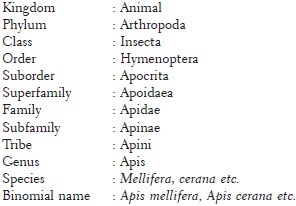
Scientific classification of bee
Honey bee's life cycle
The life of a honey bee colony is perennial. There are three castes of honey bees: queens, which produce eggs; drones or males which mate with new queens; and workers, which are non-reproducing females. The queen lays eggs singly in cells of the comb. Larvae hatch from eggs in three to four days. They are then fed by worker bees and develop through several stages in the cells. Cells are capped by worker bees when the larva pupates. A colony may typically consist of tens of thousands of individuals. Development from egg to emerging bee varies among queens, workers and drones. The average lifespan of a queen is three to four years. Drones usually die upon mating. [4]
Formation of bee's honey
Bees produce honey by collecting sugar-rich nectar from flowers, which is a clear liquid consisting of nearly 80% water and complex sugars. In the hive, the bees use their 'honey stomachs' to ingest and regurgitate the nectar many times until it is partially digested. They continue this process until the product reaches desired quality. After the final regurgitation, the honeycomb is left unsealed. This partly processed raw honey is still high in water content and natural yeast which, unchecked, would cause fermentation. Raw honey is then stored in honeycomb cells to dry. The process continues as bees inside the hive fan their wings, creating a strong draft across the honeycomb which enhances evaporation of about 80% of the water from the raw honey. Once dried, the cells of the honeycomb are sealed (capped) with wax to preserve the honey. Ripe honey, as removed from the hive by a beekeeper, has a long shelf life and will not ferment if properly sealed. [4]
Extraction of bee's honey
There are two methods to extract Bee's Honey. The traditional method is to calm or chase the bees away by introducing smoke into the beehive. When the bees have left the beehive or fully calm down, the combs are taken out and squeezed to drain the honey. Some people place the combs in a metallic bowl which has a hole at the base. Burning embers are put on the combs. Honey and beeswax melt and drains down the hole and is collected.[5]
Other method is to use a mechanical honey extractor. This extracts honey without destroying the comb. Extractors work by centrifugal force. A container holds a frame basket which spins, flinging the honey out. With this method, the wax comb stays intact within the frame and can be reused by the bees.
Chemical composition of bee's honey
Honey is a mixture of carbohydrates, proteins, aminoacids, vitamins, minerals, antioxidants and other compounds. It contains a number of enzymes, including invertase, glucose oxidase, catalase, and acid phosphorylase. Honey also contains eighteen free amino acids, the most abundant of which is proline. [6]
It contains trace amounts of the vitamins B 2 , B 4 , B 5 , B 6 , B 11 and vitamin C. Minerals like calcium, iron, zinc, potassium, phosphorous, magnesium, selenium, chromium and manganeseare also found in honey. The main group of antioxidants in honey are the flavonoids, of which, pinocembrin is unique to honey and bee propolis. Naturally darker honey has greater antioxidant properties. [6]
Acetic, butanoic, formic, citric, succinic, lactic, malic, pyroglutamic, gluconic acids, and a number of aromatic acids are found in honey. Bee's honey is free of cholesterol. [6]
Chemical composition of royal jelly
Royal jelly is an emulsion of proteins,
sugars and lipids in a water base, and is synthesized by the bee from pollen.
82-90% of the protein content is made up of a group of proteins found only in
royal jelly and worker jelly, known as the major royal jelly proteins (MRJPs),
which has five main members. These are rich in essential amino acids which
cannot be biosynthesized.
However, the lipids present are unusual, in that
they are unlike the lipids of typical insect fats. Royal jelly lipids are
composed mainly of 8-10 carbon acids, hydroxy acids and diacids, which may be
saturated, unsaturated, linear or branched. The unusual lipids of royal jelly
make it highly acidic, and give it good antimicrobial properties. [6]
Types, Qualities and Properties of bee's honey according to Ayurveda
According to the Charaka Samhita, honey is of four types. They are Makshika, Bhramara, Kshaudra and Paittaka. Makshika, the best type of honey is produced by reddish variety of honey bee. This type of honey is of the color of Tila Taila (sesame oil). Bhramara honey is produced by the Bhramara type of bee. It is Guru (heavy) and is of white color. Kshaudra honey is produced by a small type of honey bee and is brown in color. Paittaka honey is produced by a large type of bee and is of the color of ghee. [7]
According to Susrutha Samhita, honey is of eight types. Pauttika, Bhramara, Ksaudra, Makshika, Chatra, Arghya, Auddalaka and Dala Madhu. Pauttika honey is Ruksha (dry), Ushna (hot), it increases Vata, Rakta and Pitta, and this is also Chedana (liquefaction), produces heart burn and is intoxicative due to inherent poisonous nature. Bhramara honey is Guru (heavy - not easily digested) because of its Picchila (slimy) and Ati Swadu (excessively sweet) properties. Kshaudra honey is specially Sheetha (cold), Laghu (light - easy to digest) and Lekhana (anti-obesive). Makshika honey is Laghu (lighter than Kshaudra), Ruksha (dry), is the best and especially beneficial in diseases like asthma. Chatra honey is Madhura (sweet after digestion), Guru (heavy), Sheetha (cold) and Picchila (slimy). It cures bleeding disorders, leucoderma, urethritic discharges and worm infestations. Arghya honey is beneficial for eyes, eliminates vitiated Kapha and Pitta Dosha, Kashaya (astringent in taste), Katu Vipaka(pungent after digestion) Balya (strengthening) and does not aggravate Vata. Auddalaka honey bestows taste, good for voice and cures skin diseases. It is Kashaya (astringent) and Amla Rasa (sour), Katu Vipaka (pungent after digestion) and aggravates Pitta. Dala honey is Ruksha(dry). It mitigates vomiting and diabetes mellitus. [8]
According to Sushruta, some actions of new and old bee's honeys are very much opposite to each other. New bee's honey has Vrumhana guna(nourishing the body) but it does not eliminate vitiated Kapha Dosha much and is a laxative. Old bee honey is Grahi (anti-diarrheal), reduces fat and obesity. [8]
Properties of mature and immature bee's honey according to Ayurveda
According to Sushruta, mature honey
eliminates vitiated Tridosha while immature honey
vitiates Tridosha and is sour in taste. [8]
It is the best Yogavahi substance. That is to say, while without changing its own properties, honey carries the effects of the drugs added to it. It means it enhances the properties and actions of the substances with which it combines. [8]
Properties according to modern science
Experiments and studies on honey have shown that honey is antiseptic, antimicrobial, antipyretic, anti-inflammatory, antiallergent, antitoxic, sedative, laxative, antianemic, antioxidant, healing and cleansing (external and internal), moisturizing and blood-purifying. It promotes rehydration, easily digestable, stimulates immunity, and is beneficial for all types of skins diseases. [9]
Value of bee's honey in diabetes mellitus
Use of honey in medications for diabetes is mentioned in Ayurveda since ancient times. In various localities, patients suffering from diabetes mellitus use honey in place of sugar. Bee's honey is beneficial for diabetic patients in two ways. One is; honey being three times sweeter than sugar, one may need a much smaller quantity of honey as a sweetener and w/w, honey contains lesser calories than sugar. The other is, by providing vitamins B 2 , B 4 , B 5 , B 6 , B 11 and vitamin C, and minerals like calcium, iron, zinc, potassium, phosphorous, magnesium, selenium, chromium and manganese. The nutritional values of honey could be altered by feeding the bees with selective food. [10]
Medicinal uses of bee's honey
Bee's honey is used in treatment of various ailments and as a popular home remedy. Some of these uses are given below.
Cosmetic uses of bee's honey
Honey and beeswax are used in the beauty industry as a skin moisturizer, softener and to heal the skin tissue. Some cosmetic applications of bee's honey are given below -
4. Discussion
Bee's honey is a valuable product of nature with time-proven, universally accepted medicinal, dietary and cosmetic properties. It has some cultural and religious significance too. Honey can be used singly or in combination with other ingredients in treatment of various diseases. It also has the rare and invaluable quality of enhancing the properties and actions of the medicinal substances with which it combines. While due to its antioxidant properties bee's honey acts as a rejuvenator, it is also an important ingredient in beauty culture as a moisturizer and a conditioner.
5. Conclusion
It can be concluded that bee's honey is an invaluable natural substance with many diverse usages. It is an effective medicine, a safe home remedy, cosmetic and a nutrient usable by people of all ages.
References
Please refer to PDF file.
To read article including references in PDF format.
Article available online/offline on: AYU, Vol. 33, Issue-2, April-June 2012, Page no.178-182, for more details please visit: www.ayujournal.org
Authors are E. R. H. S. S Ediriweera, Department of Nidana
Chikitsa, Institute of Indigenous Medicine, University of Colombo, Rajagiriya
Sri Lanka and
N.Y.S. Premarathna, Intern Medical Officer, Disanayaka
Ayurveda Hospital, Megalle, Galle, Sri Lanka.
No part of this article may be reproduced in full or part without written permission of the Ayu Journal who can be contacted at ayujournal@yahoo.com