Role of Defence Economists
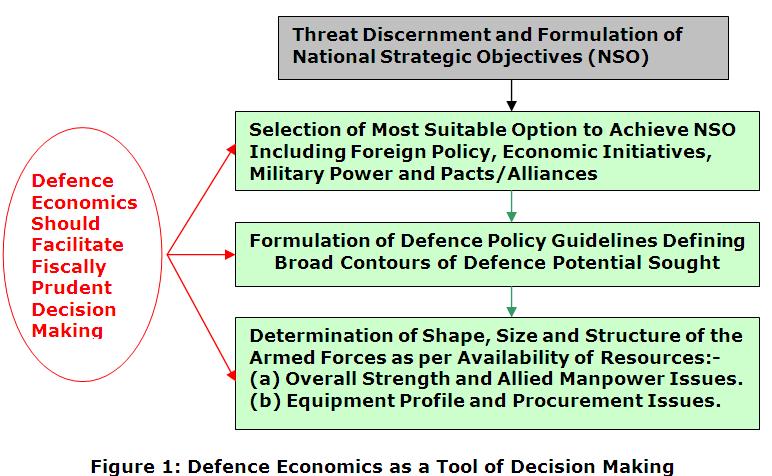
Every nation has well-considered National Strategic Objectives (NSO). These are based on a nation’s aspirations as regards its envisioned place in the comity of nations in short, medium and long terms. All its planning and initiatives (foreign policy, economic reforms and military strength) are directed towards achieving these objectives after a detailed exploration of available alternatives.
Advisory Functions - Defence economists should be able to make useful contribution in the above process by advising a nation as regards the following aspects:
Caution the leadership against being over-ambitious and seek an over-kill. NSO should be achievable, viable, practical and commensurate with the nation’s potential. Affordability must never be overlooked.Nature and Level of Military Strength Needed - Once a decision is taken as regards projection of desired military capability in a given time frame, defence economists should assist in identifying the least-cost solution. Military power of a nation can be projected in a number of ways to convey the desired message to prospective adversaries. It is for the defence planners to work out various alternatives. Some of the issues involved with cost implications are:
•Whether the strength should be based on nuclear capability or conventional forces or a combination of the two and in what proportion?
•What should be the proportion of air and ground potential?
•Degree of primacy to be assigned to missiles and its affect on land and air forces?
•Contours of naval capability with regard to type and number of fighting vessels it should possess. Are expensive aircraft carriers essential and are there any less-costly alternatives?
Defence economists should be able to provide details of related financial effects to enable selection. They should also be able to suggest development of a vibrant and economically viable defence-industrial base (to include defence research, development and production) to cater to the requirements of the military. See Figure 1.
Structuring of the Armed Forces - After the evolution of broad contours and dimensions of the force level, defence economists should provide guidelines to help determine exact shape and size of the forces and funds required to create and sustain them. They should assist in getting most cost-effective answers to the following:-
•Manpower Issues.
•Should there be a large standing military or a smaller force with considerable reserves?
•What should be the terms of engagement of regulars and reservists?
•Equipment Issues.
•What should be the equipment policy?
•What should be the proportion of imported and indigenous equipment?
•What are the fields in which indigenous competence needs to be developed?
•What role should be assigned to defence R&D?
•What should be the policy regarding co-development of equipment with other friendly countries?
•Procedural Issues.
•What procedures should be put in place to ensure transparency, probity and best value for money?
•How should contracts for import of systems be negotiated? How to obviate lapses that may prove costly to the exchequer?
•How to frame policies for defence offsets and how to draw maximum benefits from them?
•What should be the strategy to increase export of defence related goods?
Defence Budgets and Recurring Expenditure
Continuous improvement can be affected by periodic review of defence structures and functioning. Though difficult, all aspects of defence should be subjected to costing to identify areas which need cost-cutting measures. Innovative steps should be initiated to re-engineer and reconfigure targeted constituents to reduce costs and improve efficiency. Procedures should be regularly revised to make them responsive to changing ground requirements and to facilitate speedy decision-making. Regular stock-taking exercises should be carried out to identify non-core functions to offload them to civilian facilities and contracted service providers.