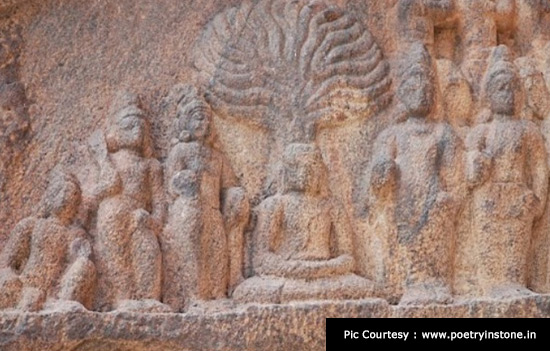
 Buddha at Brihadesvara Shiv Mandir, Tanjore, Tamil Nadu.
 Former President of India and philosopher, Dr S. Radhakrishnan wrote in Indian Philosophy Volume 1, "The 4 noble truths of Buddhism correspond to the 4 truths of Samkhya as put in the Samkhyapravacanabhasya: “1. That from which we deliver ourselves in pain. 2. Deliverance is the cessation of pain. 3. The cause of pain is the want to discrimination between prakrti and purusa, which produces the continuous union. 4. The means of deliverance is discerning knowledge” (399). Sage Kapila rejected sacrifices, prayers and ceremonies as much as Buddha did. This was much before the Sakya Muni’s times. Dr. Radhakrishnan goes on to write that:
“The Buddhists admit that Kapila, the sage to whom the Samkhya books ascribed the origin of their philosophy, lived several generations before Buddha, and that Samkhya ideas prevailed at the time of Buddha” (399).
We, that is those who are trying to quicken and give new life to the Laws Eternal, or Sanatan Dharma have no problem with Gautama, the Buddha or other earlier Buddhas or with Buddhas to come. We live by our Scriptures and the traditional commentary on these Scriptures by our holy women and men. We even consider the Sakya Muni an Avatara, or incarnation of Lord Vishnu. We further hold that the Buddha was aware of both saguna Brahman and nirguna Brahman.
Buddha at Brihadesvara Shiv Mandir, Tanjore, Tamil Nadu.
Thus, Lord Buddha kept silent about That which cannot be expressed in words since the moment one tries to define Brahman, one is made aware of the limitations of language in communicating the experience of the last stage of Yoga --- samadhi. Yet we are lampooned and ridiculed by some Buddhist scholars including such Buddhist polemicists as Johannes Bronkhorst.
Then let us now turn to what Buddhists teach and how it is done without keeping the necessary silence required by the Buddha Himself in His various Sutras.
All branches of Buddhism hold on to the theory of dependent origination. This technical term simply means that every effect is due to a cause.
Thus, there has to be a cause for say, the Vedas to come into being in the first place. Thus, according to Buddhist exegetes over the centuries, it has been held that the Vedas are of human origin since the source of any writing is to be found in human ingenuity and not in some unseen force. For anything to exist in the first place there has to be a foundational Being.
In the case of the Vedas, according to Buddhists, such a foundational Being is a logical impossibility since all Buddhists while wildly differing in other matters of their Darsana, further hold true that there is no question of anything existing at all.
They hold that all sentient beings and even insentient beings/objects have no essence or whatness to them. Thus, there is no question of a soul and Atman or any foundational Being existing. This is because everything that we perceive is marred by cognitive errors. The Pure Lands of the Buddhas is as illusory as our world and other planes of being.
Buddhists everywhere hold two more dogmas to be true: they follow the Middle Path which is not merely a path between extremes as we find in the life of Lord Buddha. The position of Buddhists can best be described as treading the middle path between pragmatism and idealism. This they call the Madhyamika theory of existence. Or, to be specific, non-existence.
Their position is that this writer in time n is entirely different from moment to moment; that is, this writer is a completely different person from moments n and n+1 and so on. This is known as momentariness within Buddhism. Khsanikavada, or momentariness too is untenable since how can a succession of moments exist if nothing at all exists? And how is it possible that something changes to another thing every succeeding moment since nothingness of sunyata is the nature of all things. Dependent origination now suspiciously sounds like the Advaitin's position of no-origination. The question now is where did Lord Buddha get His ideas for attaining Nirvana and how did His followers, in their zeal to take the Buddha’s words to every corner of the world, misinterpret Buddha Dharma?
Let us first see whether common sense and logic permits us to accept the dogmas of Buddhism:
1. Now if dependent origination is correct, then each Buddha comes into being because of past actions. Up to this we can find no logical error.
But one is curious about how a Buddha comes into being in potentiality many lives ago unless life is self-creating. The self-creation of Brahman is known as aseity, so if now we are reading of say, the Madhyamika Master Buddhapalita; then Buddhapalita must have come into being because someone willed him to come into being either aeons ago or at some point in time X.
But who is this Being? We call this Being Brahman for want of a better word and Abrahamic theists call this Being, God.
So, who revealed the Vedas to our seers?
None but a being with Brahman like qualities. Of course, the Vedas were written down much later than they were revealed and thus we have interpolations and intertextual contradictions like many Buddhist texts have within them. This internal contradiction arising out of orality and later, textuality, within religious canons is now well established in religious studies and in all faith-traditions.
Thus, dependent origination needs a critique which is beyond the scope of this essay. It is from Christian metaphysics that the strongest refutation comes. There at least has to exist a blind watchmaker for a watch to tick howsoever rickety the watch is. In their need to propagate Buddhism, Buddhist intellectuals turned and continue to turn a blind eye to the common-sense objection to dependent origination.
How did the first intelligent life come into being?
The Buddhist answer is that life arose from nothing, or ex-nihilo since nothing has any essentiality or being in the here and the now. This is absurd. This author is sitting in his study and typing which in no way is false. The external reality and the interiority of the event of typing this sentence match. How can someone who cognises have no being? If we have no esse, or being, then what is the need for dependent origination? Nothing was, is and will be.
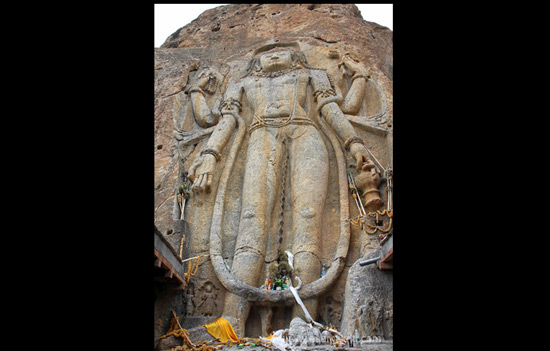 Maitreya, The Future Buddha. Close to Kargil in Jammu and Kashmir UT.
Yet Buddhists hold that Maitreya has no essential nature. The Pure Land Maitreya (Tibetan deities live in Pure Land) was potentially a Buddha, that is a Bodhisatwa, aeons ago.
Album of Thiksey Monastery Ladakh that has Maitreya-Future Buddha Pic 12
So, what is being expounded by the theory of dependent origination is mayavada. This is a gross error since Bhagavan Buddha did not expound either Mayavada or Brahmavada. He was silent after His nirvana.
If nothing exists, then what originated in the first place? There are then no Buddhas, no Nicheren Buddhism and no mind to begin with, to practice mindfulness. The Buddhist enterprise seems to be self-contradictory and hopeless. But since we consider Bhagavan Buddha an Incarnation or Avatara, there must be some mistake in this line of reasoning followed by Buddhist scholars to date.
As will be seen later in this essay, their exegesis of their own Sutras is insufficient and needs to be contextualised within the theory of our Dharma’s succession of Avataras. Adi Shankaracharya did not attack Lord Buddha in his glosses, but he attacked these false doctrines of the Buddhists. This is why Acharya Shankara could contribute to the retreat of Buddhism from Bharata. His was not a polemical attack against Buddhism but a systematic logical debunking of Buddhist philosophy. The reason why the Buddha is venerated by us, and yet we reject the religion of the Buddhists is that Bhagavan Buddha’s teachings have been misinterpreted over the last two millennia and more. More on this later.
Read Why did Buddhism Vanish from India
2. The Buddhists are certain about the various planes of existence being inhabited by various beings. If this is the case then how can these beings exist in the first place? And even if they do not exist the way we recognise existence then at least they exist as the chitta-vrittis, or the modifications of the mind of a Samkhya Yogi. We will discuss Samkhya Yoga in detail later when the ontologies or the roots of Buddhist thoughts have been sufficiently scrutinised.
Eli Franco in his book Dharmakīrti on Compassion and Rebirth with a Study of Backward Causation in Buddhism (2021) insists on cognition transmigrating which is suspiciously akin to our Dharma’s positions on ‘samskaras’ transmigrating from birth to rebirth within the cycles of samsara. It if there be nothing, then how is it that this ‘anatta’ travels from birth to birth.
The Zen grand-master Hui-neng (638-713 AD) in his famous commentary on the Diamond Sutra or in his own Platform Sutra continually asserts the non-existence even of nirvana, all the while decrying the dualities of being and non-being; the enlightened state and the non-enlightened state. Master Hui-neng comes out as a crypto-Advaita Vedantin.
That is, in their insistence on the unity of non-existence, even the Zen masters seem to exalt in one doctrine whereas in reality they decry all dogmas and doctrines --- yet all of them accept the doctrine of backward causation and thus accept our Dharma’s insistence on a foundational substratum. That is Brahman.
The aim of the Samkhya Yogi is to not find nothing but the Self within which is rejected in that most important Zen Buddhist text --- The Lankavatara Sutra. The traditional Buddhist answer to these questions of perceptions is that everything is phenomenological. If everything is entirely phenomenological it leads us to Samkhya.
We will now interrogate the meaning of Samkhya and in the light of Samkhya Yoga see and prove how Bhagavan Buddha was a Samkhya Yogi and His doctrines of silence on the existence of being is actually misread as nothingness.
As an aside, it has to be noted that the Buddhists accuse Advaita Vedantins of being crypto-Buddhists. A serious study of everyone from Sri Gaudapada onwards, reveals that Acharya Gaudapada did not discover that he had no self. Acharya Gaudapada’s Karika on the Mandukya Upanishad does not deny the Self within but affirms it. No wonder that Sri Shankaracharya never forgets to pay homage to Acharya Gaudapada in his own works. Rather every Advaita Vedantin realises that she or he has a Self, the Samkhyas call this Self, Purusha. It is another matter that all of Samkhya finally lead to monism or Advaita Vedanta.
Samkhya is the most ancient Indian philosophy which is no longer practised normatively; that is, none calls themselves Samkhya Yogis yet all the while every Yogi is practising Samkhya Yoga. Anyone who follows the Bhagavad Gita is a Samkhya Yogi.
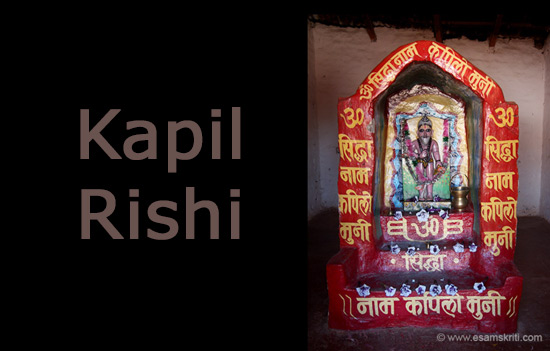 Rishi Kapila founded Samkhya philosophy & stayed in Amarkantak, M.P. where Holy Narmada starts.
So, what is Samkhya Yoga?
Simply put, it aims at transforming each of us into a perfected Yogi who at the highest level of perfection, just before her or his union with Brahman creates a world whose basis is the last remnants of this Yogi’s modifications of the mind or ‘chitta-vrittis’. Thus, this writer is the thought disturbances of the Yogi who has created this illusory universe which is nonetheless very real for this author.
As far as this author is concerned, the particular Yogi whose phenomenological turn has created this universe where this author feels he has being, is Ishwara, or akin to God. There are numerous such Yogis and as many Yogis of this level of perfection exist, so many are the universes created by their thought processes. We need to remember that Samkhya derives from the word ‘sankhya’ -- that is, numbers.
The philology of the term ‘Samkhya’ indicates that such huge is the number of these perfected beings, that to understand them we need to use a term which indicates infinity. This is the exact position of the Vajrayana practitioners.
Tibetan Buddhists and Vajrayana practitioners throughout the world maintain that everything that we see is real to the extent that we accept they are created by our own minds. If this is not Samkhya philosophy, then what is?
Thus, the Buddhist position if we are to follow without perverting the original philosophy of Bhagavan Buddha is that causation is there with a first cause and the Middle Way is to obey the Bhagavad Gita which says that a (Samkhya) Yogi is one who does not torture his own body; does not either eat or sleep too little or too much:
नात्यश्नतस्तु योगोऽस्ति न चैकान्तमनश्नत: ।
न चातिस्वप्नशीलस्य जाग्रतो नैव चार्जुन ॥ (Chapter 6, 16)
And later,
मूढग्राहेणात्मनो यत्पीडया क्रियते तप: |
परस्योत्सादनार्थं वा तत्तामसमुदाहृतम् || (Chapter 17, 19)
Lord Buddha came to establish Samkhya Yoga which is the telos of all manners of Yoga. And indeed, he came to re-establish an egalitarian society and not destroy our Dharma. His Middle Way is a revitalisation of the teachings of our Dharma. It is not an original or sui generis realisation unique to Gautama, the Buddha, that only the Middle Way works. No, it is an existing insight within Sanatan Dharma. And each pratyekabuddha is like a Samkhya Yogi with the caveat that all pratyekabuddhas and Samkhya Yogis do follow or at least, through their lives assert the truisms of our Shastras.
Read What is common to the Dhammama Pada and Bhagavad Gita
The techniques of Vajrayana, as we find in the transmissions of the Guru Padmasambhāva, who probably flourished in the 9th century AD, and later in the teachings of the Buddhist Tantric philosopher of the 15th century AD, Tsongkhapa, are all Tantric techniques which Guru Padmasambhāva took from India and thus, Vajrayana is more Tantric than even to be found in our Dharma as it is now.
Tantra, as we might be aware, is a Samkhya method for the divinisation of the body to the extent that only the subtle body remains and everything in Tantra follows from the Bhagavad Gita’s dictum:
यदा संहरते चायं कूर्मोऽङ्गानीव सर्वश: |
इन्द्रियाणीन्द्रियार्थेभ्यस्तस्य प्रज्ञा प्रतिष्ठिता | (Chapter 2, 58)
The Supreme Lord says in the above two lines that one should withdraw the senses from sense objects just like a turtle withdraws into itself if one were to become a Yogi. This is the exact teaching of the Tantras, and this is the exact teaching of Vajrayana practitioners. They follow the Buddhist shilas, or codes of conduct which again are found in Chapter 16, 1-3 of the Bhagavad Gita:
अभयं सत्त्वसंशुद्धिर्ज्ञानयोगव्यवस्थिति: |
दानं दमश्च यज्ञश्च स्वाध्यायस्तप आर्जवम् || 1||
अहिंसा सत्यमक्रोधस्त्याग: शान्तिरपैशुनम् |
दया भूतेष्वलोलुप्त्वं मार्दवं ह्रीरचापलम् || 2||
तेज: क्षमा धृति: शौचमद्रोहोनातिमानिता |
भवन्ति सम्पदं दैवीमभिजातस्य भारत || 3||
Being an incarnation of Sri Vishnu, Bhagavan Buddha through his ‘shilas’ tried to revitalise our Dharma --- not create a separate Dharma. Also, it defies logic that there can be two Dharmas simultaneously correct as the Jainas hold.
Acharya Adi Shankaracharya discarded the Jaina doctrines of syadvada and anekantavada because these very doctrines contradict these Jain misrepresentations of a Samkhya Yogi’s chitta-vrittis. It is beyond the scope of this article to discuss and show how the Jain Tirthankaras came to reform our Dharma and like the Buddhists and the very many Buddhas, none of them asserted any other truths than are to be found true always no matter what the external or even subjective conditions are: they are to be found in our Shastras. In this sense the Jain Tirthankaras too were Samkhya Yogis and did not predate our sages.
And again, in an aside, we must affirm, that like the Vajrayana way, the Jains too were Tantric in their main modes of self-realisation. The main mode of Tantra is looking inward to find the macrocosm within us, and the main modes of Buddhism and Jainism everywhere is to look within oneself and find first that we are nothing but the chitta-vrittis of a nearly perfected Samkhya Yogi. The moment this Samkhya Yogi experiences that the Yogi is One with Brahman, this reality of ours will collapse and we call it pralaya. No wonder then Buddhism has a huge corpus of apocalypses and messianic Gurus who predict the end-times.
Seen correctly, through Samkhya Yoga, the end times come when the nearly perfect Samkhya Yogi realises fully the Mahavakyas of the Upanishads and is freed from the last remnants of solipsism.
Thus, as we have seen in this elementary analysis of Buddhism, the Buddhist jhanas or siddhis, the Buddhist way of being, and Buddhist philosophy in all its various branches which are impossible to enumerate in this short essay; all without exception fulfil and complement Samkhya Yoga which in turn gestures towards non-qualified, non-dualism or Advaita Vedanta.
Even the breathing techniques and mindfulness taught in Vipassana retreats derive from the Yoga Sutras of Sage Patanjali and the various Samhitas like the Gheranda Samhita and the Hatha Yoga Pradipika. Yet often one does not hear Vipassana Masters speaking of these texts. Where does Vipassana, a Theravada technique come from? Without doubt from our Dharma. These are self-sufficient and eternal Truths which the Sakya Muni realised through His Samkhya practices. These methods of the Sakya Muni later unfortunately gave rise to a separate religion, and not Dharma, called Buddhism.
John Holt in his book, The Buddhist Visnu: Religious Transformation, Politics, and Culture (2004) speaks at length about the anxieties that Buddhists continue to suffer arising from their fear of the Buddha-Dhamma being contaminated by Hinduism. What they do not understand is that while our religions are different, our Dharma is one and the same. If only Buddhist scholars study the Yoga Vashishtha even cursorily, then they will understand that Bhagavan Buddha came to engage with the one True Dharma --- that is our Faith and He rejected the inessentials. Then Mara enjoined otherwise and created false and self-contradictory metaphors which have confused many into thinking that Buddhism is different from Sanatana Dharma. Buddhism is in fact another facet of our Dharma.
Read Dharma talk by His Holiness Dalai Lama And What is common to the Dhammama Pada and Bhagavad Gita
When one trains in Vipassana and other mindfulness techniques one feels that one has achieved a sense of being at peace. This negates the fundamental Buddhist teaching of no-self. Then how is it possible by someone who has no essence to teach other non-beings, the essence of non- being? There is hidden perhaps within these practises a secret desire for escaping the tumult of the world in the here and the now and give in to a kind of false peace. The Buddha mind is a mind after all, and it is not an imaginary psychic apparatus. It is a Samkhya Yogi’s mind. It is very real.
Read Experience of Vipassana at Dharamkot, Himachal Pradesh
Thai Buddhists believe in hungry ghosts or pretas --- if there is nothing then why fear being born a preta? The Tibetan Book of the Dead is all about rebirth and the choices one has to make in the twilight land of the dead to have the right birth for release from samsara. When nirvana is attained, one is freed from samsara, but samsara goes on existing even for the Buddhas. They are Buddhas since they want to help us even after attaining Buddhahood. In this they are more akin to Samkhya Yogis than to Advaita Vedantins or monists. Contrary to the Buddhist Acharyas, the Buddhas except the Pratyekabuddhas do not lose selfhood ever.
Where our Dharmakshetra (धर्मक्षेत्र) is Kurukshetra (कुरुक्षेत्र), it may be misguided to switch off cell-phones to find nirvana. Bodhicitta leading to Bodhisattwas do not permit running away from our Dharmakshetra. This is why it is important to remember that the teachings of the Yoga Sutras are enumerations of the Sixth Chapter of the Bhagavad Gita. They are methods of stilling the mind without running away from the woof of life.
While Vipassana practitioners hardly realise this, the Tibetan Masters and later some Chan Masters and even Theravadins understand that final victory comes not out of realising the emptiness of everything but by fully participating in both exterior and interior battles against Mara in whatever form Mara takes in the here and the now.
Buddham Sharanam Gacchami, बुद्धं शरणं गच्छामिI
Namo tassa bhagavato arahato sammāsambuddhassa.
If anyone cares to follow Lord Buddha and His teachings without being misled by some of His zealous followers, then one is certain to find that our Dharma is only enriched by Him. Buddhists are already Samkhya Yogis; they need to realise this fact for themselves. Then they will understand that the solution to world problems (dukkha) is not clinging obstinately to the theories of their religion but in finding the real nature of things and being through meditation and study.
Strangely, both meditation and serious study will show the practitioner that finally silence works best for the realities found in the Yoga Vashishtha cannot be negated. Till one experiences Brahman, theories work well. Once Brahman is experienced, silence is best. Bhagavan Buddha understood this fact as in recent times Sri Ramana Maharshi did. Their silence may be misconstrued as an assertion of nothingness. If that is true, then what is the point of Sri Dharmakirti’s works mentioned earlier?
Read Yoga Vashishtha – A treasure house of philosophy
Backward causation is non-existent, and nothing is. This, has been proven above, is absurd. Social activism and the urge to reform as we find in the Sakya Muni can find fruition only if we are convinced that there exists something or someone to help and reform. Lord Buddha realised this and set upon reforming our Dharma. The Sautrāntikas in a certain sense come closest to identifying their Samkhya-phenomenological origins. That is for another essay.
May this author find refuge in Bhagavan Buddha. May He never disown Lord Buddha as an Avatara of Sri Vishnu.
Swami Vivekananda said in his famous 1893 Chicago Speech, “The relation between Hinduism (by Hinduism, I mean the religion of the Vedas) and what is called Buddhism at the present day is nearly the same between Judaism & Christianity. Jesus Christ was a Jew, and Shakya Muni as a Hindu, The Jews rejected Jesus Christ, nay, crucified him, and the Hindus have accepted Shakya Muni as God and worship him. But the real difference that we Hindus want to show between modern Buddhism and what we should understand as teachings of Lord Buddha lies principally in this: Shakya Muni came to preach nothing new.” To read Swamiji’s Chicago Speech on Buddhism
Reflect and decide for yourself.
Harih Om.
Disclaimer: The idea of the Buddha as a Samkhya Yogi is ancient and is to be found in various writings like those of Swami Hariharananda Aranya’s commentary on the Yoga Sutras. This author has only tried to remove popular misconceptions about Buddhism in the populace.
Author Subhasis Chattopadhyay Ph.D is a theologian. His reviews from 2010 to 2021 in Prabuddha Bharata have been showcased by Ivy League Presses. He has qualifications in Christian Theology and Hindu Studies and currently teaches English Literature in the PG and UG Department of a College affiliated to the University of Calcutta. He also has qualifications in the Behavioural Sciences.
Select Bibliography:
1. Edelglass, William, and Jay L. Garfield, eds. Buddhist Philosophy: Essential Readings. New York: Oxford University Press, 2009.
2. Franco, Eli. Dharmakīrti on Compassion and Rebirth: With a study of backward causation in Buddhism. First ed. New Delhi: Dev Publishers & Distributors, 2021.
3. Huineng. The Sutra of Hui-neng, Grand Master of Zen: With Hui-neng’s Commentary on the Diamond Sutra. Translated by Thomas F. Cleary. Boulder: Shambhala, 1998.
4. Īśvarakṛṣṇa. Sāṁkhya kārikā of Īsvara Kṛṣna with the Tattva Kaumudī of Śri Vācaspati Miśra: With Sanskrit text of the Kārikā, transliteration and word-for-word meaning, and a free rendering into English with Notes. Translated by 5. Virupakshananda. Madras: Sri Ramakrishna Math, 1995.
5. Larson, Gerald James, and Īśvarakr̥ṣṇa. Classical Sāṃkhya: An interpretation of its history and meaning. Reprinted. Delhi: Motilal Banarsidass Publishers, 2014.
6. Pine, Red, trans. Diamond Sutra: The Perfection of Wisdom: Text and Commentaries. Washington, D.C.: Counterpoint, 2003.
7. Pine, Red, trans. The Lankavatara Sutra: A Zen text. Berkeley, CA: Counterpoint, 2013.
8. Potter, Karl H., and Piotr Balcerowicz, eds. Encyclopedia of Indian Philosophies: Jainism (Part II). First ed. Vol. XIV of Indian Philosophy. Delhi: Motilal Banarsidass, 2013.
To read all articles by author
Also read
2. Ambedkar erred-Buddha was Hindu
3. Harmonious Blend of Hinduism, Buddhism and Shinto strains in Japan
4. Why did Buddhism vanish from India
5. Album Amarkantak-Kapil Rishi Dhara