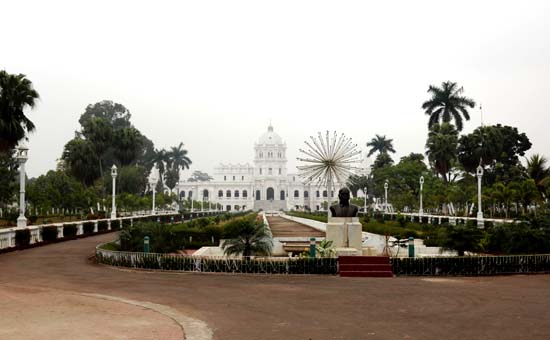
 Former Rulers of
Tripura were S.T. To show their new found status a bust of Dr Ambedkar adorns
palace entrance. 2014.
Former Rulers of
Tripura were S.T. To show their new found status a bust of Dr Ambedkar adorns
palace entrance. 2014.Indians are repeatedly told by Politicians, Courts, Media (within & outside India), Intellectuals that they should be apologetic because Dalits were denied Education for thousands of years hence Indians have to compensate present population. Could a civilization survive for thousands of years if it had denied education to a large segment of the population? Noted Gandhian Dharampalji breaks the myth.
At the outset must state my belief that the divinity that exists in me exists in every other living being. To me Karmas matter period. The purpose of this article is to provoke thought and not hurt the sentiments of any being, living or dead.
Dharampal ji studied the state of education around 1820. He visited British and Indian archives and wrote "The Beautiful Tree: Indigenous Indian Education in the 18th century". The book reproduces reports of numerous surveys undertaken by the British (1800-1830) in Bengal, Punjab and Madras presidencies. It also gives caste composition and subjects taught in schools. Education was imparted in pathshalas, gurukulas and madrasas.
“Before formulating their own educational policies, the British undertook surveys to study existing indigenous education system in India. These surveys were conducted in the Madras, Bengal, Bihar, and Punjab Presidencies to assess the state of schooling/extent of literacy. 1. Madras Presidency Survey (1822–1825) was conducted by Sir Thomas Munro. 2. William Adam carried out the Bengal and Bihar Surveys (1835). 3. G. W. Leitner conducted the Punjab Survey (1865).” 5 Of these Madras one was most detailed. Caste spellings are as in book.
Note that around 1800, England had few schools for children of ordinary people unlike India. 1 Pg. 19 The method of school teaching was better and it was this method that helped the introduction of popular education in England. 1 Pg.20
Dharampalji wrote, “The actual situation, which is revealed, was different, if not quite contrary, for at least amongst the Hindoos, in the districts of the Madras Presidency (and dramatically so in the Tamil-speaking areas) as well as the two districts of Bihar. It was the groups termed Soodras, and the castes considered below them who predominated in the thousands of the then still-existing schools in practically each of the areas.” We present following tables from the book.
Table1 MadrasPresidency. For each district Nos of Schools/Caste-wise Students.
Table 2- Madras Presidency. Language/Caste division of Male students.
Table 3- Tinnevelly district. Caste wise number of scholars.
Table 4- Tanjore district. Caste wise number of scholars.
Table 5- Guntur district. Caste wise number of scholars.
Table 1- Number of Native Schools/Colleges in Madras Presidency & Scholars.
|
Name of Collectorate |
NoSchool Colleges |
Bramin |
Vysea |
Soodra |
Other Caste |
Muslims |
Total Scholars |
|
1. Ganjam (Oriya) |
255 |
808 |
243 |
1003 |
896 |
27 |
2977 |
|
2. Vizag (Telegu) |
914 |
4547 |
983 |
2072 |
2016 |
97 |
9715 |
|
3.Rajamundry |
570 |
2356 |
653 |
472 |
579 |
52 |
4112 |
|
4.Masulipatnam |
533 |
1891 |
1108 |
1507 |
499 |
277 |
5282 |
|
5.Guntoor |
574 |
3094 |
1578 |
1960 |
832 |
260 |
7724 |
|
6. Nellore |
804 |
2466 |
1641 |
2462 |
432 |
620 |
7621 |
|
7. Bellary. |
533 |
1187 |
982 |
3024 |
1205 |
243 |
6641 |
|
8. Cuddapah. |
494 |
1416 |
1713 |
1843 |
686 |
342 |
6000 |
|
9.Chingleput. |
559 |
1259 |
424 |
4888 |
486 |
186 |
7243 |
|
10.ND.Arcot. |
699 |
1117 |
630 |
4888 |
546 |
563 |
7744 |
|
11.S.D.Arcot. |
875 |
997 |
370 |
8032 |
872 |
252 |
10523 |
|
12.Salem |
388 |
783 |
324 |
1674 |
1410 |
459 |
4650 |
|
13.Tanjore |
993 |
3955 |
222 |
10786 |
2485 |
933 |
18381 |
|
14.Trichinopoly |
799 |
1329 |
229 |
7811 |
347 |
746 |
10462 |
|
15. Madura. |
844 |
1186 |
1119 |
7312 |
3017 |
1147 |
13781 |
|
16.Tinnelvelly. |
607 |
2016 |
0 |
2889 |
3674 |
798 |
9377 |
|
17.Coimbatore. |
936 |
1642 |
289 |
6461 |
226 |
312 |
8930 |
|
18.Canara. |
0 |
0 |
0 |
0 |
0 |
0 |
0 |
|
19.Malabar-Kerala |
760 |
2310 |
97 |
4404 |
3099 |
4318 |
14228 |
|
20.Seringapatnam. |
41 |
48 |
23 |
312 |
158 |
86 |
627 |
|
21.Madras. |
305 |
359 |
798 |
3619 |
317 |
143 |
5236 |
|
22. Charity. |
17 |
52 |
48 |
172 |
181 |
10 |
463 |
|
23.Tutitons Home |
0 |
7684 |
6195 |
7809 |
3585 |
1690 |
26963 |
Total |
12500 |
42502 |
19669 |
85400 |
27548 |
13561 |
188680 |
% of Scholars |
|
23 |
10 |
45 |
15 |
7 |
100 |
Madras Presidency consisted of areas that fall in modern day Tamil Nadu, undivided Andhra Pradesh, Orissa, Kerala and Karnataka. 1 Pg. 235-243. Table 1 is an attachment to a report by J Dent, Secretary, Fort St George, 21/2/1825.
45% of the scholars were Sudras with Brahmins being only 23%.
Table 2 Caste division of Male students in Madras Presidency 1822-25
|
Speaking Language |
Brahmins/ Chettris |
Vysee |
Soodra |
Others* |
Muslims |
Total Students |
|
1. Oriya |
808 |
243 |
1001 |
886 |
27 |
2,965 |
|
2. Telegu. |
14,014 |
7,676 |
10,076 |
4,755 |
1,639 |
38,160 |
|
3. Kannada |
1,233 |
1,014 |
3,296 |
1,332 |
329 |
7,204 |
|
4.Malayalam |
2,230 |
84 |
3,697 |
2,756 |
3,196 |
11,963 |
|
5.Tamil |
11,926 |
4,442 |
57,873 |
13,196 |
5,453 |
92,890 |
Total 1 to 5 |
30,211 |
13,459 |
75,943 |
22,925 |
10,644 |
1,53,182 |
|
% of total |
20 |
9 |
50 |
15 |
6 |
100 |
*“It may be fairly assumed that the term 'other castes' used in the Madras Presidency survey included those who today are categorised amongst the scheduled casts and many of whom were better known as 'Panchamas' some 70-80 years ago.” 1 Pg. 27
50% of the Male student scholars were Sudras with Brahmins being only 20%.
An article titled The Decline of Mass Education in India by DR Gupta in Young India in December 8, 1920 tells why the divide between the rich and poor increased. “Rules were made to restrict the diffusion of education generally and among the poorer boys. Fees were raised to a degree, which the poor could not afford.” Why are backward classes in this situation they are today? For answer read Were Backward Classes always supressed in India
For more Tables see below OR you can read article in PDF. Click on PDF
Former Rulers of
Tripura were S.T. To show their new found status a bust of Dr Ambedkar adorns
palace entrance. 2014.
TABLES and Reports
1. TINNEVELLY to Board of Revenue: 18.10.1822
(TNSA: BRP: Vol.928 Pro.28.10.1822 pp.9936-7 No.4.46.7)
The preparation of the account was delayed by enquiry into castes of the female scholars who in almost all instances are found to be dancing girls. 1 Pg 97-98.
J.B. Hudleston, Tinnevelly District, Sharenmadavy,
18th October 1822. Collector
Table 3 Number of Native Schools/Colleges in Tinnevelly/Number of Scholars.
|
Brahin Scholars |
Chettris |
Vyseah |
Soodra |
Other Caste |
Muslims |
Male/Female Students |
|
1,921 |
0 |
0 |
2,708 |
3110 |
329 |
8068 |
|
24 % |
0 |
0 |
33% |
39% |
4% |
100 |
33% of the scholars were Sudras with Brahmins being 24%.
2. TANJORE to Board of Revenue: 28.6.1823
(TNSA: BRP: Vol.953, Pro.3.7.1823 pp.5345-5347 No.61)
With reference to your Secretary’s letter of the 25th of July last, and its enclosures. I have the honor how to transmit a statement in the prescribed Form, prepared from the Return received from the Tasildars of the number of schools and colleges in this District.” 1 Pg 115-116
J. Cotton, Principal Collector, Tanjore Negapatam.
Table 4 Number of Native Schools/Colleges in Tanjore Collectorate/Number of Scholars. Number of Schools 884, Colleges 109, Population 3,82,667.
|
Brahin Scholars |
Chettris |
Vyseah |
Soodra |
Other Caste |
Muslims |
Male/Female Students |
|
3,586 |
369 |
222 |
10786 |
2455 |
933 |
18351 |
|
20 % |
2 %. |
1% |
59% |
13% |
5 % |
100 |
59% of the scholars were Sudras with Brahmins being 20%.
3. GUNTUR (today’s A.P.) to Board of Revenue: 9.7.1823
(TNSA: BRP: Vol.954, Pro.14.7.1823, No.49, pp.5904-7)
J C Whish, Collector, Guntoor Zillah, Bauputtah 1 Pg. 212
Table 5 Number of Native Schools/Colleges in Guntur Collectorate/Number of Scholars.
Number of Schools 574 Colleges 0, Population 4,54,754
|
Brahin Scholars |
Vyseah |
Soodra |
Other Caste |
Muslims |
Total Scholars |
|
3094 |
1578 |
1960 |
832 |
260 |
7,724 |
|
40% |
20% |
25% |
11% |
4% |
100 |
25% of the scholars were Sudras with Brahmins being 40%.
To read all tables download Dharampal ji book in PDF by clicking on PDF-1MB.
What does book say about Education in Bengal?
Daulat Ram Gupta wrote, “In Bengal, Mr. W. Adam, conduced a similar inquiry and found that in 1835 ‘a network of primitive Vernacular schools existed throughout Bengal’, and he estimated their number to be about one lakh. The Sadler Commission has pointed out that no attempt was made to develop these schools.’ Government preferred to devote its energies to secondary and higher schools, on the theory that, if Western education were introduced among the upper classes, it would filter down by a natural process to the lower classes. Practically nothing was spent, out of public funds, on indigenous schools, and as rent-free lands attached to these schools were resumed, the schools were left without any financial aid and naturally collapsed.” Source The Decline of Mass Education in India . Also 1 Pg. 18
One Lakh village schools existed in Bengal and Bihar till about the 1830s. 1 Pg. 47 Sixty one Dom and 61 Chandal students in the district of Burdwan nearly equal to the number of Vaidya students. 1 Pg 54. Around 1850 there were app 3,30,000 schools of various denominations in Punjab showed Leitners research. 1 Pg. 57 Revenue collected at the village level helped run schools. 1 Pg. 77
Leitner on Indigenous Education in Punjab- The lowest computation gives us 3,30,000 pupils in the schools of various denominations. 1 Pg. 344 There was not a single village who did not take pride in devoting a portion of his produce to a respected teacher. Pg. 357 In Punjab, the state of local education was better because of the special efforts of Maharaja Ranjit Singh. Pg. 356
Letter by Gandhi associate Shri K T Shah to Sir Phillip, 20/2/1932, “Max Mueller, on the strength of official documents and missionary reports, concerning education in Bengal prior to the British occupation, asserts that there were then 80,000 schools in Bengal, or one for every 400 of the population. Ludlow, in his History of British India, says that “in every village, which has retained its old form, I am assured that the children generally are able to read, write and cipher; but where we have swept away the village system, there the village school has also disappeared.” (Cp. B.D. Basu, Education in India under the E.I. Co., p18).”
“In Bombay, which came under British rule after the fall of the Peshwas in 1818, a Report of the Bombay Education Society for 1819 observes:- “There is probably as great a proportion of persons in India who can read, write, and keep simple accounts, as are to be found in European countries.” 1 Pg. 377 Around 1820, there is hardly any village where these is not atleast one school. 1 Pg.18
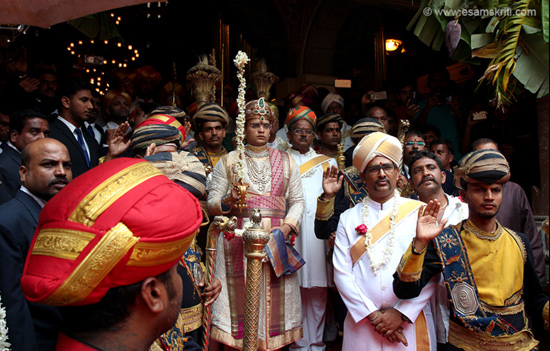 Current titular Maharaja of Mysore is an OBC just like the Great Chola Kings.
Consequences of the British killing Indigenous Education System
The neglect and deliberate uprooting of Indian education, the measures which were employed to this end, and its replacement by an alien and rootless system-whose products were so graphically described later by Ananda Coomaraswamy-had several consequences for India. 1 Pg. 81
One, it led to an obliteration of literacy and knowledge of such dimensions amongst the Indian people that recent attempts at universal literacy and education have so far been unable to make an appreciable dent in it.
Two, it destroyed the Indian social balance in which, traditionally, persons from all sections of society appear to have been able to receive fairly competent schooling. The pathshalas and madrassahs had enabled them to participate openly and appropriately and with dignity not only in the social and cultural life of their locality but, if they wished, ensured participation at the more extended level.
Three it is this destruction along with similar damage in the economic sphere, which led to great deterioration in the status and socio-economic conditions and personal dignity of those who are now known as the scheduled castes; and to only a slightly lesser extent to that of the vast peasant majority encompassed by the term ‘backward castes’. 1 Pg. 86
Are the British are to blame!
Partially Yes. We are to blame more because we did not understand the British strategy and continue to parrot this 5000 years denial of education story. Dharampalji wrote, Making Caste into EVIL
What about Untouchability?
Though this subject not touched by Dharampal will share some insights from a 2024 Supreme Court order. Untouchability was a key criteria used by British to determine who was SC but it did not exist uniformly across India.
Were SCs treated as untouchables across India?
“The 1919 Note states that untouchability as it existed in Madras, where an untouchable’s touch necessitated immediate purification, did not exist in Assam.” 7 Pg. 92/94 of Order or Untouchability was a key parameter used by the British to identify Scheduled Caste - SC order on Sub-quotas
“On the other hand, the States of Bihar, Orissa and Assam while stipulating the castes which faced untouchability observed that untouchability in the States did not exist in the same form as it existed in South India.” 7 Pg 94 of Order
Dr Ambedkar’s teacher in school was a Brahmin and the teacher was so fond of Bhim Rao that he gave him his surname. At the same time, Bhimrao faced restrictions on entry into temples. When talking of untouchability, one must distinguish between denial of education and social discrimination.
During Shivaji Maharaj time the Mahar community, to which Bhimrao belonged, manned the intelligence gathering and communication and were called HARKARAY. Source
Changing Nomenclature for Backward Classes
In the 1890’s they were called Depressed Classes. In the early 1930's, Gandhi named them Harijans. The Government of India Act, 1935 introduced the term Scheduled Caste (SC). Term Scheduled Tribe (ST) came into being when the Constitution was adopted in 1950. The word "Dalit" has come into prominence since the 1990s. There are National Commissions for SC and Backward Classes but term Dalit not used.
A Cottage Industry exists around Caste/alleged Oppression, refuse Indic history.
This cottage industry highlight case but refuse to tell facts for e.g. as pointed out by author, ex-British Council Scholar and Spiritualist Dr Satish Kapoor in Hinduism: The Faith Eternal that spirituality is not confined to higher castes or classes or gender. Veda Vyasa was born to a fisherwoman, Tiruvalluvar, the Tamil poet-saint, to a weaver. Tirupann, the Alvar saint, was panar, an untouchable etc. Pg. 71 Many saints of medieval Maharashtra came from the lower strata of society. Goraba (1236-1317) was a potter, Namdeva (1270-1350) a tailor, Tukaram (1650) a sudra peasant.
This cottage have survived and prospered during and after British Rule. Some made successful political careers. It is like those who wish India remains poor.
Utmost care taken in culling out data. Errors if any are inadvertent and without malafide intent. As always am happy to stand corrected. Love.
Also read and References
1. The Beautiful Tree-Indigenous Indian Education in 18th century. For excerpts
2. How Indian States came into being
3. How UPA communalised India's education system
4. The Decline of Mass Education in India by D R Gupta
5. Education in pre-British India
6. Indian Education in the early 19th century – useful tables.