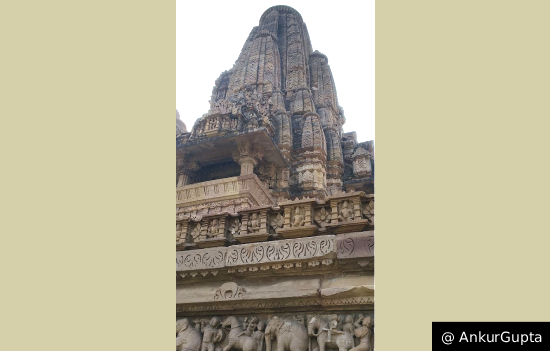
 The Spire’s Ascent: Pic is an upward-looking shot, one can see the majestic, tapering Shikhara showing layers of intricate sculptural work that climb toward the heavens.
Text and Images by Ankur Gupta.
This is the second in a series of photo features on Khajuraho Temples, the first was an Introduction to Khajuraho. Padavali Temple Morena, near Gwalior) is widely considered the stylistic inspiration for the grandeur seen here.
Fast Facts: The Chandela Legacy
a. Built: 950 – 1050 CE
b. Dynasty: Chandela Rajputs
c. Key Rulers: Yashovarman (Lakshmana Temple), Vidyadhara (Kandariya Mahadeva)
d. Material: Predominantly fine-grained sandstone; three early temples in granite.
e. The Philosophy: A journey from the physical (Kama) to the spiritual (Moksha).
The Nagara Silhouette: Architecture and Spire
The defining characteristic of Khajuraho are its towering spires, or Shikharas. These complex clusters of miniature spires give the temples a mountain-like appearance, designed to draw the eye upward toward the divine.
The Spire’s Ascent: Pic is an upward-looking shot, one can see the majestic, tapering Shikhara showing layers of intricate sculptural work that climb toward the heavens.
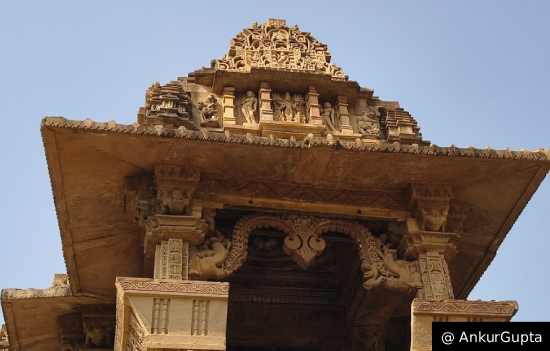 A close-up of a temple roof or entrance canopy,
highlighting the elaborate sculptural details and cornice design against the
sky.
A close-up of a temple roof or entrance canopy,
highlighting the elaborate sculptural details and cornice design against the
sky.
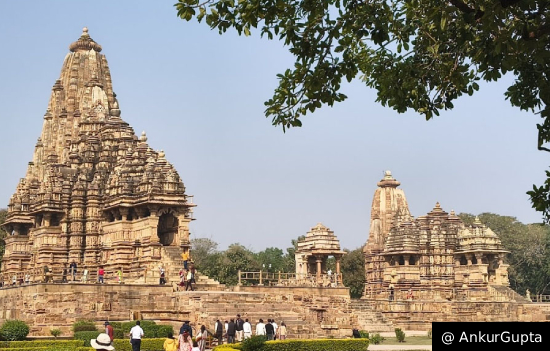 A Landscape of Stone: Pic has wide view and ground-level view showcase the sheer scale of these structures, emphasizing how the Jagati (raised platform) separates the sacred space from the
earthly plane.
A Landscape of Stone: Pic has wide view and ground-level view showcase the sheer scale of these structures, emphasizing how the Jagati (raised platform) separates the sacred space from the
earthly plane.
The Western Group: Zenith of Power
The Western Group is the heart of Khajuraho, featuring the most impeccably maintained monuments.
1. Kandariya Mahadeva: The Mountain of Shiva
Standing at nearly 31 meters, this is the most complex structure in the complex, built by King Vidyadhara (1025–1050 CE) to celebrate a successful military defense.
Rhythmic Crescendo: Dramatic low-angle view captures the successive layers of the superstructure, highlighting the deep reddish-brown sandstone as it catches the late afternoon light.
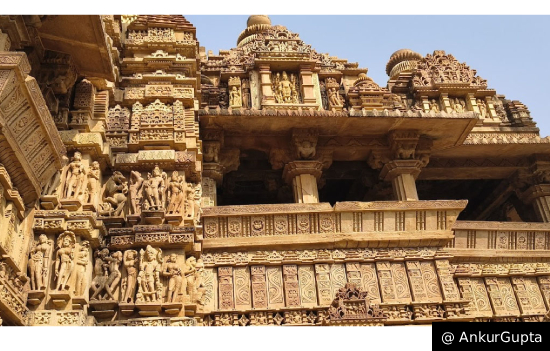 A detailed mid-section shot of a temple's exterior, displaying the famous bands of human and divine figures, including the iconic multi-limbed and dynamic sculptures.
The Multi-Tiered Facade: An angled shot shows the elevated platform and the multiple tiers of sculptural friezes that wrap around the Mandapa (hall) roof.
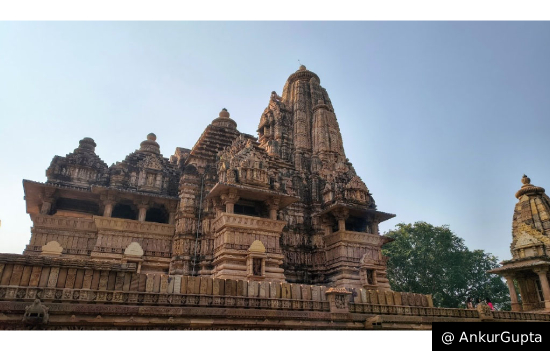 A dramatic low-angle view of a
main temple complex, capturing the successive layers of the superstructure and
the deep reddish-brown color of the sandstone.
A dramatic low-angle view of a
main temple complex, capturing the successive layers of the superstructure and
the deep reddish-brown color of the sandstone.
Density of Art: Looking at the exterior, one sees the famous bands of divine and human figures—part of the 870 statues adorning this single temple.
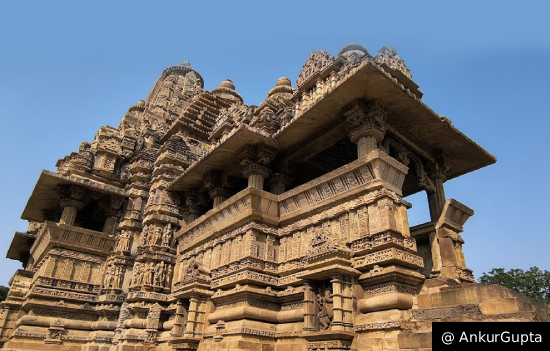 An impressive angled shot highlighting the elevated platform and the multiple tiers of sculptural friezes running along the temple's outer walls and the Mandapa (hall) roof.
2. Lakshmana Temple: The Guardian of the Threshold
Built by King Yashovarman (930–950 CE), this is the oldest fully developed Nagara temple here, dedicated to Vaikuntha Vishnu.
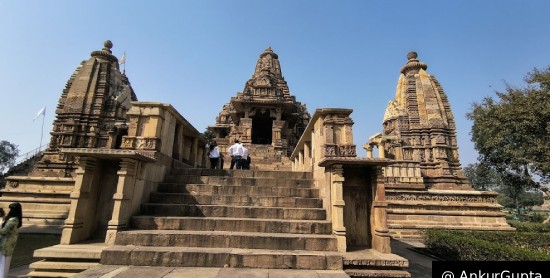 The
Grand Entrance: Picture illustrates the
experience of ascending toward the main shrine, flanked by smaller, elegant
structures.
The
Grand Entrance: Picture illustrates the
experience of ascending toward the main shrine, flanked by smaller, elegant
structures.
Iconography and Detail: The entrance detail in image (close-up of canopy) highlights the elaborate sculptural work and cornice designs that greet the devotee.
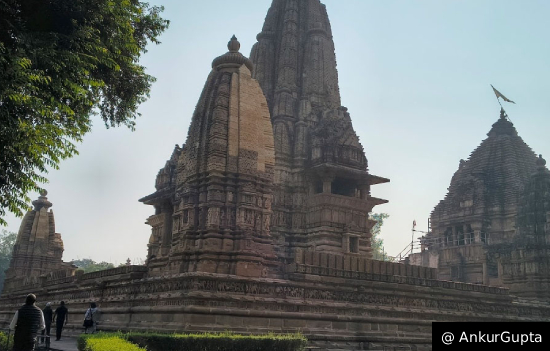 Ground-level view of two major temples from the Western Group, emphasizing their size, height, and the contrast of the ancient stone against the surrounding greenery.
Intricate
Sculpture: A Theology of the Body
The carvings are a "symphony of life," where every inch of stone tells a story. Erotic imagery constitutes less than 10% of the wall space; the rest is dedicated to dharma, war, and spiritual ascension.
The Divine Gatekeeper: In pic (carved doorway), we see the densely layered figures of musicians, dancers, and Apsaras guarding the inner sanctum.
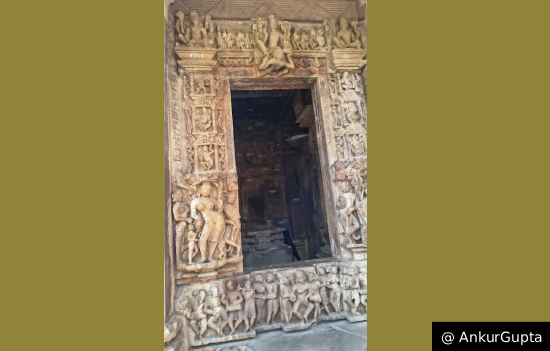 A detailed view of a richly
carved doorway leading into a temple sanctum, showing the dense layers of
figures, including musicians, dancers, and celestial beings (Apsaras).
A detailed view of a richly
carved doorway leading into a temple sanctum, showing the dense layers of
figures, including musicians, dancers, and celestial beings (Apsaras).
Venerated Deities: Close-up of Ganesha shows the god rendered with immense precision, a perfect example of the devotional art found throughout the site.
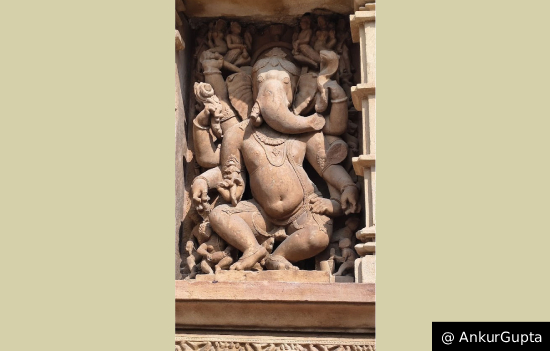 A close-up
carving of the Hindu deity Ganesha, easily identifiable by the elephant head,
adorned with multiple arms and surrounded by miniature figures.
A close-up
carving of the Hindu deity Ganesha, easily identifiable by the elephant head,
adorned with multiple arms and surrounded by miniature figures.
A Night Under the Stars: Son-et-Lumière
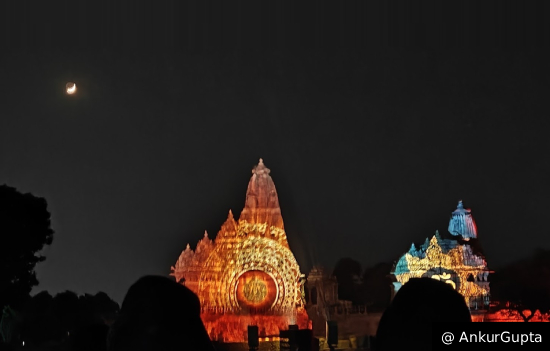
While the daytime reveals the fine details of the sandstone, the evening offers a different kind of magic. The Son-et-Lumière (Sound and Light Show) in the Western Group is an unmissable experience. Under the vast, starry skies of Bundelkhand, the temples are bathed in shifting lights while a narrative voice recounts the rise and fall of the Chandela kings. It is a hauntingly beautiful way to experience the history of these "Mountains of Light" after the sun has set.
Travel Guide: Planning Your Khajuraho Trip
Getting There: Khajuraho (HJR) has its own airport with connections to Delhi and Varanasi. The nearest major railway hub is Jhansi, though Khajuraho has a smaller station with connectivity to Delhi (Vande Bharat/Sampark Kranti). There is a highway from Jhansi to Khajuraho.
Best Time to Visit: October to March is ideal for temple hopping, with pleasant days and chilly nights. If visiting Raneh Falls, the post-monsoon months (September-November) offer the best water flow.
Weather: Summers (April-June) are scorching (up to 45°C). Winters are delightful (5°C–25°C).
Tickets: Entry to the Western Group is ticketed (digital payment preferred); the Eastern and Southern groups are generally free (except for enclosed complexes).
Pro Tip: Visit the Western Group at sunrise for the best light on the sculptures and beat the crowds.
To read all articles by author And To read all articles on India Travels and Yatras
Also read/see
1. Meaning behind Erotic Sculptures in Khajuraho
2. Pics of Vishwanatha temple
3. Pics of Western Group temples
4. Pics of Kandariya Mahadeva Temple
5. Pics of Vamana Temple and Dulhadeo/Chaturbhuj Temples.
6. Pics of Jain temples
7. All about Khajuraho Temples
8. Khajuraho Temples a Journey from Real to Surreal
9. MP Tourism site on Khajuraho
10. Pics of Lakshmana Temple and Matangeshwara Temple
12. Padavali Temple Morena, near Gwalior) is supposed to be the inspiration for Khajuraho
13. Travelogue Khajuraho, Chitrakoot and Prayagraj
14. UNESCO site