- The author evaluates Dikshitar's musical contributions from an IKS perspective, notably through three yardsticks: Indian, Knowledge, and Systems.
Muthuswami Dikshitar (1775-1835) was a remarkable individual who
mainly lived in southern India and passed away around his 60th birthday. A
composer and musician, his life and work encompass many aspects of what is today
known as IKS (Indian Knowledge Systems).
However, it is worth emphasizing that IKS was the predominant
knowledge system available in India at the time Dikshitar lived. The
celebration of his 250th birth anniversary is not about an ordinary figure but
rather a monumental presence in the world of music.
Acknowledging and honoring such a personality is undoubtedly a
challenging endeavor, and I write this piece in that spirit.
IKS, in and of itself, enables a dharmic life and is approached
through fourteen knowledge streams, communicated orally (shruti), and through
setting mantras to music, as in the Sama Veda. The connections between IKS and
music are therefore obvious.
In this article, I evaluate Dikshitar's musical contributions from an IKS perspective, notably through three yardsticks:
Indian, Knowledge, and Systems.
His contributions being numerous (480 pieces with a precise musical
notation that come from an unbroken stream of his extended musical family
parampara), I contain my analysis to a small subset of his compositions (called
kritis) that are both representative
of his larger corpus and sufficiently detailed in themselves to illustrate many
aspects of his work. For example music, poetry, religion and Sanskrit in
relation to IKS.
Let us take the Indian aspect first.
All extant texts on Dikshitar stress that he was a peripatetic musician who undertook a long journey and a six-year stay in Kashi when he was in his early twenties. Evidence for this has been adduced from the fact that he composed a few songs on deities in northern India, set in characteristically Hindustani ragas—Kashmir is specifically mentioned in a couple of pieces.
He mentions the rivers of India in his songs, notably Ganga, Yamuna,
Narmada, Sindhu and the Kaveri, which was in his immediate ecosystem. Many
smaller rivers, such as the Tamraparni and the Vegavati (Vaigai), are mentioned
in other pieces. The Ganga is special in that an entire piece is in honour of
the river (Gange Mam Pahi). There are references to Kerala (Parashurama
Kshetra), Kashi, Karnataka, Bengal (Kashi Kannada Gaula Deshadi),
and others.
Taking Knowledge and Systems, I will limit the discussion to a group
of ten kritis, known in Carnatic music as the Abhayamba Vibhakti kritis,
composed in honour of Devi Abhayamba, who resides with her consort, Lord Mayuranatha,
in the ancient temple town of Mayiladuthurai (formerly Mayavaram) on the banks
of the River Kaveri in the Tanjore district of present-day Tamil Nadu.
In a style typical of Dikshitar, the Abhayamba set of songs is each set in the eight cases of the Sanskrit language, hence the name Vibhakti kritis. Also typically, there is a possible Dhyana kriti and a Mangala kriti, totaling ten compositions. All text in italics are from his lyrics.
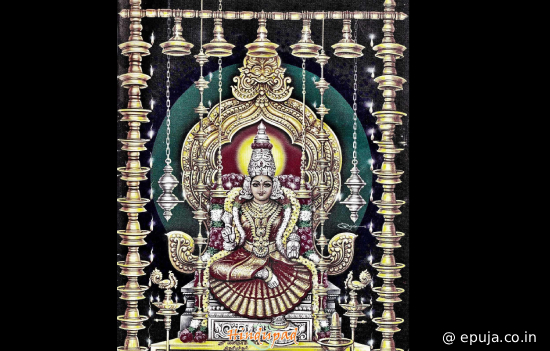
Being sensitive to the fact that most readers of this article may not
be familiar with Carnatic music, the compositions referred to here will be in
terms of the raga of the piece. This raga name is a mere identifier, and the
reader need not be aware of how a particular raga sounds.
The interested reader is provided with a hyperlink to all 10 songs,
and there are also hyperlinks to short sections referenced in the text.
The identifier ragas are Chamaram, Kalyani, Bhairavi, Sankarabharanam, Yadukula Kambhoji, Kedaragaula, Kedaram, Sahana, Todi and Sri. The first kriti in Chamaram could be the Dhyana kriti, and the last one in Sri is definitely the Mangala Kriti. Singing these ten songs in a particular order (Dhyana, eight vibhakti songs, Mangala Kriti) is therefore akin to worship or performing a complete puja—only with music.
Before one moves to Knowledge and Systems, note that the Abhayamba kritis also touch upon the Indian aspect. Yadukula Kambhoji refers to the temple's location on the banks of the Kaveri (Kaveri Tirayai) and
highlights the rivers of India as a clear marker of identity. More
fascinatingly, the songs include a kriti in the raga Sri, which is uniquely set
in three languages, Sanskrit, Tamil and Telugu, in what is called a Manipravala
kriti.
It is worthwhile to recollect the origin of these Manipravala songs.
Their origin lies in the Tamil language, and initially, this composition technique was limited to Tamil–Malayalam. It subsequently moved to Malayalam–Sanskrit, and then to Tamil–Sanskrit. All these are binary Manipravalas. Dikshitar took this to the ternary level (higher complexity) with Tamil–Telugu–Sanskrit.
At a time
when there is a shrill cry for linguistic divisions and unnecessary chauvinism
in the music world because of a contrived conflict between Sanskrit and Telugu
on the one hand, and Tamil on the other, here was a composer who lived ~200
years ago, and who saw no difference between these languages.
Link 1 select 00:27 TO 1:28
Sanskrit is the essence of IKS because it is the primal link of all
knowledge streams, and by selecting it as the medium for all his compositions,
Muthuswami Dikshitar showed himself to be the quintessential Indian. The aloof
character of our Devabhasha ensures that emotions are kept aside and that the
composer approaches the higher divinity beyond the deities to whom he addressed
his music, without a trace of emotion. He refers to Bhava, Raga and Tala in his
Kalyani piece (Bhava Raga Tala Visvasini). Knowledge and Systems are inextricably
linked in these compositions through the Sanskrit language and its multitude of
variations.
Bhava is a complex concept that has garnered significant attention in Indian aesthetics, particularly since Bharata Muni's Natyashastra. In simple terms, bhavas are emotional states expressed during a performance. They serve as mediums for evoking rasas, or emotional responses, in the audience, awakening dormant feelings. While rasa is a profoundly personal experience shaped by individual memories, bhava is more of a collective phenomenon, with performers establishing the emotional tone for the audience.
Anubhuti, on the other hand, is personal like rasa; however, it differs in
that it replaces the spontaneous dissolution of the ego into raw emotion with a
more measured contemplation of experience, knowledge, and sensory observation.
Anubhuti transcends both words and music, inviting an individual to reflect on
themselves in a somewhat detached manner, examining their feelings and
experiences.
Dikshitar's music shines with exceptional quality, where his technical skill elevates emotion to a still higher ethereal realm, offering listeners a memorable rasa experience.
One of his remarkable achievements is crafting a rasa that transcends
the typical anubhuti process, allowing listeners to be swept away by the
brilliance of the music with little trace of bhava, essentially in an Advaitic
state, in other words, in indissolvable union. This unique quality
distinguishes his work among Carnatic music masters, creating an enchanting and
inspiring musical journey.
At a higher level, the esoteric imprimatur of Dikshitar’s Sri Vidya practice pervades the ten songs in the Abhayamba group. Most notable are the references in Bhairavi (Avidya Karya Kalanam Tyajare), Sahana (Sachhidananda
Rupayam Svasvarupayam, Abheda Pratipatidayam) and Kedaragaula (Aparokshajane).
Connections with the Lalita Sahasranama become almost obligatory, as
in Chamaram (Parashakti, Paradevata), Yadukula Kambhoji (Asvarudha;
Sakala Mantra Tantra Rupa; Gudagulpha), Kalyani (Raktavarna),
Kedaram (Aprameya), Todi (Sakala Nishkala Svarupa), and
Kedaragaula (Malini Mantramaladi Tantrokyata).
The tantrik overtones are also unmistakable in Kedaram (Bimba
Pratibimba Rupinyah Bindu Mandala Nivasini Svarupini; Muladhara
Manipurakadyabja Bhedana Sphurat Kundalini).
An AI study of the lyrics of these ten songs and the 1000 names in the
Lalita Sahasranama shows a high correlation of the lyrics with the names. If
implied matches like Chandrasekhara Priya (in Yadukulakambhoji) and Sivapriya
(in the Lalita Sahasranama are taken into account, the correlation becomes
even higher. More detailed studies on this aspect are underway.
Coming to the musical and poetic aspects, the ten songs are set in
four major ragas (Todi, Bhairavi, Kalyani, Sankarabharanam) and six popular,
traditional ragas (Sahana, Kedaram, Kedaragaula, Yadukula Kambhoji, Chamaram,
Sri). The songs in the four major ragas give a complete picture and are of
educational value to students of music, as no aspect of the raga svarupa is missed.
It is undoubtedly no coincidence that several of these ragas occur in his other
group kritis on Kamalamba (Todi, Kalyani, Bhairavi, Sankarabharam, Sahana,
Sri), Nilotpalamba (Kedaragaula), the Navagrahas (Yadukula Kambhoji, Chamaram),
and the Panchalinga Sthalas (Kedaram).
While on the topic of Raga Chamaram, one of the two in the group with the higher madhyama note (Prati Madhyama in Carnatic music; Tivra Madhyam in Hindustani music), it is one of four Abhayamba songs in which the raga's name appears in the lyrics (the other three being Bhairavi, Kalyani and Sri). This inclusion of the raga name is not uncommon in Carnatic compositions. Still, it is all too pervasive in Dikshitar’s compositions. It is often hidden and becomes apparent only when sandhi is taken into account (Mangalalaya Bhogi
Nuta Padam, for example, hides the raga name Abhogi), unlike other
composers, who merely state the raga name in their lyrics, as when they say the
deity invoked likes that particular raga.
Link 2 6:00 TO 6:12
Svarakshara is another musical stratagem that heightens the appeal of
the songs, and it is the term applied when the lyrics match the solfa syllables
(sa, ri, ga, ma). Two striking examples are seen in Kalyani (Bhasamana corresponding
to pa sa and ma) and Yadukula Kambhoji (Gamapadadi nuta padayai corresponding
to a rare prayoga ga ma pa da in this raga).
Prasa or matching of syllables in various lines is a popular pastime
of poets all over the world, and Dikshitar was no exception, as is seen in Yadukulakambhoji.
Hiranya Mani Kundalayai
Himachala Sadanayai
Link 3 2:22 TO 2:45
The first and last syllables match, the latter because the case endings
are the same. Here is another example from Kalyani, which is only a minor
variation of the above in terms of prasa.
Bhukti Phala Prada Daksha Mrdani
Bhakti Prada Nipuna Tara Bhavani
Shakti Sampradayaka Sharvani
Bhukti Mukti Vitarana Rudrani
Link 4 7:37 TO 9:10
The second syllable, prasa (Dvitakshara prasa), is more subtle and definitely originates in ancient Tamil poetry, such as the Tiruppavai. This element has entered Sanskrit, Telugu, and Kannada poetry, but it is notably absent in the works of Kalidasa and his contemporaries. The composer Dikshitar makes extensive use of second syllable prasa, particularly in a section where the second syllable 'la' and its variants are repeated. This occurs in the Kedaragaula piece, and the section is worth quoting in full. It is essential to emphasize the "Indian" context of the composer's work, as traditions and practices from one linguistic tradition are often seamlessly transferred into another.
Baladi Namadheya Prakashinya Kadi Tatvanta Prakashinyahah
Muladi Dvadashanta Prakashinyahah Sthuladi Maunanta
Prakashinyahah
Trailokya Mulaprakrtyahah Svashaktyahah Saloka
Samipya Sarupya Muktayahah
Malini Mantra Maladi Tantroktyahah Shulini
Guruguha Svanubhava Gatyahah
If the semi-vowels ‘la’ and ‘ra’ are taken as being equivalent, a few more second-syllable prasa cases may be identified in this extract.
Link 5 3:00 to 4:41
Finally coming to tala or laya aspects (time measures), Dikshitar
employs standard time measures of 8 (Adi), 7 (Tisra Triputa), 5 (Jhampa), and 3
(Rupaka) beats, the last being his favourite time measure, with its obvious
connections to Sri Vidya and Tantrik worship (Tripurasundari, Nistraigunya,
Trikona, Trirdaseswari, Tripuramalini, Tristha, Trayi, Trayambika, Triloka,
etc).
The essence of these Abhayamba kritis on the listener is subtle and cannot be easily generalised. The insights gained from experiencing them, as well as the emotions felt, can vary significantly among listeners, depending on their understanding of Sri Vidya, ragas, talas, and other elements of the lyrics. The layering of these distinct systems into a complex whole is the essence of Dikshitar’s compositions, where the listener does not realise what element is driving what. As a personal aside, this writer has consistently felt that the Tisra Triputa tala in the Bhairavi song is what drives the raga, not the other way around.
Therefore, each composition becomes a multifaceted and challenging
muse, revealing its secrets in different ways and with varying degrees of
expression to those who engage with it. IKS is contextual, and the music of
Muthuswami Dikshitar is ever more so.
May we be strengthened by fearlessness.
Varadabhaya Haste Namaste Sri Dakshayani Abhayambike.
Gautam R.
Desiraju is at the Indian Institute of Science, UPES Dehradun and Rishihood
University, Sonepat. He is the recipient of a Ministry of Education (IKS
Division) grant to write two IKS textbooks for Class 11 and 1st Year UG
programs.
For all articles by author
For
all articles on Music
Also read
1. A Tribute to Muthuswami Dikshitar
2. Comparing Carnatic and Hindustani Music