- Evolution of education from Gurukul to current times. The purpose of education must be to build wisdom. Ideas how can education enable future readiness.
In ancient India, education was not a commercial industry or a factory line, it was a sacred way of life. The dominant model was the Gurukul system, a tradition that dates back to the Vedic period (around 1500 BCE). In a gurukul, students (shishyas) lived with the guru (teacher) in a remote ashram or forest hermitage, an immersive, residential form of education designed to nurture the whole being – intellect, character, spirituality, and practical skills.
Holistic development was the hallmark of
the gurukul education . The guru taught through oral instruction, storytelling,
debate, and living example. The curriculum was astonishingly broad for its
time, encompassing the Vedas and Upanishads (sacred texts) for spiritual and
philosophical grounding, philosophy and logic to hone critical thinking,
mathematics and astronomy to understand the natural world, medicine (Ayurveda)
for health, martial arts for defense, and even arts and crafts for creativity.
The idea was to produce not just a learned individual, but a good human being – one who understood their dharma (duty) and could contribute responsibly to society.
The intense guru-shishya bond ensured learning was deeply individualized; the guru adapted teachings to each student’s needs and abilities.
When the British established their rule in India, their colonial education was designed less for fostering wisdom or holistic individuals, and more for producing a cadre of useful employees for the colonial administration. In 1835, Thomas Babington Macaulay’s infamous Minute on Education set the tone: he argued that India’s ancient literature and sciences were “inferior” and that the true aim should be to teach English language and Western knowledge. Schools emphasized reading, writing, and arithmetic, European history and science, all taught via rote memorization, textbooks, and examinations. The British educational philosophy had a distinctly utilitarian and elitist bent, educate a small section of Indians who could then help govern the masses (the so-called “downward filtration” theory). It was education not for enlightenment, but for administration.
The worth of a student was limited to a
numeric mark or class rank. This shift to written examinations and precise
marks was a hallmark of industrial-age education.
We largely continued to operate schools in the mold, chalk-and-talk classrooms, standardized curricula, exams determining fate, and a one-size-fits-all approach. Incremental changes were made – but the 100-year-old core model wasn’t fundamentally redesigned. We still see crowded bookstalls selling coaching manuals and question banks, and students obsessing over guess-papers much like their great-grandparents did.
The system keeps preparing youth for a world of yesterday – an assembly-line workforce, even as a very different world is arriving at our doorstep.
This isn’t for lack of critique. Visionaries and educators have long called for reform. Rabindranath Tagore established Shantiniketan a century ago as an open-air school to break free from rote learning. Yet, such experiments have been the exception. Schools prioritize teaching to the test”, often at the cost of deeper understanding. Even students of literature or history ended up chasing “model answers” rather than engaging creatively with the material.
Knowledge is overflowing. Digital
technology has democratized information but a paradigm shift is overdue.
We now live in an age of knowledge super-abundance, where a device in your
pocket can summon virtually any fact or lesson on demand.
As futurist Ray Kurzweil predicts, by 2030 “AI will be able to process all of human knowledge” and answer anything, doing what no individual human could. In such a world, the purpose of education can no longer be just to transfer knowledge. That job is increasingly being outsourced to Google and AI assistants.
The new purpose of education must be to
build wisdom: the ability to use knowledge – to filter it, critically evaluate it, imagine new ways to apply it, and above all, to develop the judgment and ethics to guide its use.
Yuval Noah Harari encapsulates this well: “In such a world, the last thing a teacher needs to give her pupils is more information. They already have far too much of it. Instead people need the ability to make sense of information, to tell the difference between what is important and what is unimportant, and above all to combine many bits of information into a broad picture of the world.” In short, education must shift from content delivery to context
building.
We need to liberate classrooms from one-size-fits-all teaching, allowing each student to learn at their own pace (truly reviving the gurukul’s personalized ethos, but with technology). On the other hand, AI like Chat GPT can do much of the cognitive heavy lifting – writing essays, solving math problems – which forces us to confront what exactly students should be learning now.
Society might wrestle with questions like how to assess “wisdom” or creativity fairly for college admissions or hiring. These are not trivial challenges. Yet, these must be faced head-on.
It is asking us to redefine what it means to be “educated.”
In ancient India, the guru’s aim was indeed wisdom – even if framed as spiritual enlightenment. In a way, we are circling back to that outlook, but in a modern, secular context. We want learners who are wise, ethical, and adaptable ironically, having nearly infinite knowledge on tap, is what makes human wisdom the true scarce, valuable commodity of the future.
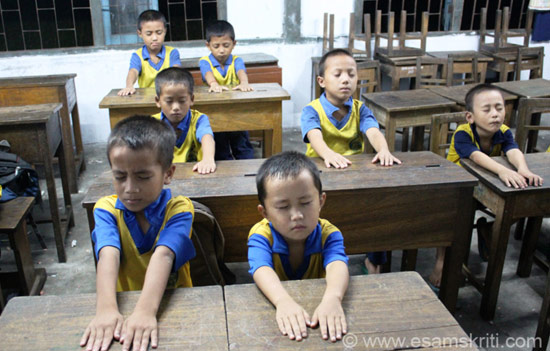 Kids of Ramakrishna Mission School, Along, Arunachal daily learn how concentrate.
The shelf-life of skills is shrinking; the half-life of knowledge is rapid in
many fields. So if we treat education as a fixed checklist of skills and facts
to master by age 18 or 21, we risk leaving graduates outdated a few years
later.
Technology already enables instant
language translation, yet we still drill students in foreign languages for
years; software can solve advanced equations, yet we still emphasize manual
calculus. For years, learning to code was an essential future skill. So
millions learned coding. Suddenly, AI can generate that code.
This isn’t to say traditional subjects have no value, they do in
building mental discipline and understanding. It, however, highlights a failure
to reprioritize. We keep adding more to the plate (coding classes! financial
literacy! robotics!) without subtracting or deeply rethinking what truly
prepares a child to thrive in 30, 40, 50 years ahead.
True “future readiness” might actually mean embracing uncertainty and learning how to learn (and unlearn). Preparing children for such continuous reinvention is very different from the current notion of loading them with as many hard skills as possible. It is more about mind set: adaptability, resilience, curiosity, and initiative. These are often best learned by facing challenges, experiencing failure, collaborating in diverse teams – things that our exam-centered schooling doesn’t accommodate well.
There is also a psychological angle. We push children into a regimented pursuit of predefined success (marks, ranks, “stable” careers) in the name of future security. Yet the very rigidity of that journey can leave them ill-equipped to handle change. A student whose entire childhood was scripted around acing exams and following a set path might struggle when the path disappears or twists unexpectedly, as is happening with technological disruption.
Does that make human learning obsolete? Not entirely, but it changes the game.
For example the skill shifts from writing rote code to architecting systems,
understanding problems deeply, or managing AI tools and higher-order
skills. Those who merely learned coding by rote might find themselves upended,
We
may need to teach young people that their career could have multiple chapters,
requiring continuous upskilling and even changing fields entirely.
For all the focus on top universities and cream-of-the-crop students, the fate of India (and any country) rests largely on the vast majority of youth who don’t attend elite institutions. These are the millions in public universities, vocational programs, or who directly enter the workforce after basic schooling. Many are from rural areas or disadvantaged communities where educational resources are thin. This is perhaps the most critical question of all.
A huge number of young Indians still receive education of subpar quality. That’s nearly half the workforce lacking key skills, even though they may have degrees.
The image of Ray Kurzweil’s imagined future – where some can afford brain-enhancing AI nano. While that is a futuristic example, the principle applies today: we must strive to democratize the tools and opportunities of learning. Equity can’t be an afterthought; it should be the foundation of this new era
Where do we go from here?
Education is on the cusp of a transformation as radical as life’s emergence from water to land. This Cambrian moment for education is both exhilarating and daunting. We have before us an opportunity to redesign learning to be more in tune with human potential and the demands of the future – to finally break free from the old confines and let education evolve, diversify, and flourish.
But as with the Cambrian explosion, evolution doesn’t guarantee survival for all; it favors those who adapt. The question is, will we – educators, institutions, policymakers, parents – adapt fast enough to guide this change positively, after centuries of fragmenting knowledge into silos, we are coming full circle to a more integrated vision of education – not unlike the gurukul’s comprehensive approach, but updated for a pluralistic, digital world.
The new ideal is a person who is not
only knowledgeable, but also emotionally intelligent, ethical, creative, and
resilient. This is
essentially wisdom education making a comeback, backed by modern science and
pedagogy.
This journey from the past to the future of education leaves one both reflective and hopeful. Reflective, because we see how each era’s system was a product of its circumstances, and how those circumstances inevitably change. Hopeful, because human beings have an extraordinary capacity to learn and adapt. Our ancestors transitioned from oral knowledge systems like the gurukul to formal schools, and now we will transition to something new – perhaps a global network of learning that lasts lifelong.
Through all these changes, the essence
of education remains the same: to empower each individual to realize their fullest potential and to contribute to society.
This article was first published on author’s blog and here
eSamskriti has got author permission to share.
Author
is a Chartered Accountant and works with a leading Hospital Group in India.
Also
read
1. Decline
of Mass education in India
2. Indigenous
education in India in the 19th century
3. Learning in Ancient India and Today’s Engaged Education
4. Rediscovering
India Bullet Points
5. Vedic
concept of Education
6. Education
the words of Sri Aurobindo and Mother
To read all articles
on Education