- The Maratha Kings of Tanjore,
particularly Serfoji II and Tulaja I, played a pivotal role in shaping and
systematizing the Bharatanatyam repertoire through their royal patronage and
rich compositions.
We earlier
shared Influence of Maratha Rulers of Thanjavur on Carnatic Music The word Maratha means all sections of society in Maharashtra then and not the narrow definition that exists today – Editor.
Chhatrapati Shivaji’s half-brother, Venkoji Bhonsle, set up the Maratha kingdom in Thanjavur in 1676, and the Marathas ruled Thanjavur for 179 glorious years, until 1855, when the kingdom was annexed under Lord Dalhousie’s doctrine of lapse policy.
As Marathi-speaking people, running a kingdom administered in Telugu and ruling over a Tamil-speaking population, the Maratha kings developed a uniquely hybrid courtly culture. Thanjavur was blessed with rule of three great Hindu dynasties–Cholas (Tamil), Nayakas (Telugu) and Marathas (Marathi).
Maratha rulers of his lineage, Serfoji II and Tulaja I
made a very significant contribution to the evolution of dance compositions and
its repertoire during their reign in Tanjore.
Their ways of systematization of the Thanjavur court dance dominated the Quartet’s activities, proving intellect of the kings. This is often neglected due to the much-celebrated popularity of the Tanjore quartet’s repertoire even today.
During the latter half of the eighteenth century the
rulers of Tanjore became interested in Dasiattam. Thus, royal patronage of
dance reached the pinnacle during their time. They ruled during an important
period in the history of Indian Performing Art and their contribution is
immensely large.
Without their patronage renowned composers, like the Carnatic Trinity (Muthuswami Dikshitar, Syama
Shastri and Thyagaraja) and the Tanjore Quartet (Chinnaiah, Ponniah, Sivanandam
and Vadivelu) who configured Bharatanatyam for the stage,
may never have been able to create the profound work for which they are highly
revered.
The literature related to development of dance was compiled in manuscripts. The ones titled ‘Prabhanda’ were compiled by Shahaji II and ‘Nirupana’ by Serfoji II. Both rulers penned
several compositions themselves and these seem to be the major link between the
repertoire of the Nayaka period and that of the Tanjore Quartet of the 19th
century. A study of these brings to light the
gradual development of the Bharatanatyam repertoire.
The single theme focus of Serfoji’s ‘Nirupana’ (Ekartha concept) can perhaps be considered for contemporary Bharatanatyam recitals.
Although the art of dancing was known under different
names - Kuttu, Adal, Natyam, Dasiattam, Bharatam, Natyamu, Chinnamelam, and
Sadir, each of these names was coined and established during these three
dynasties who ruled Thanjavur from 9th to the 19th century AD.
In the Sangam and Chola period it was known as - Kuttu,
Adal, Natyam and Dasiattam. In Nayak period - Natyamu, Kelika, Chinnamelam and
in Maratha period - Sadir. The Sadir term was in popular usage until the
Anti-Nautch movement in the late 19th century.
SERFOJI II
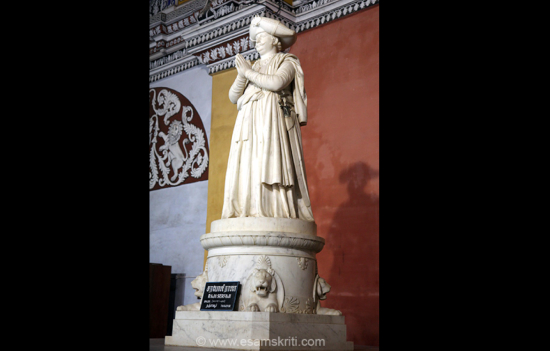 Maratha Palace, Tanjore. 2016.
Serfoji II Maharaj (A. D. 1777-1832) is known as the
greatest of the Maratha rulers. He was an enlightened and educated soul; the
quintessential Indian maharajah of the British colonial era who was at home
with both Latin as well as Sanskrit and could converse and compile literary
works in both Tamil and English. He was a distinguished King endowed with such
high privity (in the context of performance (including dance
and movement) privity refers to a deep, often subjective, shared connection or
mutual knowledge between dancers) and
encyclopaedic knowledge in different subjects.
He was a patron of traditional Indian arts like dance and
music. He authored famous works like Kumarasambhava Champu, Mudrarakshaschaya
and Devendra Kuruvanji and introduced western musical instruments like Clarinet
and Violin in Carnatic Music. Tyagraja, Muthusamy Diksithar and Syama Sastri
were patronized by Serfoji II.
His contribution to music and dance is immeasurable like
the musical forms such as Ovi, Abhang, Sakhi, Dindi, Nirupanas etc of Marathi
origin, which were used by the Kirtankaras in Harikatha Kalakshepa. His knowledge in music and
dance is evident from several of his Nirupanas - Natyaprabandha written in
Marathi which include several dance pieces of the Sadir-attam repertoire, which
were popularly performed by the accomplished dancers of his court.
DANCE VARIETIES
The dance pieces in Marathi composed by Raja Serfoji give
a complete picture of the items of the present Bharatanatyam recital. Serfoji
II wrote hundreds of songs in Sanskrit, Telugu, Marathi, and all are set for
music and dance recitals.
He authored several dance pieces of Alarippu, Jatiswaram,
Sabdam and Padam etc and composed numerous Kavuthuvam, Slokavarnam and
Prabhandas, all adapted to Bharatanatyam. Sollukattu, Swaras, Jathis and
Sahithyas with their respective notations in Indian Swaras were given for every
item with meticulous care. Jayajaya and Saranu are danced as
the dedicatory pieces to the chosen deity, the third
item is seva or Allaru (Alarippu) consisting of Sahityas conveying the dancer and
salutation to the audience.
Then follows a series of jatis, combination of Svara and
tala without any theme called Jatiswaram. This is also a part of the
invocation.
The Sabdam that follows constitutes the genesis of the
story convened through Abhinaya and Nritya in Vilambakala. This is followed by
Varnam, which is the major attraction of the whole performance. Partaking of
Nritya and Abhinaya Padam or Sahitya follows.
To bring out the bhava and rasa, this item is rendered in
a slow tempo, ending with the Svarajathi. The Tillana or Tirana is followed.
Next Jakkini is performed. This is followed by Geetam
which indicates the delicate mode of raga. Then the Prabandham an old
composition having a theme and Triputam or Tripitam, which is classified as
desi nritta, are followed. Then Slokam is danced were
in the verse is rendered with abhinaya and
Kavutuvam is a terminal song in praise of a deity and the Mangalam forms the last
piece.
Though these Nirupanas are in Marathi language they are
set to Carnatic mode of Raga and Tala. This
forms a good background for Sadir dance. This type of dance performed by a solo
dancer depicting or dramatizing a complete play was called Bhedyaka. They are
narration of a story with vivid themes possessing all the features of a dance
repertoire.
Nirupana literally means the amplification of a theme. The root seems to have been from the Maharashtra Keerthan, popularly known as Kathakalakshepam. Serfoji was the first composer to introduce a single theme concept. Serfoji’ s Nirupanas present a single theme woven into a series of eighteen different types of dance compositions.
The eighteen items figuring in one Nirupana are: 1.
Jayajaya 2. Pada 3. Geethi 4. Saranu 5. Swarajathi 6. Prabandha 7. Alaru 8.
Abhinayapada 9. Triputa 10. Sollu 11. Tillana 12. Sloka varna 13. Sabda 14.
Arjitapada 15. Kautta 16. Varnam 17. Jakkini 18. Mangala.
Tulaja I
Tulaja I (A. D. 1728-1736) is remembered as a linguist and scholar. He wrote ‘Sangitha Saramritham’ which dealt with rasas and melas popular in his period. He promoted lots of Padams, Darus and Svarajathis. Apart from Carnatic music he gave scope for Hindustani musicians in his court. He strengthened the Maharashtrian tradition of bhajans and kirtans.
Sangita Saramrita is a Sanskrit text attributed to King
Tulaja I and is perhaps the most incomplete section in all the available
manuscript materials. However, the fragments are complete enough to provide us with a unique vision of the Maratha enterprise of
re-working indigenous cultural practice. This
text clearly reflects an attempt to reconcile the local traditions of dance
with Sanskrit textual tradition.
Its vocabulary is thus a unique amalgam of local (Telugu/Tamil) vocabulary for movements, which are called ‘Adavus’ in the text, and representations of dance as found in medieval Sanskrit texts such as the ‘Sangita Ratnakara’ of Sarangadeva, the ‘Sangita-Muktavali’ of Devenacharya and the ‘Nrittaratnavali’ of Jayasena, each of which Tulaja liberally cites in his work.
This description of the Tattadavu provides a Sanskrit
equivalent (khanatpada-kuttanam). Moreover, it provides a description of the
practice of the step in alternating speeds of Vilambita and the others,
supplies the vocalized rhythm or Cholkattu (theyyathai), and gives a short
description of the formation of the step.
According to Sangita Saramrta the method adopted for learning these adavus, begins in the Araimandi position with the student holding the centre of a rod or dandika, placed horizontally at the chest level supported by two vertical poles in front of the dancer. This practice of holding dandika is referred to in Sanskrit as ‘Dandika Grahana’. Samu in Telugu connotes the exercise with the stick and its Tamil equivalence is ‘Salambam Pidithal’, meaning holding the rod.
As this tradition was in vogue during the Maratha period, it would be worthwhile to revive it in its old form, to ensure the balancing of the body with correct posturing and perfection of the basic stance ‘Ardhamandali’, for beginners.
The text Sangitasaramrita by Tulaja vividly describes the
adavus. This adavu sampradaya mentioned in his text, established its existence three
hundred years ago. The following eighteen adavus described are:
1. That Adavu
2. Kuttu Adavu (Thattai taha dhittai taha)
3. Nati adavu (Nata adavu)
4. Dhi dhi thai (Theermanam)
5. Dhigi dhigi adavu (Kuchipudi)
6. Kudichu (Thangidu tha tha dhinna)
7. Mardana (Kuddiccu mettadavu.)
8. Thati Mettu
9. Anukur Adavu (Nadai Adavu)
10. Simiradavu (That tai tam dhit tai tam)
11. Kadasakal
12. Thatikattaradu (Visaradavu)
13. Parikra adavu (Sarukkal adavu)
14. Endi Kattrdu
15. Veechi kal
16. Vlzhinduveechi
17. Chakkara Chutu
18. Mandi adavu
Tulaja classifies the adavus into 18 groups.
He mentions four karanas which are acrobatic in nature. There are more
movements under the titles brahmari and Padashiksha vidhi. The Tanjore brothers
simplified and reused the varieties of already existing adavus. They
systematized the adavu system. Of the many varieties mentioned in Sangita
Saramiritha, 25 varieties are already obsolete.
Some of the new adavus in practice in present
day dance do not appear in the text. This shows that dance has changed over the
centuries in shape and form.
Summary
The Maratha Kings of Tanjore, particularly
Serfoji II and Tulaja I, played a pivotal role in shaping and systematizing the
Bharatanatyam repertoire through their royal patronage and rich compositions.
Invaluable Compositions like 'Nirupana' and 'Prabanda' can be choreographed for the modern stage presentation of Bharatanatyam. Thus, the
contributions of the Tanjore Maratha kings remain indispensable to the
historical evolution of Bharatanatyam.
Author Sanjana Sivakumar is Asst Professor, Department of Natya, Dr. MGR Janaki College of Arts and Science, Chennai.
To read all articles on Bharatanatyam
To read all articles on Indian Dance Forms
Also read
1. Maratha Rulers of Thanjavur
2. Album Maratha Palace
3. Hear Sangam
Talks video on same topic 47 minutes
4. Contribution of Tanjore Maratha Kings to Bharatanatyam