- Know about the evolution of Pallava Temple Architecture and the key
monuments they made.
The Pallavas were great builders who played a significant
role in the development of Dravidian architecture. They built some of the most
beautiful temples in South India—their architecture and sculpture can be
considered one of the most spectacular chapters in the history of South India.
The Pallavas ruled in South India for roughly 600 years between
275 CE to 897 CE with Kanchipuram as their capital. Along with the Cholas and
Pandyas, they dominated the political history of South India for many
centuries.
Their contribution to the architectural splendour of the
south bear testimony to their power. Pallava
architecture bridged the transition from rock-cut architecture to structural
temples.
This article was
first published in the Bharatiya Vidya
Bhavan Journal.
It was Mahendravarman I who initiated rock-cut
architecture in Pallava country. Some of the cave temples he excavated are the temples
at Mandagapathu in South Arcot district, Mamandur and Sivamangalam in North
Arcot District and Pallavaram near Chennai. The upper rock-cut cave at
Tiruchchirappalli is by far the best of Mahendravarman I’s
creations.
The most famous example of Pallava architecture is of
course, the monuments at Mamallapuram, a seaport town at the mouth of the Palar
River, 56 km south of Chennai. Some historians opine that Narasimhavarman
Pallava, the man behind this wonderful set of temples, poured the treasure he
had seized from Vatapi during his conflict with the Chalukyas, into this
ambitious construction project and was named after him— Maha–mallapuram,
‘City of the Great Wrestler’. It was built on the
shore to probably connect the Pallava court directly to the Indian Ocean trade.
The talented Pallava sculptors created this architectural marvel on a large
granite hill, 100 feet high, half mile in length from north to south and a
quarter of a mile wide, and a smaller granite outcrop further south.
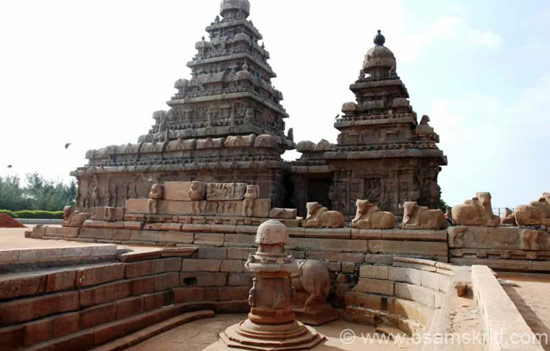 Shore Temple Mahabalipuram. 2016.
 The monuments at Mamallapuram can be grouped into
rock-cut temples, monolithic structures called rathas, bas relief sculptures
carved on open air rocks and structural temples. The temples at Mamallapuram
show a natural progression from carving temples out of caves.
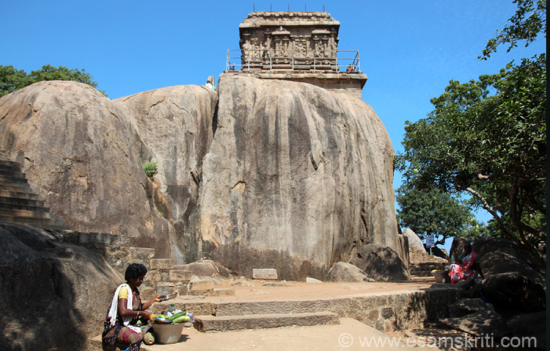 Temple on top of rock.
Historians believe that the Pallavas intended to outdo
the Chalukayan king Pulakeshin II’s (with whom the Pallavas had long standing rivalry)
free-standing temples at Vatapi made from blocks of cut stone. This ‘architectural
race’ was perhaps a sign that political factors and not
necessarily pure devotion, dictated the architectural efforts of the rulers of
that period.
There are fifteen cave temples in Mamallapuram and two in
Saluvankuppam a village 3 km north of Mamallapuram. The biggest of these caves,
the Pancha Pandava cave, was carved along the lines of an ambitious plan of a
sanctum in the centre and a circumambulatory path around it.
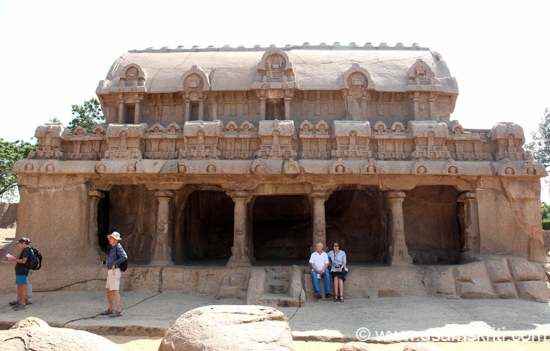 Bhim Ratha front view, one of the Five Rathas, Mahabalipuram.
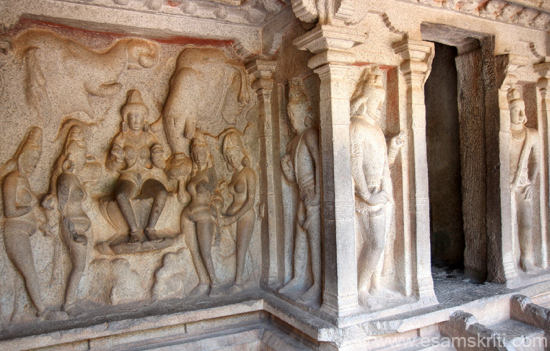 Gaja-lakshmi panel.
 Detailed caption - Here
Lakshmi is depicted on the lotus wearing a peculiar type of crown noticed in
Pallava sculpture and svarnavaikakshaka (golden cross-garland on the torso) and
hands in position to hold lotuses. The goddess is flanked by 2 nymphs on either
side carrying pots filled with water for her bath, which the 2 elephants pour
over her head. Right of pic are dvarapalas
The Goddess
Durga mounted on a prancing lion, attacking the buffalo-headed demon Mahishasura
is one of the most outstanding creations of Pallava art. See pic no 20 in album
There are ten monolithic temples at Mammallapuram among which
the most famous are the group of structures called the Pancha Pandava rathas.
The five rathas, named after the Pancha Pandavas namely Dharmaraja, Bhima,
Arjuna, Draupadi and Sahadeva are on different planes and elevations. Of these,
the Dharmaraja ratha is the stateliest and carries a number of the maker’s
titles, many of which are also found in the Kailasanatha temple in Kanchipuram.
The temple is also called Atyantakama Pallavesvaragraham. To see album pics 1 to 14.
Narasimhavarman Pallava then embarked on a great creative experiment, which, according to some historians, shows the close relationship between art, politics and myths.
This experiment was the bas relief sculptures on open air
rocks—the Descent of the Ganga or Arjuna’s
Penance carved in a single block of sandstone and profusely bedecked with
animals, gods, sages, serpents in a sophisticated visual double entendre. At
the centre of the sculpture stands an emaciated sage, balancing on one foot
with his sunken eyes fixed on the heavens. Next to him is Shiva extending his
hand in blessing. Half-bird, half-human beings called kinnaras are playing on
horns, drums and cymbals with a host of animals looking on. Each of them is
carved with remarkable realism and attention to detail.
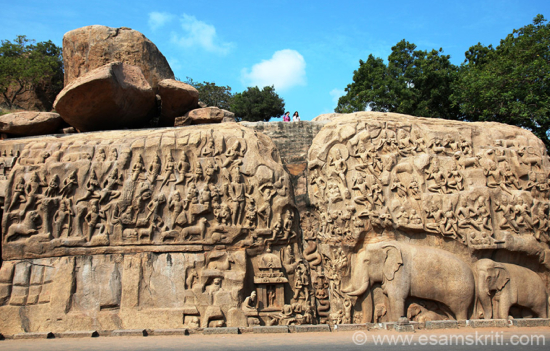 Arjuna’s Penance.
 The Descent of Ganga or Arjuna’s
Penance is virtually a classical poem in stone. There are two interpretations—one
that it represents the story of Sage Bhagirath who prayed to Shiva that the
heavenly Ganga be allowed to descend on his densely matted hair and come to the
Earth. Another interpretation is that the saint was Arjuna receiving from Lord
Shiva the mighty weapon known as Pashupata. Arjuna was a famed archer, while
Narasimhavarman Pallava was a wrestler—the mahamalla. The sculpture can
thus also be read as a eulogy to the Pallava king, a declaration that, he, like
Arjuna had earned the blessings of Lord Shiva.
At the bottom of the sculptures, three sages were carved,
probably allusions to King Narasimhavarman, his father King Mahendravarman and
grandfather Simhavarman. These sages representing three generations of eminent
Pallava kings are without their heads today. It is believed that the Chalukyan
King Vikramaditya I, the old Pallava foe, fought and defeated Narasimha Pallava’s
young grandson and marched on to Mamallapuram where he ordered the beheading of
the three sages in a symbolic move.
Rock-cut architecture was later completely abandoned and structural temples became the Pallava signature. The Pallava artisans naturally found the structural temples more advantageous than rock cut temples because they could be built on plains without hillocks. The structural temples fall into two groups—the Rajasimha group (700-800 CE) and the Nandivarman group (800-900 CE).
There are six examples of the former, three in
Mamallapuram (the Shore Temple, Isvara and the Mukunda temples), one at Panamalai
in South Arcot district and the temples of Kailsanatha and Vaikunthaperumal at
Kanchipuram.
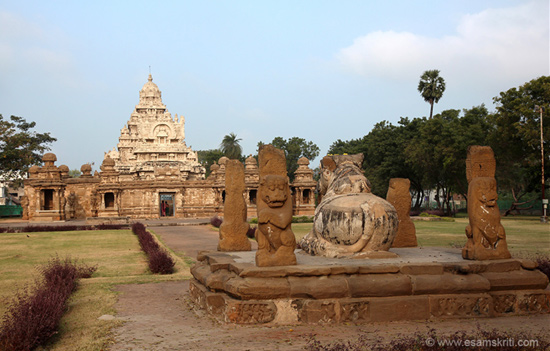 Kailasanatha Temple, Kanchipuram
The earliest of the structural temple was the Shore
temple. Its excellent workmanship has outlasted the action of wind and sea and
the shifting sands of the shore. The next was the Kailasanatha temple at
Kanchipuram built mostly during the reign of Rajasimha, though the actual
completion of the structure is credited to his son Mahendravarman II and his
queen Rangapataka. It displays all the main features of the Pallava style. The vimana
in the temple is a further development from that of the Shore Temple and is at
once substantial and well-proportioned.
Some of the features of the Kailasanatha temple were
later adopted in the Virupaksha temple at Pattadakal by the Chalukyas.
Perhaps the most mature example of Pallava architecture
is the Vaikunthaperumal temple at Kanchipuram. Slightly larger than the
Kailasanatha temple, its principal parts—cloisters, portico and sanctum—are
no longer separate buildings but are amalgamated into a well-articulated
structure. To see album of Perumal temple
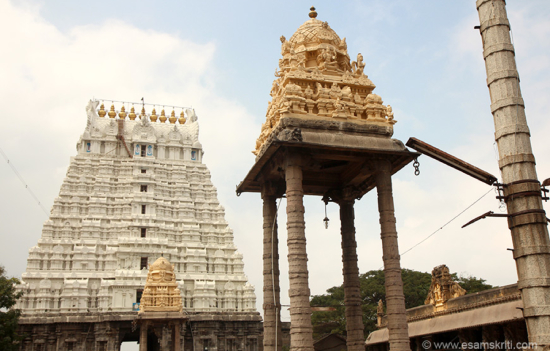 Vaikunthaperumal temple, Kanchipuram.
 The second group of Pallava structural temples, the Nandivarman
group, mostly consists of small temples and in no way form an advance on the achievements
of the previous age. These modest structures were witnesses to the decline of
the Pallava power.
The Pallavas were undoubtedly great architects besides
being a strong political power in South Indian history.
This article was first published in the Bhavan’s Journal, February 1-15, 2026 issue. This article is courtesy and copyright Bhavan’s Journal, Bharatiya Vidya Bhavan, Mumbai-400007. eSamskriti has obtained permission from Bhavan’s Journal to share. Do subscribe to the Bhavan’s Journal – it is very good.
Also see albums
1.
Shore Temple,
Mahabalipuram
2.
5 Rathas
Mahabalipuram
3.
Kailasthanatha
Temple, Kanchipuram
4.
Vaikuntha Perumal
Temple