- Article starts with Swami Vivekanand’s thoughts on India, strengths and weakness in the spiritual and cultural space. Six reasons why the world respected India then!
Lot
of messaging about India being a Vishnu Guru (VG) in the last ten odd years.
This article seeks to put matters into perspective without getting into the
politics of it. The Iran-USA/Israel War of March 2026 has shown how dependent
India is on the Middle East for Crude Oil and fertilisers, LPG etc so forget the
VG bit.
Titles
comes from karmas for e.g. I earlier wrote that it was during the battle of Bardoli, in April 1928, that someone referred to Patel as the peasant’s Sardar. The appellation caught on. Vallabhbhai Patel did not call himself Sardar, people did.
So
also why is India called Bharat. I earlier wrote that the word Bharata i.e. Bha means light and knowledge
and rata means devoted. Bharata means devoted to light as against darkness. In
a spiritual sense, it means knowledge of inner-self. Thousands of years later
India is still known for spirituality. The
word Bharat is referred to in the
Holy Gita i.e. Arjuna as the best, foremost among the Bharata dynasty. Refer
chapter number/verse 3.41, 7.11, 7.16, 8.23, 14.12, 18.36. Sandhya Jain wrote Bharat is the land
of Bharatas
India was
respected because of spirituality, selfless export of culture and GDP.
V Srinivas,
author of Awakening the
Nation-Rediscovering the spirit of India with Swami Vivekananda quoted Swami Vivekananda, “The gift of India is the gift of religion and philosophy and wisdom and spirituality. They do not want to be carried on the floods of blood but come on the wings of peace and love, and that has always been so.” Lectures Colombo to Almora 199.1 Pgs. 110-4 of book 9
Steve Jobs,
founder APPLE came to Neem Karoli Baba Ashram, Kumaon to connect with his inner
self.
V Srinivas wrote, “The one characteristic of Indian thought is its silence, its calmness.” 9 Swami Vivekananda spoke, “Those great masterminds producing momentous results in the hearts of mankind were content to write their books without even putting their names. Who knows the writers of our philosophy or the Puranas. They all pass under the generic name of Vyasa, and Kapila and so on. They have been true followers of the Gita, ‘To work you have the right, but not to
the fruits thereof.’” Lectures Colombo to Almora 200.201 9
Swami Vivekananda spoke, “We must go out, conquer the world through our spirituality and philosophy.” CtoA 204.1 “One-fourth of the effect that has been produced in this country by my going to England and America would not have been brought about, had I confined my ideas only to India.” CtoA203.1 9 India must become outward looking.
Swamiji spoke, “It cannot but think that we have to learn many things from other nations.” CtoA197.2 “That we did not go out to compare things with other nations, did not mark their workings, has been one of the greatest cause of the degradation of the Indian mind.” CtoA188.1 India
must learn from others and benchmark with the best in the world. 9 Make in India
& for the World
Swamiji
never referred to India as VG although he spoke about spirituality.
Key thoughts-Learn from others, be outward looking &
detached and export Spirituality.
India needs
political stability, economic prosperity and upholding Dharma.
Reasons why the World Respected India (VG word seems post 1950 origin)
1.
Progress during 150 years of Gupta rule (320-750 A.D.)
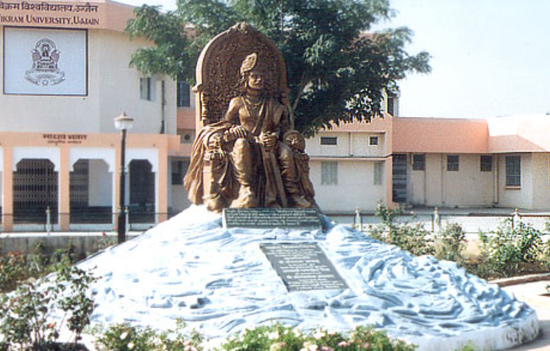 Vikramaditya image, Ujjain University. 2006.
The
cultural upswing was based on
Dharma. It predicated an unalterable faith in human behavior, self-restraint
and self-discipline. Emphasis was on individual experience rather than belief.
Running
through a diversity of religious beliefs and social outlook, it laid emphasis
on non-violence, truth, non-stealing, continence and non-possession as
essential steps in progress.
Dharma-sastras
provided the basis of Aryan society, mode of social adjustment, laws of
inheritance and of civil and criminal justice. However, Dharma-Sastras were not
thrust upon. The stress was always
on making people appreciate the essence of Dharma and then live. All classes happily adopted them. Sanskrit, a
living language, elastic in structure, rich in expression was the living
embodiment of Dharma and a powerful integrating force.
The age saw the perfect lyric and drama of Kalidasa, the astronomical discoveries of Varahamihira, Iron Pillar of Delhi, the beauty of early Ajanta frescoes, the completion of the Mahabharat and the composition of Vayu, Matsya Puranas. The six systems of Indian philosophy took final shape during this period. There was Aryabhatta, Varahamihira and Brahmagupta whose works in mathematics etc are India’s contribution to the world.
Its
strength lay in its integral outlook and was
based on as much as military strength as on internal order and economic plenty,
the sap of its vitality was drawn from ancient tradition and race memory. The
people, having discovered in their traditional way of life something noble and
splendid, saw that it reflected the greatness of their rulers. Source The History and Culture of Indian People
by the Bhartiya Vidya Bhavan
This progress was
shared without the power of the sword.
2. What was the Impact of Hindu Science on Ancient and Modern
Worlds?
Alok
Kumar wrote in Prabuddha Bharata,
monthly magazine of the Ramakrishna Mission (excerpts) -
“Based on Swami Vivekananda speech at Brooklyn Ethical Association Alok wrote, ‘Bharat’s main contribution is in the invention of the numeral system, the Hindu numerals, where there are ten symbols (from one to zero, the last numeral invented was zero) and the location of these numbers define their magnitudes.’”
“Only two discoveries chosen from the non-Western world were considered by the American Association for the Advancement of Science in its Science Journal published in 2000: (1) invention of zero and (2) the astronomical observations of the Hindu and Mayan sky-watchers for agricultural and religious purposes. Both involved the works of the ancient Hindus.”
Why Hindu contributions to astronomy were important?
“In astronomy, the spherical shape of the earth was recognized by the ancient Hindus. Aryabhata (476 - 550 CE) used an analogy of a kadamba flower to demonstrate the distribution of various life forms on the Earth.”
Aryabhata assigned diurnal motion to the Earth and kept the sun stationary in his astronomical scheme.” To read full article
Read Indian
Foundations of Modern Science by Subhash Kak and Ancient India’s Mathematical Prowess by B L Razdan
I
am not even referring to Ayurveda and work of Charaka/Sushruta or the
metallurgical skills that went into making the Iron
Pillar of Delhi .
 Yoga is India’s gift to the world and for free. Pic by Benoy K Behl.
Read
Ayurveda
and Modern Concepts and Yoga’s Gifts to Contemporary Western World and SUPER BRAIN YOGA
is Thoppukaranam and Ayurveda and Unani Medicine
3. Export of its Culture to Southeast Asia and Far East?
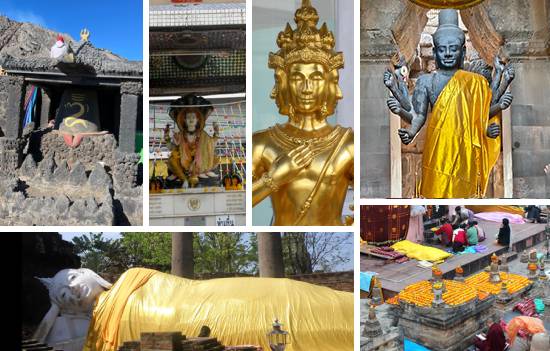
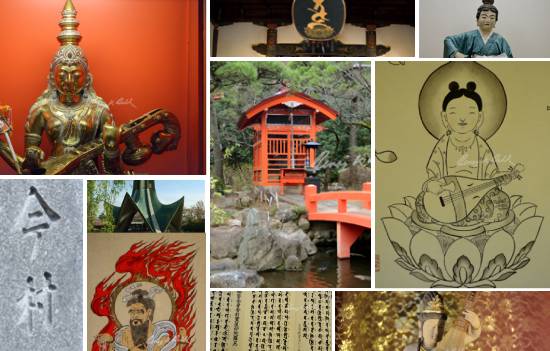 Hindu deities worshipped in Japan. By Benoy K Behl.
Countries impacted were Cambodia, Vietnam, Thailand, Indonesia, China, South Korea, Japan, Mongolia. For sake of brevity giving article links –
1.
Historical Ties
India and Thailand
by Wanna Sudhit.
2.
Ganesha Temples in
Indonesia
by Hidayat Atjeh.
3.
Album Hindu
symbols in Thailand
4.
Ramayana in
Cambodia
by Dr Ujwala Anand.
5.
Buddhist Heritage
in China by Benoy K Behl
6.
Indian origin of
Tibetan Medicine
by Dr Arun Chandan.
7.
Influence of
Ayurveda on Chinese medicine by Dr Arun Chandan.
8.
Six Days of Indic
Heritage in Cambodia
by Divyaroop Bhatnagar.
9. Yatra to Mount
Bromo, named after Lord Brahma by Shobhna Vora.
10.
About My Son,
Vietnam
by Shobhna Vora.
11.
SCHOLAR Pilgrims
from India to China-Sanskrit on the Silk Route by Prof Dr
Shashibala.
12.
How Indian Masters
Controlled Epidemics in China earlier by Prof Dr Shashibala.
13.
Samskriti,
Sanskrit and Indonesia by late Guru Anand Krishna ji.
14.
India and Mongolia – Shared Heritage
by Prof Lokesh Chandra.
15.
Sanskrit
manuscripts and Indian scripts in Japan by Prof Dr Shashibala.
16.
Exploring Temples
of Java
by Rajiv Malik.
17.
Ramayana Performances
in Southeast Asia
by Benoy K Behl.
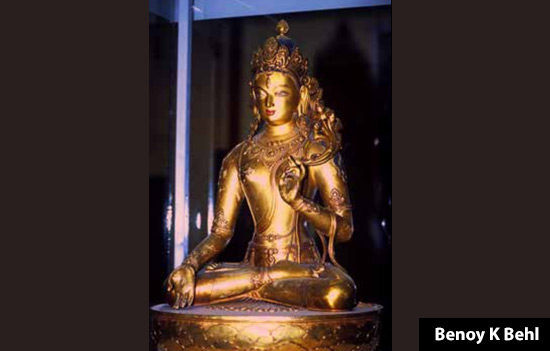 White Tara, 17th century, Zanabazaar Museum, Ulaanbaatar, Mongolia. Pic by Benoy K Behl.
Other countries
1.
Lithunia – A Vedic Nation
by Major S N Mathur
2.
Photographic
Exhibition Buddhist Heritage of the World by Benoy K Behl
3. India and Bulgaria – cultural connect by Prof Dr Shashibala. Click on PDF
This
is by no means an exhaustive list of contributions.
When
was in sharing mode, there were no minorities, depressed classes and vanvasis.
These man made divisions need change.
4. India’s share of World GDP
Alok
Kumar wrote in Prabuddha Bharata, monthly magazine of the Ramakrishna Mission –
“Dr Angus Maddison (1926–2010), a distinguished British economist who taught at the University of Groningen, the Netherlands, wrote a book, Contours of the World Economy: 1–2030, in which he compiled the
Gross Domestic Products (GDP) of various nations during the past two millennia.
Following were his results for the GDP of Bharat:
Table 1 - India GDP from 1000 A.D.
|
Year
(AD)
|
Bharat
GDP as % of world economy
|
|
Beginning
of Christian Era
|
32
|
|
1000
|
28.1
|
|
1500
|
24.4.
|
|
1600
|
22.4.
|
|
1700
|
24.4
|
|
1820
|
16
|
|
1913
|
7.5
|
|
2003
|
5.5
|
The above table tells us that the Bharat’s economy was close to one-third of the world’s economy at the beginning of the Christian era. The only other nation which was comparable to Bharat was China.” To read full article
India was rich thus attracted invaders. None invade a poor country.
5. We are unlike any Christian or Muslim country in the world.
Writing
in 2018 about former President Mukherjee speech senior journalist Sandhya Jain wrote, “We believe in ‘Diversity in Unity’, because everything emerges from Oneness. Indian pluralism, or ‘sarv dharma sambhav’ (all faiths are harmonious) and ‘ekam sat, vipra bahuda vadanti’ (truth is one, the wise call it by many names) is rooted in this awareness.” Read Our
Cultural Legacy
When we accept the TRUTH is one, the source of conflict ceases to exist. It is also a
reason why Indics do not convert.
6. India was and is respected for its Democracy
So
obsessed are we with western style democracy that we forgot the Concept
of Elections and Democracy in the Vedas and Dharma Sastras. Maharshi Aurobindo
said in 1926, “The idea of the King as the absolute monarch was never an Indian idea. It was brought from Central Asia by the Mahomedans.” 13 India absorbed Greeks, Central
Asians, Mughals and Europeans but did not become them. That capacity to digest rather than be replaced is rare in civilisations. India never rejected the material world. It simply placed it within the framework of Dharma-Artha-Kama-Moksha.
Current day India resists change, is obsessed with reservations, has a colonial education system, seeks to prevent Sanatana Dharma from flowering, is happy importing from China rather than innovate etc. cannot dream of scaling the heights and contribution to global welfare that were achieved earlier.
Unless
India decolonises Vishwa Guru is a dream. Supreme
Court can lead
Things are changing but India has a long way to go. Talk less
Work More was a slogan during the 1975 Emergency. Indians need to follow that
now.
We should recall Maharshi Aurobindo’s words (India’s Rebirth)
May 1909: “When it is said that India shall be great, it is the Sanatan Dharma that shall be great. When it is said that India shall expand and extend herself, it is the Sanatan Dharma that shall expand and extend itself over the world. It is for the Dharma and by the Dharma that India exists….” 13
India should aim to be VISHWA MITRA (world’s friend) not VISHWA GURU. What that means and how is the subject matter of another article.
Also read and
References
1.
The myth of
Civilization
- : “India was once the teacher of the world; what made it unique was its spiritual wisdom. The world learned from it.”
2.
History of Vishwa
Guru Bharat
3.
What is Vishwa
Guru
4.
What is a Vishwa
Guru – “The idea of the vishwaguru as an outward-facing social and political project of the state has obvious pedagogic but also transformative dimensions. Ian Hall, in his study of Modi's approach to foreign policy, usefully defines ‘world guru India’ as ‘the notion that India has a unique mission in the world and unique wisdom to convey.”
5. Vishwa Guru India – the how and the why – “India's unique worldview emanating from our civilisational culture; secondly, our remarkable achievements during the last 75 years; thirdly, our intrinsic strength to offer something that the global community so very critically requires.”
6. Why
has India reimagined its role from Vishwaguru to Vishwamitra – “Under Modi, this projection found renewed vigour. Internationally, it allowed India to project soft power through instruments including yoga diplomacy, the celebration of Ayurveda, and narratives of India’s ancient scientific and philosophical achievements.”
7. Vishwa Guru – A Glorious Legacy – “Ancient Indian mathematicians pioneered concepts like zero, the decimal system, and algebraic equations. Astronomers such as Aryabhata advanced celestial understanding, while Ayurveda, the traditional medical system, dates back millennia. The Iron Pillar of Delhi stands as a testament to ancient metallurgical skills.”
8. Time
has come for India to reclaim its status as Vishwa Guru – “For those surprised at the reassuring dominance India once had, it’s worth noting that there was a time when India’s share in world trade was about 24.5% – at par with the share of the entire European continent.”
9.Awakening the
Nation-Rediscovering the spirit of India with Swami Vivekananda
10.
Ayurveda and
Modern Concepts
11.
Why India is
called Punya Bhumi
12.
Indian Foundations
of Modern Science
13. India’s Rebirth – Writings of Sri Aurobindo
India never rejected the
material world. It simply placed it within the framework of
Dharma-Artha-Kama-Moksha.