- This article traces the origin of Western style Feminism, explains why its export to India and blind adoption endangers Indian society. It examines what must be done to restore balance that existed in Bharat, it being the only country where women are revered as SHAKTI.
A moment on a public panel revealed a deeper truth: we are increasingly uncomfortable hearing our own civilizational story. Drawing from history, scripture and lived experience, one questions the unquestioned adoption of “pseudo feminism” in Bharat and asks whether empowerment without roots can ever lead to harmony.
The
friction tearing through our society today is not out of any circumstances, it
was engineered. The fraying trust between men and women is breaking families
and children are growing up amid confusion and contradiction.
At the
root of this unrest lies the steady infusion of foreign ideologies; radical
feminism, cultural self-hatred, civilizational guilt and perpetual victimhood,
introduced to weaken social cohesion from within. The Hindu family structure
now stands strained between conflicting narratives.
These
ideas were pushed into the Hindu discourse, casting Bharat as backward and its
traditions as oppressive. In doing so, they have turned independence into
separation, equality into conflict and empowerment into alienation.
Families
that nurtured generations are now pressured by narratives that erode trust,
respect and love, leaving men and women unsure of their roles and children
confused about values and traditions. A civilization built on harmony and Dharma
is being pushed toward division, distrust and disintegration.
Chanakya
warned that nations collapse from within before they fall from outside. Today,
ideological imports masquerading as liberation are corroding trust, family, and
social order in Bharat.
Primarily
a solo keynote speaker on culture, history, spirituality and environmental
responsibility at forums that engage deeply with Indic thought, history and
cultural continuity; I recently spoke at a literary
festival. Though I engage in formats aligned with “complete
civilisational narrative” approach, I could not deny this invite and found myself in a panel nominally discussing “women’s empowerment.” From the outset, the questions and the discussion revolved around narratives narrowly focused on victimhood; the responses of the other panelists largely followed the same line.
I
attempted to offer a different perspective to broaden the conversation. I
reminded the audience that Hindu society descends from a valorous lineage, one
that defended the land, culture and Dharma for over fourteen centuries. I
pointed out that we were led to forget our own strength and undervalue
traditions that have always revered and honoured women, that history of courage and resilience has been overshadowed, leaving us with diminished pride in ourselves. I highlighted that foreign-imported concepts of “feminism” have disrupted this harmony, undermining a culture that has never discriminated between genders. The response that followed revealed how firmly such narratives have taken hold in public discourse.
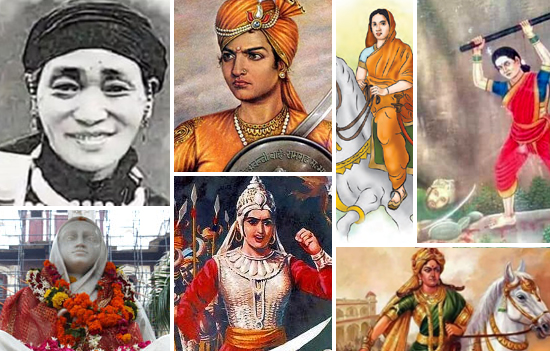 Women Warriors of India.
While
the audience reacted with openness and interest, which was encouraging, the
other panelists and the moderator seemed uncomfortable engaging with this
perspective. That moment made something clear to me; we are being conditioned to view our society through lenses
of inadequacy and guilt, while our deeper legacy of balance, dignity and valour
remains largely unspoken.
It is this experience that made me realize the need to revisit the origins and consequences of this “pseudo feminism” in Bharat to understand how borrowed ideas have reshaped and in many cases strained our social fabric, families and collective self-understanding.
Origin of Western
Feminism
The
framework of feminism and women’s empowerment did not emerge from
Hindu civilizational thought. It developed in Europe and
North America as a response to legal and social restrictions placed on women by
feudal laws, the Church and later industrial capitalism.
Western
women were denied formal education, property rights, inheritance, political
representation and economic autonomy. Confined to domestic roles and little
opportunity for independent livelihoods, they were treated as dependents,
legally subordinated to fathers or husbands rather than autonomous persons and
had no voting rights.
The word “feminism” was coined to describe these struggles advocating modest but essential reforms, access to education, property, and political voice.
Even as feminism sought justice, its ideals were repeatedly co-opted by political and ideological forces. The French Revolution (1789–1795) radicalised these concepts by transforming rights into political claims. Most of these advances were rolled back after the radical phase of the Revolution ended. Marxist thinkers like Angela Davis (1944) fused feminism inside Marxist revolutionary ideology; framing the family as a site of oppression and economic dependency as the root of female subjugation. Women’s liberation was not about rights
but about dismantling existing social structures.
Colonialism used feminist rhetoric strategically as a
justification for domination by portraying colonised societies as oppressive to
women. In Bharat, the British authorities selectively highlighted sati and
purdah to construct a narrative of native barbarism, positioning imperial rule
as a moral mission to “save” women from their own cultures.
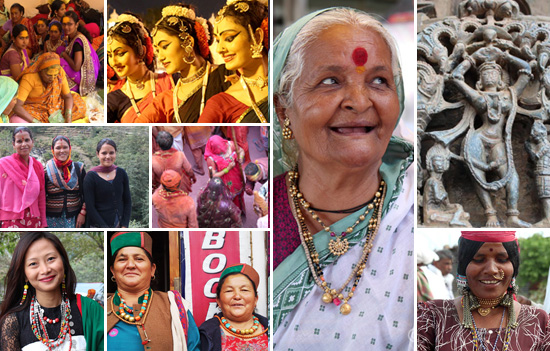 Women across India. Purdah, selectively used, is not Hijab.
The
World Wars marked another critical phase in the political use of women. During World
War I and World War II, Western governments invoked equality and emancipation
rhetoric to mobilise women into the workforce. With millions of men conscripted
into military service, states faced acute labour shortages and turned to women
to sustain factories, munitions production, transport and agriculture.
Governments declared women equal citizens and framed labour participation as
both national duty and liberation.
However, this equality was strictly functional and temporary. Once the wars ended, women were pushed back to domestic roles, wages declined and the rhetoric of equality disappeared. Equality was granted only when it served state objectives.
In
socialist states, particularly the Soviet Union and Eastern Europe, the
political use of women became more systematic and ideologically explicit; women’s liberation was framed through labour. Marxist
theory identified
the family as an oppressive structure and economic dependency as the root of
female subjugation. Work, therefore, was presented as liberation and the state
positioned itself as the new protector replacing the family. Lenin and later
Stalin argued openly that women had to be drawn into production to build
socialism. Women were pushed into factories and collective labour while still
retaining domestic responsibilities, creating a double burden rather than genuine
freedom. This was not empowerment in any meaningful human sense, women were not
liberated; they were reallocated.
By the
1970s, overt revolutionary language gave way to “women’s empowerment,” formalized by the United Nations and development agencies. The UN International Women’s Year
in 1975 and the UN Decade for Women from 1976 to 1985 marked the institutionalization
of this new terminology under Secretary-General Kurt Waldheim.
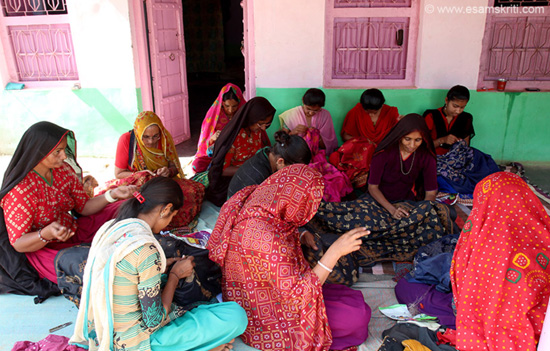 Kutch ladies do stitching work in their free time. Village Noronha. 2018
The
word empowerment was used because it sounded progressive without being
confrontational, moral without being radical and reformist without challenging
foundational structures.
The
World Bank, under President Robert S. McNamara, became the principal engine of
this new development feminism. McNamara integrated women into a technocratic
framework linking gender to productivity, fertility control, poverty management
and human capital, viewed as economic inputs. Western development agencies,
like USAID and the UK’s Overseas Development Ministry,
promoted these ideas by tying them to aid programs. The OECD then spread the
same language to other donor countries making “empowerment” a standard part of international funding.
Empowerment
need not come at the cost of family, dignity, or harmony. Detached from
Bhartiya context, “Pseudo-feminism” has reshaped social narratives!
Whereas thousands of miles east, in Bharat, the position of women has always been fundamentally rooted in respect and spiritual authority rather than subordination. Hindu society never regarded woman as inferior; it worshipped her as Shakti, honoured her as mother, protector, teacher and the very soul of the household. From the Vedic period onward, women were active participants in intellectual, spiritual and social life.
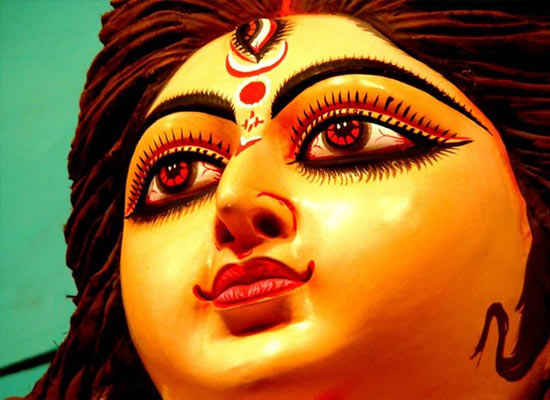 Worship of God as Mother is unique to India.
The
Rishikas; Gargi, Ghosha, Lopamudra and Apala composed hymns, engaged in philosophical debates and were recognized as
Brahmavadinis, standing on equal intellectual footing with men. Thirty such
women are mentioned in the Rig Veda alone, a testament to their spiritual
authority and unhindered access to sacred knowledge.
Women
studied the Vedas, philosophy, music and statecraft alongside men in gurukuls,
decisively challenging any Western notion that women were subordinated or
denied learning.
Hindu
society understood marital and familial relationships as partnerships, not
hierarchies of domination. Men and women were seen as complementary halves,
each essential for the well-being of the family and the proper functioning of
society. The concept of Ardhanarishvara embodies
this eternal unity, showing the equal importance of masculine and feminine
principles. The wife is the Ardhangini, literally the “half-body” of her husband, signifying mutual completeness.
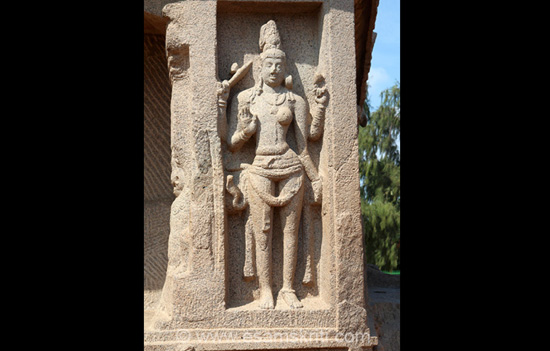 Ardhanareeshvara
at 5 Rathas, Mahabalipuram. 2016.
Ardhanareeshvara
at 5 Rathas, Mahabalipuram. 2016.
This cosmological vision shaped social
life, women were revered not only as mothers, wives and daughters, but also as
moral and spiritual guides, whose counsel and active participation were
indispensable for living a Dharmic life.
Women
in Hindu society were never confined to the home. Alongside their education and
intellectual pursuits, they actively took part in religious rituals, managed
economic and agricultural activities, engaged in trade and even shaped the
affairs of the state. Queens like Rani Durgavati and Rani Ahilyabai Holkar were
far more than ceremonial figures, they ruled with wisdom, courage and
exceptional administrative skill, earning admiration and respect from their
people.
Law
codes like the Dharma Shastras recognized their right to own property, inherit
family wealth and give consent in marriage, acknowledging them as independent
agents with real social and economic authority. In sharp contrast, European
feudal systems bound women legally to fathers or husbands, denying them both
public voice and personal autonomy. Read
How
the British created the Dowry System in Punjab
Hindu
scriptures further affirm this equality. Men and women have equal access to
Dharmic knowledge, spiritual practices and the pursuit of moksha. Goddesses are
revered as embodiments of wisdom, prosperity and power. Rituals place women at
the centre highlighting their vital role in sustaining life, society and Dharma.
In this worldview marriage is understood as a sacred partnership, where duty and responsibility complement one another rather than creating hierarchies. In the household and community alike, contribution of women; whether domestic, agricultural, or commercial, was valued and respected, never exploited for political gain or economic convenience; unlike Western models, which often equate their labour outside the home with liberation.
Even in
times of war or societal crisis, Hindu tradition never sidelined women. They
were seen as equal partners in the resilience and defence of the land. History
remembers women who led armies, guided communities and safeguarded social order
during invasions, standing shoulder to shoulder with men in courage and duty.
In every sphere, spiritual, social, economic and political, Hindu women
exercised authority and earned respect. Hindu civilizational ethos does not
need slogans of “empowerment”; since dignity, responsibility and autonomy have been woven into the very fabric of life.
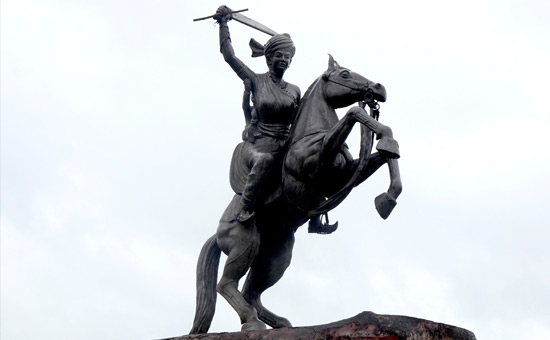 Rani Laxmibai-near Burhanpur,
Madhya Pradesh.
Rani Laxmibai-near Burhanpur,
Madhya Pradesh.
It is this inner cohesion of civilization, that Chanakya cautioned, that must be protected.
As he
observed, “A state collapses from within before it is conquered from without… external enemies merely exploit internal rot.” In Book IX, Chapter 3 of the Arthashastra, he
identifies sedition, espionage, fifth columnists and internal collaborators as
the most dangerous instruments through which external enemies penetrate a
nation. He asserts that foreign aggression succeeds by first corrupting
loyalties, sowing dissent and hollowing out the defences of
a state from within.
In the same way, ideas imported from outside create an undercurrent that erodes the very foundation of society long before any overt attack. This is exactly how notions like pseudo-feminism” and similar ideologies have operated in Bharat; by fueling movements and protests that disrupt social harmony, corrode trust between communities and genders, fracture families, and dismantle the value systems that have sustained Hindu civilization for millennia.
Hindu society was never built on hostility
between men and women, at its core lay Dharma, balance and mutual respect.
Imported feminism, divorced from civilizational grounding,
teaches our daughters to view families as cages, our sons to see commitment as
a liability and all members to approach each other with suspicion. Independence
does not mean separation, equality does not mean conflict and empowerment is
not alienation; true freedom is built on trust, responsibility and the harmony
that binds families and communities together.
Today,
that harmony is under threat from a new class of power brokers who control the
narrative, portraying the Hindu family as oppressive and mocking virtues like
duty and sacrifice. Political parties, NGOs and global institutions raise women
related issues to gain influence, mobilize support, or silence dissent. Safety
is invoked during elections, laws are passed but rarely enforced and outrage
rises or falls with political convenience. Corporate
feminism
reduces empowerment to a slogan for selling products and polishing images,
measuring success in output rather than dignity or well-being. Pseudo-feminism
is not about women, it is about control.
Should we imitate the failed social experiments that have
fractured the Western world?
If we
wish to preserve our civilizational continuity and harmony, such narratives
must be rejected. The values of mutual respect and complementary equality that
lay dormant over the last four to five decades must be revived and re-instilled
in our children. Unless the values that once drew the world to Bharat for
learning- science, art, moral guidance and trade are passed on to the next
generation, our civilizational strength cannot endure.
Meenakshi
Sharan is a hospitality entrepreneur, an avid history buff, an independent researcher known for debunking false narratives and a civilisational activist. She is a contributing writer at various online publications including Firstpost, News 18, E Samskriti, OpIndia etc. Her threads on various subjects pertaining to indology have been popular and emerged as a reference points in popular narratives.
Her book, “Ancient Future, sanatan wisdom for preserving mother earth” is ready for publication and should be out soon. Currently she is working on her second book ‘Paid in Blood’ a segue from her ground movement Samuhik Tarpan,
which is in its 10 year of practice now.
Her talks, articles and constant demand of recognising the horrors of 1947, was heard as 'Vibhajan ki Vibhishika', announced by the PM in 2021.
Her campaign of Shraddh Sankalp Diwas and Samoohik
Tarpan for the Hindus killed throughout Islamic & Christian invasions and
partition of Bharatvarsh has become a movement observed by thousands of Hindus
spanning 14 countries of the world.
Her production of Odissi ballet “Saraswati Untold” in the classical Odissi dance form using relevant shloka from Vedas and Purans, based on the geographical evidences from Hindu Scriptures garnered critical acclaim. Saraswat Untold is the first ever repertoire on the Sarawati river.
To serve her Indic roots, she has founded Ayodhya Foundation, which promotes revival of Vedic Culture & relevant art forms. She is on X, FB, Instagram as @MeenakshiSharan.
Also read
1. Unsung
Women Warriors of India
2. All articles on Indian Women