- Know about the deeper significance of making Rangoli. How it’s making helps in unknown ways.
A glance at the vibrant primary colours of red and yellow enveloped in pristine white dots, curves and lines of rice powder is enough to evoke joy in onlookers’ eyes. But it is more than just what meets the eye; it’s science!
Rangoli/Kolam, has the power to significantly alter our way of looking at
the mundane and apparently inconsequential. It goes deeper than drawing some colourful
pictures in the courtyard during festivals and special occasions. Often its
significance is limited to being a cheerful and welcoming piece of art at the
front door and not much thought is given to it beyond that. But the history and
science behind it is extremely impressive. To think that so much powerful
thought and science are behind the origin of the art of rangoli is remarkable
and proves the highly advanced knowledge held by our ancestors.
This article was
first published in the Bharatiya Vidya
Bhavan Journal.
Rangoli is the culmination of the
use of mathematics, geometry, fractals, Fibonacci, neuroscience, ephemerality,
divinity, harmonious co-existence and calmness induction, all in a drawing!
Our ancestors were masters in weaving the most sophisticated scientific
findings into simple daily rituals so that the general population could gather tremendous
benefits for their well-being. They made it all so simple and practical for us
that we started taking it for granted. We soon lost this highly beneficial art form
and it was relegated to a few occasions in some households.
Fortunately for us, we still hold the power to make every day a little more
magical. We ought to perceive such mundane things from a new perspective. We
should learn to appreciate all the blessings given to us by our ancestors and
give them a new life.
A striking aspect of rangoli making is fractals, which is the geometry of
eternity. Fractals are a curve or
geometrical figure, each part of which is the same statistical character as the
whole. In math, a fractal is a never-ending pattern. Fractals are built by
repeating something over and over again. Fractals may be created by using numbers
or images as in rangoli. It is said that nature is so relaxing to us because it
is full of curves fractals. In the same way a rangoli is pleasing to the one
who makes it as well as the onlooker. Various orthodox designs are made in a repetitive
pattern to invoke positive energy. The repetitive patterns induce a meditative
state and help in becoming aware of the present moment. Science now recommends doodling-like
art forms to reduce anxiety by turning anxious thoughts into shapes and
repetitive patterns.
The making of a complex traditional rangoli is all-embracing and engages
all your faculties. It is a good way to start your day with focus,
concentration and agility. The need to pay attention to details improves concentration and cognitive skills. It is a good way to de-stress, induce calmness, create a good mood and promote general well-being. Drawing by hand develops focus, patience and joy, a dire need especially in today’s fast paced world of doom-scrolling.
Being outdoors and on your feet for some time every morning may turn out to
be just what the doctor prescribed. Another interesting fact is the acupressure point which is activated by letting
the rangoli powder flow between the thumb and forefinger. It is equally true that
a guest entering a house and beautifully decorated with rangoli cannot help but
feel a sense of positivity and good vibes. It brings peace and prosperity to
the home and wards off unpleasantness.
The not-so-trivial practice of rangoli-making teaches us the profound trait
of transience and ephemerality. As the day progresses, footsteps, rain and winds
smudge the painstakingly drawn patterns. But that does not deter us. In spite
of it being short-lived we are ready and eager to start afresh again the next morning.
This daily act of creation and destruction is acted
out beautifully and teaches us the importance of impermanence in our daily
lives. The rhythm goes on.
We become part of this great ancient tradition which subtly teaches us
about not getting attached. Many ancient cultures including Tibetan Buddhist mandala
art and Japanese ikigai practise rituals to inculcate the concept of
impermanence. A wonderful opportunity awaits us to be a part of this
centuries-old living tradition; something sacred, something personal. It is a
lesson in mindfulness and finding joy and meaning in small, everyday rituals.
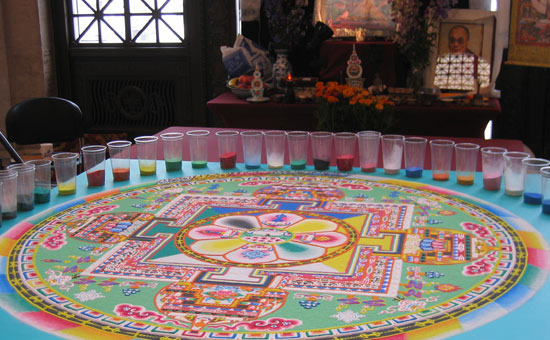 Tibetan Mandala.
In earlier days ground rice was used to make
the patterns. This was designed as a way of giving back to nature. The
ants and small insects would partake of the rice, a way of recycling and harmonious
coexistence. Ancient texts recommended the use of vermillion and saffron for
rangoli in the temples and flowers and rice during wedding rituals. Symbolism has
been a part of many ancient cultures.
Rangoli continues that tradition by using specific forms and symbols in
patterns to attract peace and prosperity. Symmetry is an innate property of
nature and our brains respond to it favourably and instinctively. To create
such a pattern one uses both the right and left parts of the brain.
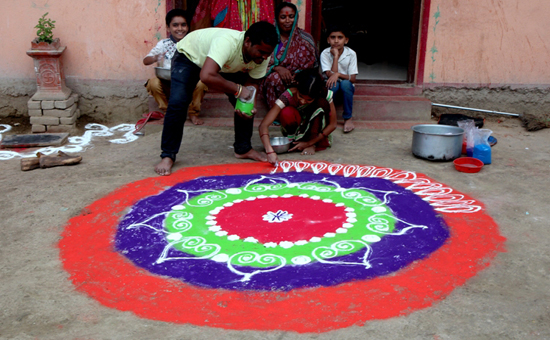 In Lonar, Maharashtra
Symmetrical patterns create ease and comfort in the brain, be it art, music
or architecture. Such art practices encourage
concentration and a flow state that can relieve anxiety. Beauty is nourishment for the soul and without it we don’t just lose aesthetics, we lose meaning. There is a reason antique artifacts still evoke joy and meaning.
Beauty shapes how we experience the world and connect with each other. When it is ignored, society loses more than elegance; it loses inspiration, empathy and a little bit of magic. We benefit highly from bringing beauty into our homes and the best part is that we don’t have to travel far for it—it’s at our fingertips. As Fyodor Dostoevsky rightly said, ‘Beauty will save the world’.
Indian celebrations are incomplete without toran, rangoli, flowers, music, gulal,
lights and food. Steeped in tradition, all these elements carry immense
significance and give a sense of completion and fulfilment to the festival.
Among them, rangoli holds a special place.
The art form is mentioned in our
revered Ramayana and Mahabharata and has the distinction of being one of the 64
essential art forms.
The art of rangoli is a wonderfully practical way to convert a mundane
morning into a purposeful and happiness-inducing one. The cumulative impact of
creating rangoli daily should therefore not be underestimated.
This article was first published in the Bhavan’s Journal, January 1-15, 2026 issue. This article is courtesy and copyright Bhavan’s Journal, Bharatiya Vidya Bhavan, Mumbai-400007. eSamskriti has obtained permission from Bhavan’s Journal to share. Do subscribe to the Bhavan’s Journal – it is very good.
Also read
1.
Significance
of Kolams
2.
Tibetan
Sand Mandala