- Know about the mode of worship of Sri Krishna at Mannargudi Temple Kumbakonam, the author’s personal connect and the annual Panguni
Brahmotsavam held in March.
I have always felt a personal connect with the Rajagopalaswamy Temple in Mannargudi i.e. near Kumbakonam, Tamil Nadu’s temple town. It is part of my family history, tied to my grandfather's maternal roots. When I visited grandfather home as a child he shared stories of the temple tank and its beauty. I was too young to understand everything then, but I still remember the experience.
In
March 2026, during festival days I returned to Kumbakonam. This visit felt
different. I started to notice more and appreciate the temple and felt deeper
connect with its divinity.
Dakshina Dwaraka and a Chosen Land
Mannargudi
is known as Dakshina Dwaraka, and is considered the southern counterpart
to the Dwaraka in Gujarat.
The name Raja Mannargudi itself reflects this. A town that belongs to its lord.
Mannargudi is one of the 108 Abhimana Kshetrams of Perumal.
This
sacred land is called Champakaranya Kshetram i.e. once filled with fragrant Shenbaga flowers. According to local traditions Sri Krishna
chose this place hence the name Champakesavan.
A Temple You Can Never Finish
The
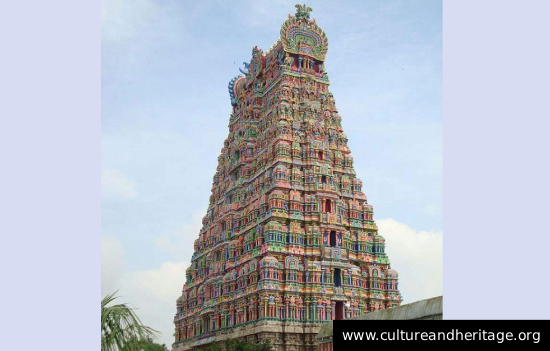
temple sprawls across nearly 24 acres, a world unto itself.
A
154-foot Rajagopuram towers above the town. Inside, the temple unfolds through
seven Praharams, each revealing another layer of space and experience.
The
streets around the temple are called Gopalasamudram. The word Samudram
means ocean, and feels apt. The streets spread wide and vast, as though the
entire town is an ocean around Krishna.
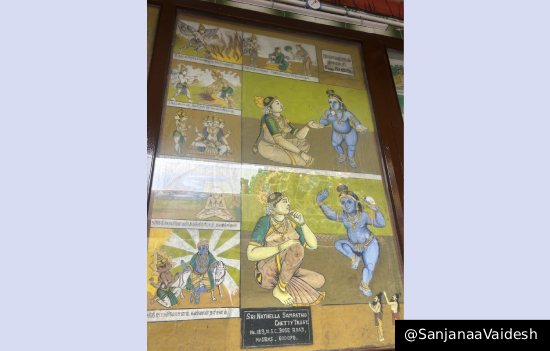
The walls are adorned with intricate paintings and detailed artwork, especially scenes from Krishna's life, his childhood, and his life among the cowherds. Every corridor feels alive and every turn reveals something new.
Locals
often say that, no matter how many times you visit, you can never fully see the
temple in one go. Each visit leaves something unseen, quietly calling you back.
Near
the temple's heart stands the Dwaja Stambam, a 54-foot pillar crowned with Garuda.
It is believed Thirumangai Alwar (8th century) was associated
with its installation. This Alwar was the last and most prolific of the 12 Alvar poet-saints who was known
for his intense devotion to Lord Vishnu.
The Moolavar: Rooted to the Earth
Inside
the sanctum stands the Moolavar, Vasudeva
Krishna, the one who protects and preserves everything. He stands directly on
the earth, without a pedestal.
It
feels the keeping of Krishna in a standing position is intentional. While he is
not above, but showcases that Vasu means earth and Vasudevan is the king and protector of Earth. You are simply
standing in front of Krishna and not looking up at him.
Rajagopalan: One Among the Cowherds
If
the Moolavar is stillness, the Utsavar
is life.
Sri
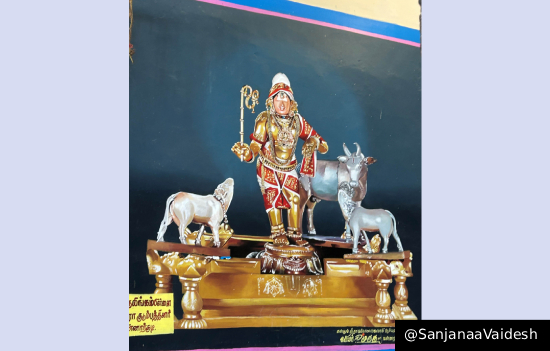
Vidya Rajagopalan is Krishna as Gopala, the lord and protector of cows.
Here he is one among them and not just their lord. He wears a single vastram that flows from his waist to his head, styled like a
cowherd's turban, just like the people he belongs to. 4
At
his hip rests a small bunch of keys, a detail that feels intimate, like a
keeper's secret.
On
either side stand his consorts, Rukmini and Satyabhama. He wears
an earring in one ear and a Kundalam
(generally worn by men) in the other. This subtle difference reflects something
deeper. Krishna here embodies both masculine and feminine energies, strength
and gentleness held together effortlessly.
The Story and the 32 Forms
The
temple's story carries its soul.
Two
sages, Gopilar and Gopralayar, set out to seek Krishna in Dwaraka.
As they began their journey, Sage Narada met them and told them that
Krishna had already completed his avatar and left for his heavenly abode to Vaikuntha.
The
sages fainted in grief. Sage Narada revived them and instructed to perform
penance there, assuring them Krishna would come. They returned and performed
deep penance in this land. And Krishna did come.
Krishna
appeared as Vasudeva Perumal, granting them darshan. He also promised that each
time they went around the temple, he would reveal himself in different forms.
It
is believed there are 32 forms of Vishnu here, each representing a path to the
divine. The final and most complete of these is Rajagopalan. This is why he is known as Sri Vidya Rajagopalan,
symbolizing the many ways that ultimately lead to him.
Santhanagopalan: A Personal Prayer
In
the same sanctum as the Moolavar, a
deeply moving presence is, Santhanagopalan, the child Krishna. He is
seen reclining on a serpent bed, in a tender and beautiful form.
Devotees
who visit this Sannidhi are allowed to hold the child Krishna, praying for Santhana
Prapthi, the blessing of children. This is not just a ritual; it feels deeply
personal, filled with hope and quiet faith.
Haridra Nadhi: A Memory That Stays
The
vast temple tank, Haridra Nadhi, stretches like a serene lake. This was one of the first things I remember that grandfather told me – its scale and beauty.
It's
believed Krishna himself bathed here. Standing at its steps, the stillness
feels full, as though it remembers. And somewhere in the world of devotion,
Goddess Andal, is believed to have alluded to this sacred space, connecting
Mannargudi to the poetry of Bhakti.
When the Lord Steps Out
During
March and April, Mannargudi transforms. Sri Vidya Rajagopalan emerges in Veedhi Ula, moving through the streets of Gopalasamudram
to meet his people.
The
grand Panguni Brahmotsavam, an 18-day celebration, fills the air with
processions, rituals, and deep devotion. The Ther Thiruvizha, where the massive
temple chariot is pulled through the streets, is a striking moment. The Vennai
Thazhi festival, where butter is offered in a playful remembrance of Krishna's
childhood, brings joy and closeness to the celebrations. Apart from this, the
Margazhi festivities and the Thepotsavam, are celebrated with beauty and joy.
This
time, I saw it differently. It was no longer just a procession and it felt like
a connection. Like the deity had stepped out
into the world.
A Temple You Return To
Mannargudi
is not a place you complete; it's a place you return to. For what you missed.
For what you felt. For what you begin to understand only over time. And for
Krishna, not distant, not unreachable, but present, gentle, and still walking
among his people.
To
read all articles by author
Author Sanjanaa V S is the Academic Director and Trustee at Dr. GSK Group
of Schools. She has experience in teaching and curriculum development in Social
Sciences and Commerce and is a gold medallist in MA International Studies and a
CIDTL-qualified educator. Her work focuses on mentoring teachers, strengthening
inquiry-based and student-centred practices, and integrating Social Emotional
Learning and dramatics into classrooms. She is committed to shaping learning
environments where experience, reflection, and inclusion guide meaningful
learning for both students and teachers.
Also see albums
1.
Temples
of Kumbakonam
2.
Navagraha
Temples Kumbakonam