- What were changes made to Indian Classical Music during Mughal rule in brief? Ideas to revive Indian Classical Music the Indic way.
Introduction: The Anatomy of Cultural
Subjugation
When
imperial invasions occur, the objective is rarely confined to seizing territorial
boundaries or extracting material wealth. True conquest seeks to redraw mental
geographies. Throughout world history, colonisers and invaders have recognised
that an ancient civilisation cannot be permanently subdued until its native
culture, indigenous knowledge systems, dietary wisdom, festive traditions, and
artistic expressions are dismantled or systematically co-opted.
When
a society’s cultural memory is severed, its
collective self-confidence collapses. In Bharat, while the physical destruction
of grand temple architectural centers is documented, the subtle ideological and
aesthetic subversion of our native art forms was far more pervasive.
Every classical art form in the Indian Knowledge System (IKS)—whether Natya
(theatre/dance), Shilpa (sculpture), Chitra
(painting), or Sangeet
(music)—was conceived not as sensory indulgence (bhoga) or
commercial entertainment (manoranjan), but as a pathway to
self-realization (Atma-Sakshatkar) and eventual liberation (Moksha).
Among these, Sangeet holds a preeminent place as Nada Yoga.
Due
to historical geography, the northern regions of Bharat bore the direct and
relentless brunt of foreign invasions over several centuries. Consequently, the
North Indian classical tradition underwent profound institutional disruptions
and courtly shifts, whereas Southern Bharat enjoyed greater geopolitical
continuity, allowing the Carnatic tradition to preserve its temple-centered,
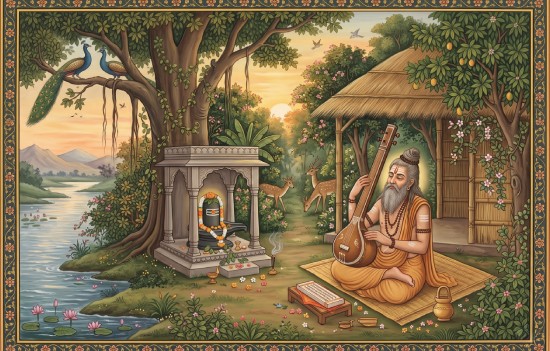
intensely devotional (Bhakti) ethos largely unruptured. Examining this unique historical trajectory of North Indian classical music—as geopolitical pressures compelled its journey from sacred temple sanctums to the feudal enclosures of medieval courts, and ultimately into the commercial marketplace of today—reveals an urgent civilisational need to restore this sacred heritage to its original spiritual purpose.
 Created by AI.
1. The Metaphysical Foundation: Nada
Brahma and the Four Pillars of Dharma
In Sanatan philosophical treatises, sound is not merely an acoustic phenomenon; it is the primordial vibration of cosmic consciousness—Nada Brahma. Rooted in the Sama Veda and
codified in monumental works such as Bharata Muni’s Natya
Shastra and Sharngadeva’s 13th-century Sangita Ratnakara,
Bharatiya sangeet was considered an Upaveda (Gandharva Veda).
Sharngadeva
opens his authoritative text with an unequivocal invocation:
चैतन्यं सर्वभूतानां विवृतं जगदात्मना ।
नादब्रह्म तदानन्दमद्वितीयमुपास्महे ॥
(Sangita Ratnakara 1.1)
"We worship that Nada-Brahma, the divine consciousness manifest in all beings, the unexcelled bliss that sustains the cosmos."
Here,
vocalisation and instrumentation were designed to harmonise the subtle energy
centers (chakras) of the human body, leading the practitioner
from sonic vibration (Ahad Nada) to
unmanifest cosmic silence (Anahad Nada).
The Cyclical Erosion of Purity
This
sacred orientation must be understood through the lens of cyclical time (Yuga-Dharma). In the Manusmriti (1.81–82), Dharma is allegorised as a sacred bull (Vrishabha):
चतुष्पात् सकलो धर्मः सत्यं चैव कृते युगे ।
नाधर्मेणागमः कश्चिन्मनुष्यान् प्रति वर्तते ॥ ८१ ॥
इतरेष्वागमाद् धर्मः पादशस्त्ववरोपितः ।
चौर्यानृतमायाभिर्धर्मश्चापैति पादशः ॥ ८२ ॥
In
the golden age of Satya Yuga, Dharma stood steady upon four legs (Chatushpad):
Tapas (austerity), Shaucha (purity of
thought and sound), Daya (compassion), and Satya (truth). With
each passing epoch, human consciousness underwent moral and vibrational decline-becoming
Tripad in Treta, Dvipad in Dvapara, until in
our present Kaliyuga, where it totters precariously on a single fraying
limb: Satya (Srimad Bhagavatam 1.17.24).
As
cosmic purity declined, human arts gradually drifted away from rigorous
spiritual discipline toward worldly attachments.
2. The Ancient
Golden Era: Dev-Stuti in
the Temple Sanctuaries
Before
medieval political ruptures, North Indian classical music thrived inside temple
sanctums, monastic centers, and autonomous royal academies governed by Dharmic
kings.
1. The Prabandha and Dhrupad Linages: Early
classical music found expression through Prabandha-gana, which
evolved into the austere, meditative architecture of Dhruva-Pada (Dhrupad)—the "unwavering verse."
2. The Haveli Ecosystem: In
traditions like the Ashtachhap of the
Vallabh Sampradaya and the devotional circles of Swami Haridas in Nidhivan
(Vrindavan), the musician sat facing the deity. The compositions, set in pure
Sanskrit, Braj Bhasha, and Maithili, were pure Dev-Stuti—hymns dedicated to Mahadeva, Bhagwan Sri Krishna, Sri Rama, and Devi Saraswati.
When
Emperor Akbar reportedly traveled in disguise to Vrindavan to hear Swami
Haridas, he asked Tansen why the master’s music
sounded vastly superior to Tansen’s own virtuosic renditions. Tansen
replied with profound honesty:
"Jahanpanah, I sing to please an earthly sovereign on the throne of Delhi; my Guru sings solely for the Lord of the Universe."
3. The Imperial Court Era: The Shift to Nripa-Stuti (16th–18th Century)
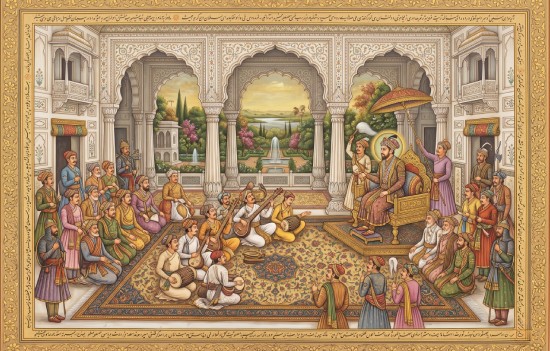
The
geopolitical incursions of the Delhi Sultanate and the Mughal Empire altered
the cultural landscape of northern Bharat. Massive desecration of historic
temple universities cut off traditional patronage networks for poets,
sculptors, and musicians.
Faced with existential survival, master musicians moved into royal darbars. While their technical genius kept the acoustic framework of ragas and talas intact, the soul of the art—the Sahitya (lyrical intent)—was radically transformed.
 Created by AI.
The Alteration of Identity: The ‘Miyan’ Prefix
The Persian court honorific ‘Miyan’ entered raga nomenclature when Akbar
appointed Ramtanu Pandey (Tansen) to his Navaratna court, granting him that
court title. Older, traditional ragas were re-labeled to reflect court
innovations:
a. Ancient Todi became Miyan
ki Todi,
b.
The Vedic monsoon melody Megh/Malhar became Miyan
ki Malhar,
c. Sarang became Miyan ki Sarang,
d. Later, Tansen's son Bilas Khan gave rise to Bilaskhani Todi,
The Khayal Revolution under Muhammad Shah "Rangila"
The most profound secularisation occurred during the reign of Mughal Emperor Muhammad Shah "Rangila" (reigned 1719–1748). The court discarded the meditative austerity of Dhrupad in favour of Khayal (from the Arabic/Persian for "imagination" or "whim").
Courtiers Niyamat Khan
(Sadarang)
and his nephew Feroz Khan (Adarang)
standardised hundreds of bandishes. To flatter the royal patron, they systematically
inserted his name into the Antara (second
verse), engineering a brazen fusion of political sycophancy (Prashasti)
and romantic longing (Shringara):
a. Raga
Bageshree
(Chhota Khayal):
Sthayi: "Kavan dhang tora man leenho re / Tu to chatur sujaan..."
Antara: "Sadarangile Muhammad Shah
salaamat / Jug jug jiyo Chhatrapati raja..."
The Historical Irony: A decadent
Mughal monarch was ironically hailed by Hindu court singers using the
indigenous, sacred sovereign title Chhatrapati Raja.
b. Raga
Yaman:
Antara: "Muhammad Shah rangeele baalam, tum sang neh lagaaye..."
The
Subversion: The
sublime devotional love (Madhurya Bhava) originally addressed to Krishna
was re-channeled to courtly hedonism.
|
|
Vedic / Temple Era (Dev-Stuti)
|
Medieval Court Era (Nripa-Stuti)
|
Modern/Commercial Era
|
|
Philosophical Goal
|
Moksha,
Nada Upasana, Self-Realization
|
Imperial
honor, sensual delight (Bhog-Vilas)
|
Monetary
gain, viral metrics, entertainment
|
|
Central Focus
|
Parabrahman,
Shiva, Krishna, Devi
|
The
King / Emperor (Akbar, Muhammad Shah)
|
Individual performer's ego, consumer market.
|
|
Dominant Form
|
Sama-gana,
Prabandha, Temple Dhrupad
|
Darbar
Dhrupad, Khayal, Thumri, Dadra
|
Khayal,
Fusion, Cinematic Light Classical.
|
|
Primary Patron
|
Temples,
Dharmic rulers, Rishis
|
Sultanate,
Mughal & Princely Courts
|
Mass
streaming platforms, corporate sponsors.
|
c. Raga
Darbari Kanada:
Originally
derived from the ancient Karnataka/Kanada ang, its court variant was preserved
with royal praises:
"Chhatrapati Akbar Shah chiranjeev raho, jaake tej se bhuvan ujiyaar..."
Extolling the "splendor" of an emperor whose conquests had brought catastrophic destruction to native strongholds like Chittorgarh.
Through these historical compromises, music was effectively
reduced from Dev-Stuti
(adoration of the Divine) to Nripa-Stuti
(flattery of the ruler).
Historical Evolution of Classical
Music
4. The Contemporary Dilemma: Ideological
Inertia and Commercialisation
With
the abolition of royal courts in independent Bharat, music transitioned into
mass concert halls, radio, and digital streaming. However, two lingering
challenges remain:
1. Unconscious
Continuation of Subjugation: Decades after independence, many
performers continue to sing panegyrics to medieval conquerors without
questioning the context or literary meaning, treating profound sahitya
as mere phonetic filler for displaying lightning-fast vocal runs (tans).
2. Commercial
Trivialisation: Driven by algorithmic trends, the sacred
stillness of raga development is frequently sacrificed for sheer auditory
fireworks, reducing an introspective discipline to disposable entertainment.
It must be noted with deep respect that amidst this
landscape, a dedicated minority of genuine classical masters, temple
practitioners, and devotional singers across Bharat continue to treat their art
as pure sadhana, selflessly safeguarding the spiritual sanctity of our musical
traditions.
5. The Path of Cultural Resurgence:
Reclaiming the Sacred Heritage
A
true civilisational resurgence cannot stop at political or economic milestones;
it demands a conscious purification and revival of our cultural expressions.
Restoring Bharatiya Sangeet to its true stature does not require dismantling
the intricate melodic grammar or the gharana disciplines developed over
centuries. Rather, it requires realigning the art with its foundational intent:
1. Re-sanctification of Sahitya (Lyrical Purity): Classical vocalists must consciously revive bandishes steeped in Upanishadic truths and classical Bhakti literature—the padas of Surdas, Tulsidas, Meerabai, Kabir, Purandara Dasa, and Tyagaraja.
A
historic precedent exists: in the early 20th century, Pandit Vishnu Digambar Paluskar boldly rescued classical music
from decadent quarters and reintroduced it to public life through sacred Ram-dhun and congregational singing.
2. Reviving Nada Upasana: Art must
be reclaimed as an instrument of inner transformation. Raga performance should
evoke Shanta, Bhakti, and Karuna rasas
rather than competitive showmanship.
3. Re-anchoring Music in Temple
Ecosystems:
Establishing sustained, community-backed temple music sabhas ensures that
younger generations experience classical music as a living, sacred offering (seva)
rather than a transactional commodity.
Author's Note
I do not write this as a certified musical expert or a
seasoned scholar, but simply as a humble rasika and a conscious inheritor of
our shared civilisational heritage. The thoughts articulated here reflect the
historical and cultural realities observable across the arts today. I bow in
deep reverence to all those dedicated gurus, classical exponents, and
devotional practitioners who continue to safeguard Bharatiya Sangeet as an
authentic path of sadhana.
To read all
articles by Author
To read all articles on
Indian Music
Also read
1.
Comparing
Hindustnai and Carnatic Music
2.
Hindustani Classical Music – its evolution and emotional synthesis