- This article defines who is a Bodhisattva, The Bodhisattva's Path: Key Stages and Practices. This includes Essential Conditions for Abhinīhāra. Next The Ten Pāramitās: Perfections of the Bodhisattva and The Ten Bhumis or stages of Purification.
Abstract
This paper explores the profound concept of the
Bodhisattva within Buddhist tradition, detailing the arduous yet compassionate
path undertaken for the liberation of all sentient beings. It delves into the
etymological roots of the term, the foundational stages of determination
(Abhinīhāra) and prophecy (Vyākaraṇa), and the rigorous cultivation of the Ten
Perfections (Pāramitās).
Furthermore, the paper examines the progressive spiritual development through the Ten Stages of Purification (Bhūmis), highlighting the Bodhisattva's unwavering commitment
to universal enlightenment over individual salvation. Drawing upon
traditional Buddhist texts, this study aims to present a clear and
comprehensive understanding of the Bodhisattva ideal in simple English.
1. Introduction
The Bodhisattva, an ideal personality in Buddhist tradition, embodies profound devotion to alleviating suffering and guiding all beings towards eternal bliss. This selfless being is always engaged in removing the suffering of others and leading them to a state of ultimate happiness. The Bodhisattva's journey is characterized by a complete absence of self-interest, focusing instead on the welfare of others (para).
Though spiritually advanced and capable of achieving
personal freedom at any moment, a Bodhisattva remains committed to a grander
ideal: “What is benefit in my being emancipated alone, when other beings are in
suffering? I will make a boat of righteousness and take the entire beings to
the other shore of the process of repeated existence.” 1 This unwavering resolve drives the Bodhisattva through countless
existences with tireless zeal and devotion.
2. Defining the Bodhisattva
2.1
Etymology
The term 'Bodhisattva' is a compound of two Sanskrit words: 'Bodhi' and 'Sattva'. 'Bodhi' signifies perfect Enlightenment, omniscience, and right knowledge. 'Sattva' translates to 'a being'.
Therefore, a Bodhisattva is fundamentally defined as a
being who strives for the attainment of perfect
enlightenment, not just for themselves, but for the benefit of all. 8
2.2 The Core
Ideal
The central tenet of the Bodhisattva ideal is profound altruism. The Bodhisattva's career begins as an ordinary individual who gradually fulfils the Ten Perfections (Pāramitās) in three distinct ways, progresses through ten stages of purification, and ultimately achieves Bodhi.
Throughout this extensive journey, the Bodhisattva
leads a virtuous life, inspiring others to follow suit, helping them purify
their minds, and freeing them from suffering. This commitment is rooted in the
understanding that true liberation is collective, not individual.
3. The Bodhisattva's Path: Key Stages and Practices
The path of a Bodhisattva is a structured and rigorous
spiritual endeavor, marked by specific determinations, prophecies, and the
cultivation of supreme virtues.
3.1
Abhinīhāra: The Perfect Determination
Abhinīhāra represents a perfect determination, a
resolute commitment to the Bodhisattva path. It is characterized by an intense
desire, unflagging enthusiasm, unyielding effort, continuous progress, and
complete devotion towards the ultimate goal of universal enlightenment.
A classic example is the story of Gautama Buddha in a past life as Sumedha Tāpasa. Upon encountering Dīpaṅkara Buddha, the first Buddha in that tradition, Sumedha was profoundly inspired and made a solemn resolution to achieve perfect enlightenment and become a Buddha himself. This moment marks the true beginning of a Bodhisattva's career. 8
3.1.1 Essential Conditions for Abhinīhāra
For the successful fulfilment of Abhinīhāra, eight
essential conditions are outlined: 2
1.
Human Existence: The aspirant must be born as a human being, as other species
like Garudas, Nāgas, or Devatās cannot attain Buddhahood.
2.
Masculine Gender: The potential Buddha must be of masculine gender, as neither
females nor those of indeterminate gender are considered capable of achieving
Buddhahood in that specific capacity.
3. Buddha-bīja: The presence of the 'seed of Buddhahood' (Buddha-bīja) within the individual is crucial. Dīpaṅkara Buddha recognized this potentiality and the 'sprout of Buddhahood' (Buddha-aṅkura) in Sumedha.
4.
Vision of a Buddha: The resolution to become a Buddha must be made in the
presence of a living Buddha to reach fruition. In the absence of a Buddha, this
vow can be made before a Cetiya (shrine) or under a Bodhi-Tree.
5. Recluse Life: The household life is considered full of distractions and impurities. Therefore, embracing the life of a recluse is deemed essential for the Bodhisattva's progress.
6. Eternal Qualities: The aspirant must possess specific eternal qualities, including the attainment of the five Rūpa-Jhānas (form absorptions), four Arūpa-Jhānas (formless absorptions), and five types of intuitive knowledge (Abhiññās).
7. Power of Sacrifice: Immense power of sacrifice (Adhikāra) is necessary, where actions are dominated by 'giving-up' and self-sacrifice, thereby accumulating spiritual strength.
8.
Chandatā: A strong, one-pointed determination for the attainment of Bodhi,
ensuring unwavering devotion to the goal.
3.2
Vyākaraṇa: The Auspicious Statement
Vyākaraṇa refers to an auspicious declaration made by
a Buddha, foretelling the future enlightenment of a Bodhisattva. The Buddha,
with profound insight, observes the aspirant and analyzes their future,
recognizing their accumulated spiritual potential. Based on this, the Buddha
makes a prophecy, stating that the individual will attain Bodhi and become a
Buddha after a specific period.
For instance, Dīpaṅkara Buddha, seeing Sumedha Tāpasa
lying on a waterlogged road, was moved by his vast merits and spontaneously
declared that Sumedha would become a Buddha after “Four Asaṅkheya and one Lakh
years.” 8 Such a prophetic statement is known as Vyākaraṇa.
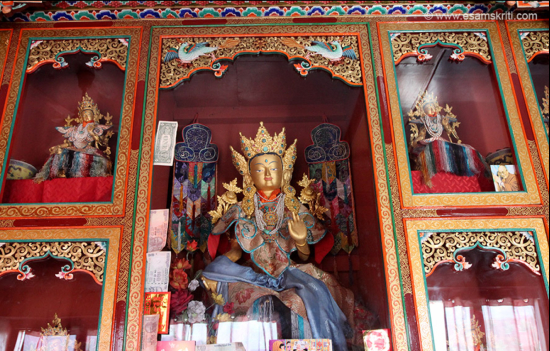 Centre of pic is Guru Rinpoche, Thiksey Monastery Leh, considered a Bodhisattva. 2016.
3.3 The Ten
Pāramitās: Perfections of the Bodhisattva
The Pāramitās, or perfections, are the ten virtues that a Bodhisattva cultivates and brings to utmost maturity over countless lifetimes. These are considered the 'Buddhakāraka-guṇa'—the qualities that lead to Buddhahood. 3 and 8
3.3.1 List and Explanation of the Ten
Pāramitās
1. Dāna-pāramitā (Perfection in Giving Alms): This involves the practice of generosity, giving without expectation of return, even sacrificing one's own possessions or life for the welfare of others. 4
2.
Sīla-pāramitā (Perfection of Following Moral Precepts): Adherence to ethical
conduct and moral principles, leading to purity of action, speech, and thought.
3.
Naiskramya-pāramitā (Perfection in Renouncing Household Life): The practice of
detachment from worldly desires and the adoption of an ascetic or monastic
life, conducive to spiritual development.
4. Prajñā-pāramitā (Perfection in Right Understanding): The development of profound wisdom and insight into the true nature of reality, leading to the eradication of ignorance.
5.
Vīrya-pāramitā (Perfection in Acquiring Vast Power/Effort): Unwavering energy,
perseverance, and diligent effort in pursuing the path to enlightenment and
helping others.
6.
Kṣānti-pāramitā (Perfection in Forbearance): The cultivation of patience,
tolerance, and endurance in the face of adversity, criticism, or suffering.
7.
Satya-pāramitā (Perfection in Penetrating into the Truth): Commitment to
truthfulness and integrity in all aspects of life, leading to a clear
understanding of ultimate reality.
8.
Adhiṣṭṭhāna-pāramitā (Perfection in Developing Strong Determination for Good):
Firm resolve and unshakeable determination to achieve noble goals and benefit
all beings.
9.
Maitrī-pāramitā (Perfection in Developing Perfect Friendliness for All Beings):
The cultivation of boundless loving-kindness and goodwill towards all sentient
beings, without discrimination.
10.
Upekṣā-pāramitā (Perfection in Developing Indifference Towards Pleasure and
Pain): The attainment of equanimity, a balanced and impartial mental state that
remains undisturbed by worldly fluctuations of happiness and sorrow.
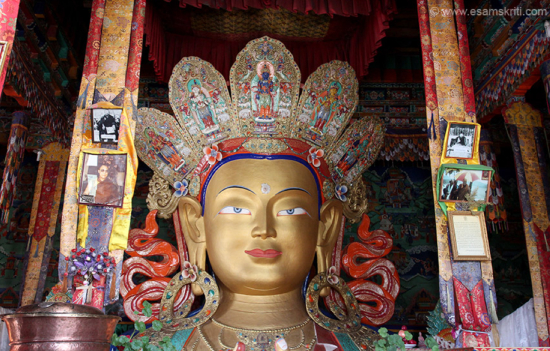 Maitreya or Future Buddha, Thiksey Monastery, Ladakh. 2016.
3.3.2 Levels of Pāramitā Fulfillment
Each Pāramitā is fulfilled at three progressive
levels: 5
1.
Pāramitā: The sacrifice of an organ of the body for the benefit of others.
2.
Upapāramitā: The sacrifice of material possessions or things for the welfare of
others.
3. Paramārtha-pāramitā: The ultimate sacrifice, offering one's own life for the sake of others.
A Bodhisattva meticulously fulfils each perfection to
its highest degree, demonstrating a comprehensive understanding from beginning
to end, and from end to beginning, ensuring these virtues become an intrinsic
part of their being. 8
3.3.3 Evolution of Pāramitā Concepts
The concept of Pāramitās has evolved across different
Buddhist traditions.
While early Piṭaka literature acknowledges the
concept, the precise number was not always clear. The Buddhavamsa
explicitly lists ten Pāramitās. 3 In contrast, Asaṅga, a prominent figure in Mahāyāna Buddhism, described six Pāramitās: Dāna (generosity), Sīla (morality), Śānti (patience), Vīrya (effort), Dhyāna (meditation), and Prajñā (wisdom) [8].
Each of these six plays a specific role: Dāna alleviates poverty, Sīla extinguishes impurities, Śānti eliminates anger, Vīrya accumulates moral impressions, Dhyāna stabilizes the mind, and Prajñā dispels ignorance, leading to clarity about reality. 8
The Dasabhūmika-sūtra also presents a list of ten Pāramitās, retaining the initial six and adding four more: Upāyakausalya (skillful means), Praṇidhāna (vow), Bala (power), and Jñāna (knowledge) [8]. It is generally understood that the six Pāramitās represent an earlier formulation, with subsequent additions and variations being integrated over time.
3.4 The Ten
Bhūmis: Stages of Purification
The Bodhisattva's spiritual journey is further delineated by ten stages of purification, known as Bhūmis (grounds or levels), through which they progressively advance towards Buddhahood.6/8 These stages represent increasing
levels of spiritual maturity and insight:
1.
Pramudita-Bhūmi (Joyful Stage): The Bodhisattva experiences great joy upon
realizing the path to enlightenment and committing to the welfare of all
beings.
2.
Vimala-Bhūmi (Immaculate Stage): All moral defilements and impurities are
cleansed, leading to a state of pristine purity.
3.
Prabhākari-Bhūmi (Illuminating Stage): The Bodhisattva radiates the light of
Dharma, illuminating the path for others.
4.
Arcismati-Bhūmi (Effulgent Stage): Characterized by intense spiritual radiance
and the burning away of remaining defilements.
5.
Sudurajaya-Bhūmi (Very Difficult to Conquer Stage): This stage involves
overcoming deeply ingrained obstacles and subtle delusions, requiring immense
effort.
6.
Abhimukhi-Bhūmi (Face-to-Face Stage): The Bodhisattva directly confronts and
understands the nature of dependent origination and emptiness.
7.
Durangama-Bhūmi (Far-Going Stage): The Bodhisattva develops advanced skillful
means and compassion, capable of reaching out to countless beings across vast
distances.
8.
Acala-Bhūmi (Immovable Stage): The Bodhisattva achieves an unshakeable resolve
and stability in their commitment to enlightenment, free from all wavering.
9.
Sādhumati-Bhūmi (Stage of Good Beings): The Bodhisattva develops perfect wisdom
and the ability to teach and guide others effectively.
10.
Dharmamegha-Bhūmi (Cloud of the Doctrine Stage): The final stage, where the
Bodhisattva is fully imbued with the Dharma, like a cloud ready to shower its
wisdom upon the world, leading to the attainment of Tathāgata-Bhūmi, the stage
of a perfectly Enlightened Buddha. 8
4. Conclusion
The Bodhisattva ideal
represents a pinnacle of compassion and wisdom within Buddhist philosophy. It
outlines a rigorous, multi-faceted path of self-cultivation and selfless
service, driven by the profound vow to liberate all sentient beings from
suffering.
Through the
steadfast cultivation of perfect determination
(Abhinīhāra), the recognition of their future enlightenment through prophecy
(Vyākaraṇa), the meticulous practice of the Ten Perfections (Pāramitās), and
the progressive advancement through the Ten Stages of Purification (Bhūmis),
the Bodhisattva embodies the ultimate journey towards universal enlightenment.
This ideal serves as an enduring inspiration,
demonstrating that the pursuit of individual
liberation is inextricably linked with the liberation of all.
References
1. N.K. 34. Saṃsārasotaṃ chinditvā, viddhaṃsitvā tayo
bhave, Dhammanāvaṃ samāruyha, Santāressaṃ sadevake.
2. N.K. 34. Manussattaṃ Liṅgasampatti,
Hetu-satthāra-dassanaṃ. Pabbajjā Guṇasampatti, Adhikāro ca chandatā.
3. B.V. 304. Dānaṃ sīlaṃ ca nekkhaṃmaṃ, Paññā-viriyaṃ ca kīdisaṃ, Khanti-saccaṃmadhiṭṭhānaṃ, Mettupekkkhā ca kīdisā.
4. N.K. 112. Bhikkhāya upagataṃ disvā, Sakattānaṃ
pariccaji, Dānena me samo natthi, Esā me dānapāramī.
5. N.K. 62. Aṅgapariccāgo pāramiyo nāma,
Bāhirabhaṇḍa-pariccāgo upa-pāramiyo nāma, Jīvitapariccāgo paramatthapāramiyo
nāmāti.
6. Div., 127, 490; Lal., 363, 475.
7. Mahāyāna-sūtrālaṅkāra - 13,16.
8. Har Dayal.The Bodhisattva Doctrine
in Buddhist Sanskrit Literature.
Author - is Dean
School of Buddhist Philosophy, Head Department of Buddhist Studies and
Department of Foreign Languages, Sanchi University of Buddhist-Indic Studies,
Sanchi, Raisen, Madhya Pradesh, India.
Who
is a Bodhisattva - In Thervada and Mahayana Buddhism
Also read
1. Evolution of Buddhism in India
2. Samkhya and Buddhism
3. Buddha and his Message by Swami Vivekananda
4. Introduction to Buddhism
5. Bodhisattva – Ideals, Practices and Characteristics
6. What is a Bodhisattva
7. Bodhisattva of Compassion