- This
FAQ tells how was Hinduism become accepted as a religion in Indonesia, how can
Hinduism be monotheistic if it has so many Gods and briefly what is Brahman as
explained in The Holy Gita. Hindus adjust everywhere!
Prime
Minister Modi recent visit to Prambanan Shiv Temple in Indonesia and the Puja
there attracted a lot of media attention in India. We recently published a
photo feature on Prambanan Temple. Read Here
I wondered if Hinduism was accepted as a religion in Muslim majority Indonesia. eSams author Sanjay, who lived in Indonesia for years, told me a while ago that Hinduism’s acceptance as a religion is of recent origin actually in 1962.
To
obtain government approval as a religion in Indonesia one had prove that
Hinduism was monotheistic. Given that Hinduism
has a number of Gods wondered how they proved it for e.g. pratimas from Prambanan
Shiv Temple-
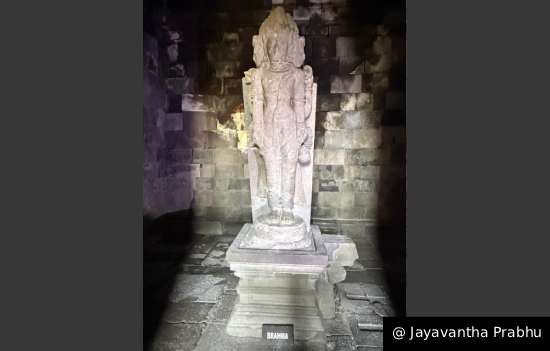 Brahma.
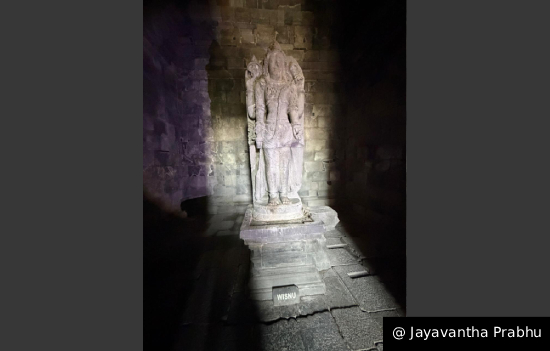 Vishnu.
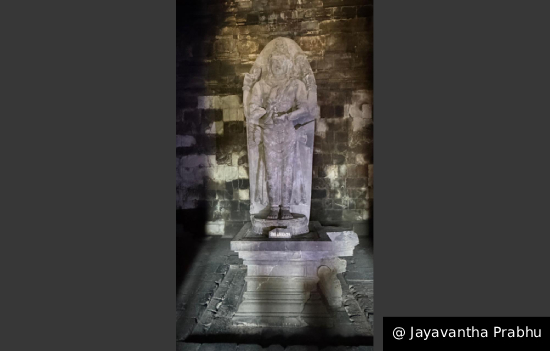 Mahesh.
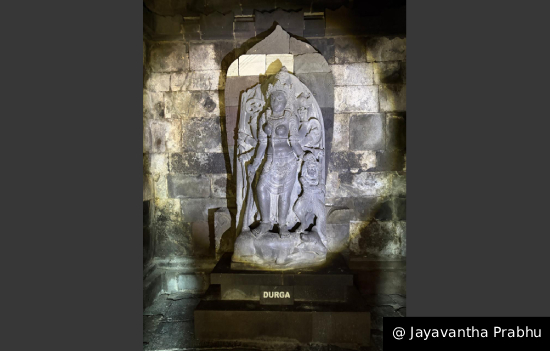 Durga.
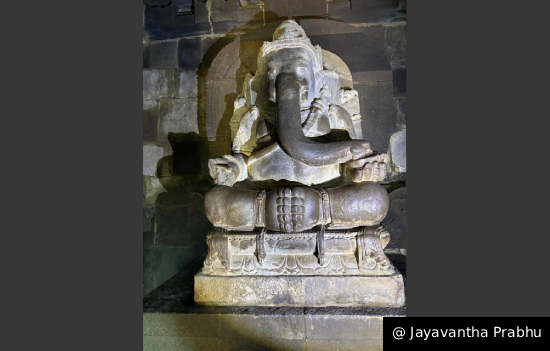 Ganesha.
How can Hinduism be monotheistic if it has so many Gods?
Ed.
Vishwanathan wrote in Am I a Hindu, “As per the Christian, everything came from the Word, and the Word was God. So also, in Hinduism we believe everything came from Brahman, and Brahman is God. The vibratory aspect of Brahman is called AUM. From Om came the Mother God and the Godhead i.e. Trinity i.e. Brahma, Vishnu and Shiva.” Pg. 207 “The Trinity aspect of God exists in Christianity too where it expressed as, God the father, God the son, God the Holy Spirit.” Pg. 209 Read Concept of God in Christianity
& Sanatana Dharma
Does Hinduism believe in one God-monotheism and how does it
co-exist with polytheism?
I earlier wrote, “Yes. A Hindu accepts the Supreme Being both in his saguna (with
attributes) and nirguna (without
attributes). The Vedas call Him Brahman or Parmatma. ‘Tat Tvam Asi’ or ‘That thou art’ means ‘I am Brahman’. ‘Tat Tvam Asi’ is from the Chandogya Upanishad. The Harihara icons in
which Vishnu and Siva are entwined, rest on the principle that the Ultimate
Reality is one.
“Hindus believe that within everybody is an imperishable soul called Atman. This soul is part of the universal soul Paramatman or Brahman.” The subject experience of Brahman is called Sat-Chit-Ananda or “Being Consciousness, Bliss.”
It is pure
consciousness or our true nature and means freedom from the cycle of birth and
rebirth. In Baudhic thought, it is called Shunyata which means atma (used for
simplicity) is pure, not associated with any karma or thought that makes
rebirth necessary.” 1
““Ekam Sat Vipra Bahudha Vadanti” is a sutra quoted from the Upanishads. It means: “That which exists is ONE sages call it by various names.” 1
A few weeks ago
read a good article by V K
George
in The Hindu that told how Hinduism
was accepted as a religion. To get official recognition the temple asserted
that Hinduism is a monotheistic religion. The trimurthi pratima that you saw
above are symbols of one Supreme God. We must note that, strictly speaking, Hinduism is henotheistic and not monistic. Monotheism is an Abrahamic concept. But for purposes of simplicity, monotheism is used here.
How was
Hinduism accepted as a religion in Indonesia?
George wrote, “Initially there was confusion after Indonesia’s independence in 1945. The founding principle of the modern Indonesian state has five components (Pancasila-5), and the first is monotheism, or faith in one supreme god. Dharma (later Parisada Hindu Dharma Indonesia, PHDI), founded in Bali in 1959, and reframed Balinese practice around a single supreme deity, Sang Hyang Widhi Wasa.” Read What
is the significance of Number FIVE in Indian Faiths
For
details read Ami Ganatra blog, “The first step was to define key principles of Hinduism. Just like the 10 commandments of Christianity and five pillars of Islam (arkān al-Islām), five overarching beliefs for Indonesian Hinduism were stated. Named Panca Shraddha, the principles drew heavily from the booklet of Shri Narendra Dev Shastri-Dasa Sila Agama Bali. For one
to be Hindu, she needs to profess shraddha (faith) in the following five
concepts -
1.
Sang Hyan Widhi - One Almighty God Almighty,
2.
Atman - Existence of Atman or spirit in every creature,
3.
Karmaphala - Every action has a consequence (karma theory),
4.
Punar Bhawa - Reincarnation or rebirth after death,
5.
Moksha - Complete liberation from the cycle of birth and death consequence of
good and detached conduct when alive.
Essentially,
the same concepts of Dharma that we associate with in India too. To get around
this issue of many Gods, a supreme Almighty God was re-imagined as a unity of
the Tri-murti of Brahma Vishnu Shiva. This unifying entity was called Sang
Hyang Widhi Wasa or Acintya (अचिन्त्य). Acintya is that which is beyond human imagination, rather that which transcends human imagination. In this sense, it is actually not different from Brahman. Note the dual connotation of ‘Sangh Hyang Widhi’. It could imply ‘Divine ruler of the Universe’ as well as ‘Divine, Absolute Cosmic Law’. In the former, it satisfies the first Pancasila. In the latter, it equates to Dharma thus retaining its Sanatan essence.
Shaivite
Hindus had used term Sang Hyang Widhi from before, but, for Shiva.
On the lines of Islamic Namaz read five times a day, Hindu scholars defined Puja Tri-Sandhya to be performed three times a day – at dawn, at noon and at dusk.”
Formation of Parishada Hindu Dharma Indonesia (PHDI) as the foremost body for Hindus has helped strengthen the unity further and has given the community some clout in dealing with the government.”
Hindus adjust everywhere. Do others do? Indonesia
is a Muslim country that respects its past Hindu culture.
What is Brahman as explained in The Holy Gita?
eSams author Dr Subhasis wrote, “Brahman is the oblation; Brahman is the clarified butter, etc., constituting the offerings; by Brahman is the oblation poured into the fire of Brahman; Brahman verily shall be reached by him who always sees Brahman in all actions.” (Ch 4, Verse 24-Translated by Gurudev Swami Chinmayananda)
There is none other than Brahman. This
is the message of the Bhagavad Gita and of all our Scriptures.
There is but the One who manifests as the many. Our Agamas and Tantras too reiterate this Truth.”
Gurudev wrote, “This is a famous stanza i.e. chanted throughout India as a prayer at the table before Hindus eat their meals.”
If
Hindus of Indonesia had not explained the essence of Sanatana Dharma and adjusted,
no Hindus might have existed in Indonesia today.
Also
read
1. Comparing
Indic vs Abrahamic Faiths - A Primer
2.
Post
Independence Hindu Renaissance in Indonesia by Ami Ganatra
3.
Islamization
of Indonesia
4.
Ganesha
Temples in Indonesia
5.
Sanskrit,
Bhasha
6.
Historical
Ties India Indonesia
7.
Meet
Hindus of East Java
8.
Ramayan
performance at Prambanan Temple
9. History of Prambanan Temple - Indian Express