- The making of the Shri Ram Mandir, Ayodhya is only
the first step. It is now important to visualise how Ayodhya can re-build and
strengthen the Civilization in India and other countries of Southeast Asia where
Ramayana continues to be part of their heritage. Author outlines Three Circles
of Responsibility.
The Lesson of Somnath
There
is an important lesson from independent Bharat that must not be forgotten:
Somnath Mandir.
After
Independence, the reconstruction of Somnath Mandir became a powerful expression
of civilizational recovery. Sardar Vallabhbhai Patel supported its
reconstruction, while K. M. Munshi played a central role in carrying the
project forward. The reconstruction ultimately became a public and
institutional effort, rather than simply a project of the state.
The
initiative also generated considerable debate. Prime Minister Jawaharlal Nehru
was uncomfortable with the participation of the President in the inauguration,
reflecting his concern about the relationship between the modern Indian state
and expressions of civilizational revival. President Rajendra Prasad
nevertheless attended the consecration in May 1951.
The Somnath Mandir was rebuilt. The consecration took place. A
historic civilizational task was been accomplished.
But,
perhaps the larger lesson of Somnath lies not merely in what was achieved, but
in what should have followed.
The
reconstruction of a Mandir cannot, by itself, be the final objective of a
civilizational movement. The reclamation of a sacred institution must become
the beginning of a wider programme of renewal - of Dharmic education,
scholarship, traditional knowledge, sacred geography, cultural institutions,
Mandir institutions and Hindu social organisation.
Somnath
was reclaimed but the achievement did not
fully transform into a comprehensive, long-term civilizational programme. That
is the lesson Ayodhya must absorb.
The Lesson of Ayodhya
Every
great civilizational movement must learn to think beyond achievement.
A
civilisation cannot stop after reclaiming an institution. It must ask how that
institution will be sustained, what it will nurture, and what it will make
possible for generations to come.
The
reclamation of Shri Ram Janmabhoomi has been one of the defining civilizational
movements of modern Indian history. The construction and consecration of Shri
Ram Mandir represent the fulfilment of a centuries-old aspiration.
However, the
completion of the Mandir should not be understood as the conclusion of that
journey but be understood as the beginning of a new
responsibility.
We
cannot rewrite what happened after Somnath but can learn from it.
The
question before Ayodhya ji is therefore no longer merely whether Shri Ram Mandir
has been reclaimed. The question is what
Shri Ram Mandir will enable Hindu civilisation to build next.
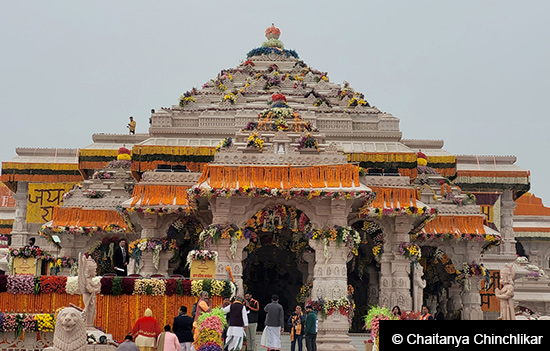 Shri Ram Mandir, Ayodhya. 2024.
From Mandir to Civilizational
Institution
A
Mandir becomes a civilizational institution when its influence extends beyond
its walls and its Dharma extends beyond its rituals. Its responsibility cannot
end at the Garbha Griha.
The
reconstruction of Shri Ram Mandir has created a new centre of civilizational
gravity. Every important decision taken in Ayodhya ji now has the potential to
influence the future direction of Hindu civilisation and not merely the pilgrims
who visit the city.
The
reclamation of Shri Ram Janmabhoomi therefore marks not the end of a
civilizational journey, but the beginning of a new responsibility.
The
question before Hindu society is no longer whether Shri Ram Mandir should
exist. It exists. The question is no longer merely how it should be protected. It
must be protected.
The
bigger question is - What will we build around it, through it and because of
it?
A
Mandir can be reclaimed in one generation. Its traditions may need to be
transmitted across a hundred generations.
A
structure can be completed by architects and engineers but a civilisation
around that structure must be built by Acharyas, scholars, devotees, educators,
families, administrators, institutions and society.
That
requires more than preservation. It requires scholarship, institutional
imagination and inter-generational thinking.
It
requires us to understand Shri Ram Mandir not merely as a completed structure,
but as a living civilizational institution whose influence can extend far
beyond its walls and across generations.
The
question, therefore, is not simply what Ayodhya has regained. It is what
Ayodhya can now create.
That
responsibility unfolds through three expanding circles.
The First Circle: Ayodhya ji
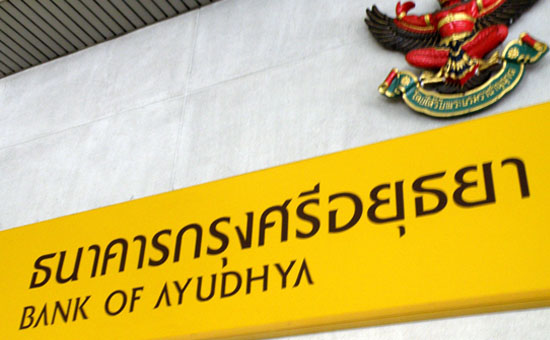 Bank of Ayudhya, Sukumwit Street, Bangkok, Thailand. 2009.
Every
civilisation requires a centre. For Hindu civilisation, Ayodhya ji is not
merely a sacred city. It is a living symbol of Shri Ram, a sacred geography and
now a visible centre of civilizational renewal.
The
first responsibility of Shri Ram Mandir therefore begins at home.
Ayodhya
ji must evolve into a centre of Dharma, scholarship, Gurukul education,
research, civilizational memory, cultural preservation and institutional
leadership.
The
rebuilding of Ayodhya ji cannot end with roads, airports, hotels and pilgrim
facilities. These are necessary foundations but infrastructure alone does not
create a civilizational centre.
A civilizational centre requires institutions that generate
knowledge, transmit traditions, nurture scholars, educate generations and
preserve memory.
Ayodhya
ji must therefore aspire to produce institutions capable of sustaining Hindu
civilisation for centuries to come.
This
is the First Circle of Responsibility.
The Second Circle: Bharat
The
responsibility of Shri Ram Mandir does not end at the boundaries of Ayodhya ji.
For
millions of Hindus, Ayodhya ji represents an ideal. What develops there - its
institutions, scholarship, priorities and leadership - will inevitably
influence Mandirs, educational institutions, scholars, devotees and
policymakers throughout Bharat.
Shri
Ram Mandir must therefore become a source of guidance, scholarship, inspiration
and civilizational confidence for the entire nation.
It
can help strengthen the wider Mandir ecosystem, encourage Dharmic education,
support traditional knowledge systems, preserve civilizational memory, nurture
Acharyas and scholars, and contribute to the cultural renewal of Bharat.
The
responsibility is not to create one exceptional Mandir in one exceptional city
but to create an ecosystem in which Mandirs across Bharat are able to
rediscover and fulfil their wider civilizational role.
This
is the Second Circle of Responsibility.
The Third Circle: The Global Ramayana
Civilization
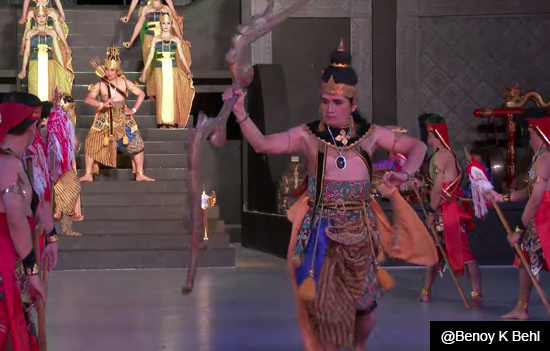 Ramayana performance in Southeast Asia. Pic by Benoy K Behl.
The
story of Bhagwan Shri Ram does not end at the borders of Bharat.
Across
Nepal, Indonesia, Thailand, Cambodia, Laos, Malaysia, Mauritius, Fiji, Trinidad
and Tobago, Suriname, Guyana, South Africa, the United Kingdom, North America
and many other parts of the world, the Ramayana continues to shape identities,
traditions, festivals, literature, performing arts and collective memory.
Read Ramayana
performances in Southeast Asia and India
Millions
who may never visit Ayodhya ji nevertheless regard Shri Ram as part of their
civilizational inheritance.
For
them, Ayodhya ji is not merely a city. It is a sacred civilizational reference
point.
The
responsibility of Shri Ram Mandir therefore extends beyond Bharat itself.
Ayodhya ji can become a place that helps nurture, connect, document and
strengthen the worldwide Ramayana tradition.
It
can become a meeting point for scholars, artists, practitioners, communities
and institutions that have preserved different expressions of the Ramayana
across centuries and continents.
The
Mandir rebuilt after centuries of aspiration can become a source of strength
and connection for all those who continue to preserve the legacy of Shri Ram
across the world.
This
is the Third Circle of Responsibility.
Three Circles, One Responsibility
These
three circles should not be understood as three geographical markets of
influence. They are three expanding circles of responsibility.
Ayodhya ji → Bharat → Global Ramayana Civilization.
The
movement is geographical, but its deeper meaning is civilizational.
What
begins in Ayodhya ji must strengthen Bharat.
What
strengthens Bharat can enrich the wider Ramayana world.
And
what is preserved across the global Ramayana civilization can, in turn, deepen
Bharat's own understanding of its civilizational inheritance. The circles
therefore are not separate. They are interconnected.
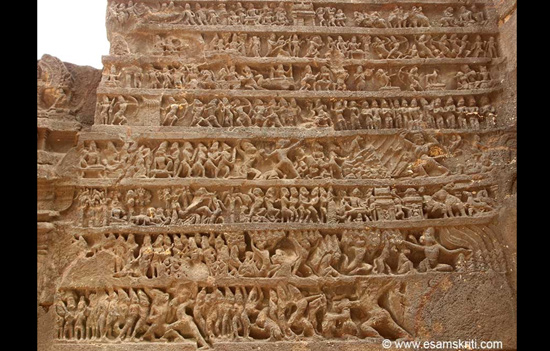 Ramayana Panel at Kailasa Temple, Ellora.
The Way Forward
The
Mandir of stone is now complete. The larger work has only begun.
The
task before our generation is to ensure that Ayodhya becomes more than a
destination for pilgrims. It must become a centre of Dharma, knowledge, culture,
scholarship, Seva and civilizational confidence - first for Ayodhya ji, then
for Bharat, and ultimately for the global Ramayana civilization.
A
structure can be completed in one generation. A civilisation must think in
centuries.
The
reclamation of Ayodhya gave us the Mandir. The responsibility of our generation
is to give that Mandir a civilizational future.
That
is Ayodhya: The Way Forward.
Author Sandeep Singh is author
of Temple Economics and A Decade for Mandir. This article is based on his forthcoming
book, Ayodhya: The Way Forward.
Also read
1.
Experience
of Ayodhya Ram Mandir Pran Pratishtha held on January 22 2024
2.
Why
is making of Ram Mandir important for Asia
3.
Architecture
of Sri Ram Mandir