- This photo feature
has some excellent pics on Bordubudur and tells you about the monument in
brief.
Photographs &
Inputs by Jayavantha Prabhu. To make photo feature more complete included a few
pics from Photodharma.net and Shutterstock.
There is a specific kind of silence that exists only at the summit of Borobudur just before the tropical sun breaks over the Kedu Plain. It is a silence that has persisted since the 8th century, when the Shailendra Dynasty first envisioned this massive volcanic "spiritual stairmaster."
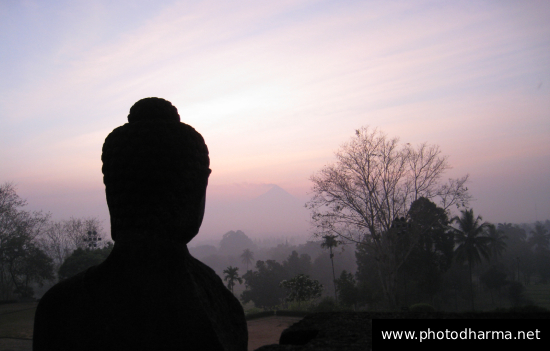
For the modern traveller, Borobudur is not merely a destination; it is a physical process of shedding worldly weight. As we approach the base of this world’s largest Buddhist monument, we are greeted by the Kamadhatu, the realm of desires, where 160 hidden relief panels
depict the messy, often karmically complicated laws of human cause and effect.
It is a grounded beginning to a journey that aims for the stars, reminding us
that every path to enlightenment starts in the mud of our daily existence.
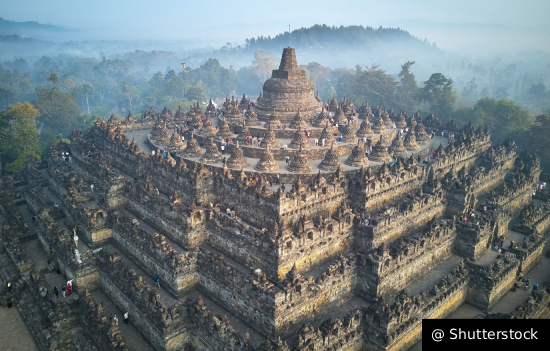 See note at end of piece.
 As the narrative
of the stone begins to flow, we find ourselves ascending into the Rupadhatu, the sphere of
forms. Here, the architecture shifts into five square terraces, lined with
galleries that feel like an endless, silent library of the soul. The Lalitavistara reliefs
wrap around these walls, meticulously narrating the life of Prince Siddhartha
from his miraculous birth to his eventual enlightenment under a Bodhi tree. To
walk these corridors is to witness the evolution of a man into a deity, carved
with a Javanese aesthetic that softens the austere lines of traditional
Buddhist art into something more organic and relatable.
One cannot help
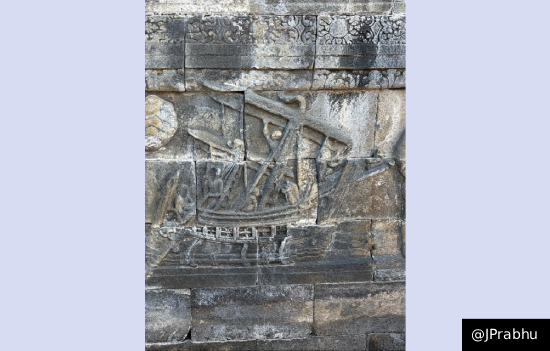
but marvel at the Borobudur
Ship reliefs - these intricate carvings of 8th-century outrigger vessels
are more than art; they are historical evidence of the maritime prowess that
once allowed our shared cultures to traverse the Indian Ocean with ease.
The transition to
the upper circular terraces, the Arupadhatu, is a deliberate architectural shock. The square,
gallery-lined paths vanish, replaced by three open circular platforms that
signify the formless realm. Here, the soul is meant to detach from all earthly
forms.
We were surrounded
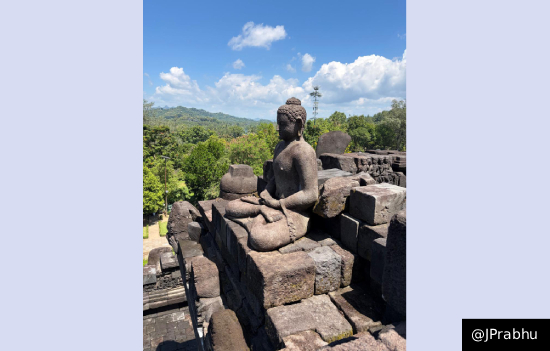
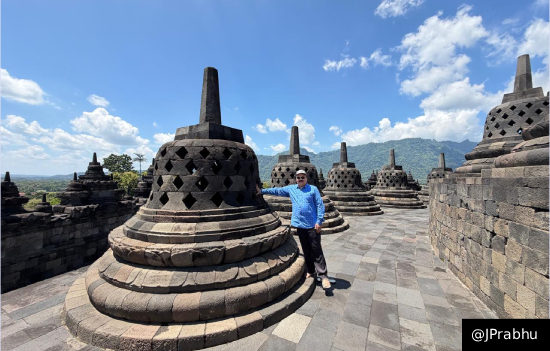
by 72 perforated,
bell-shaped stupas, each housing a seated Buddha statue that gazes out
toward the surrounding volcanoes.
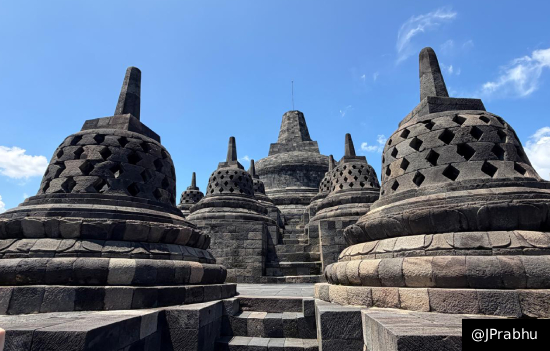
The effect is
mesmerizing - a panoramic 360-degree view that places the traveller at the very
center of a stone mandala. Crowning this entire structure is the Great Stupa, a massive,
empty central dome. It stands as a profound architectural statement: at the
pinnacle of knowledge, there is no form, only the void of Nirvana.
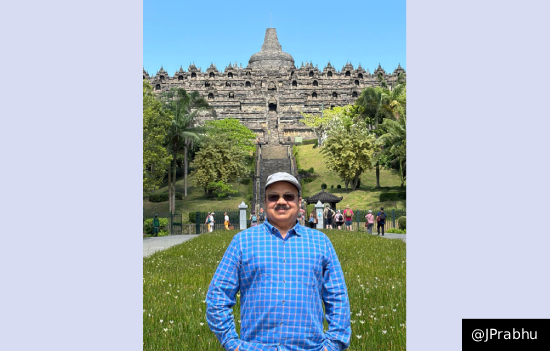
For our global
peers planning a visit from London, New York, or Mumbai, the logistics of 2026
have become quite precise. Access to the temple structure is strictly capped at
1,200 visitors per day, which means your "pilgrimage" must be booked through the official portal at least a week in advance.
You will be
provided with Upanat
sandals, specifically designed to prevent the erosion of the ancient
andesite stone by the thousands of modern feet that tread upon it. The best
strategy is to aim for the 8:30 AM slot, allowing you to experience the morning mist (and a relatively cool 26°C) before the Javanese humidity begins its afternoon ascent toward 34°C.
The journey to
Central Java is significantly streamlined with the opening of the Yogyakarta International
Airport (YIA). While those coming from India will likely transit
through Singapore or Kuala Lumpur, the new airport handles international
arrivals with impressive efficiency.
Ensure your Visa on Arrival (VoA)
is handled via the e-VoA portal to skip the long queues, and keep your SATUSEHAT health declaration ready on your phone.
To truly capture
the essence of Borobudur, plan your trip for the dry season between May and September, when the clear skies allow the volcanic peaks of Merapi and Merbabu to stand as silent guardians over your morning meditation. Useful links –
1. Official Temple Ticketing (Borobudur &
Prambanan): borobudurpark.com — This is the only place to secure your specific time-slot for the Borobudur climb.
2. Indonesian e-Visa (e-VoA): molina.imigrasi.go.id — Use this to skip the physical "Visa on Arrival" queues at the airport.
3. SATUSEHAT Health Declaration: satusehat.kemkes.go.id — The mandatory portal for your health pass, required within 72 hours of your flight.
4. Indonesian Electronic Customs Declaration (e-CD): ecd.beacukai.go.id — Complete this online before you land to breeze through the "Nothing to Declare" green channel.
5. Yogyakarta International Airport (YIA): yogyakarta-airport.co.id — For checking real-time flight statuses and ground transport options like the airport train.
Pro Tip: Download the SATUSEHAT and Grab (for local transport) apps before you leave India. They are the "Swiss Army knives" of modern Indonesian travel.
We now present
more photos. Most pics from J Prabhu. Some from photodharma.net
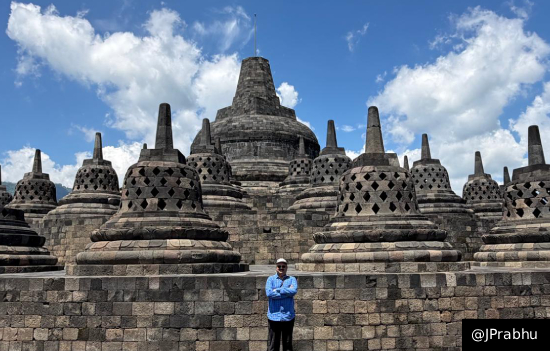 Bell shaped stupas – behind is Great Stupa.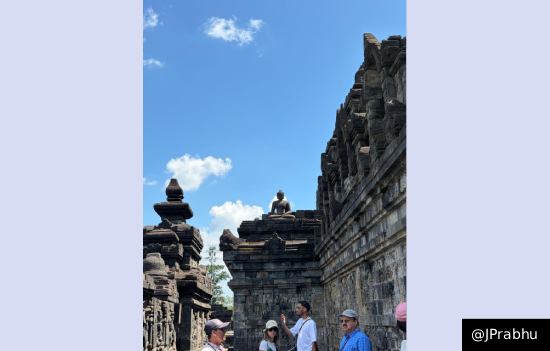
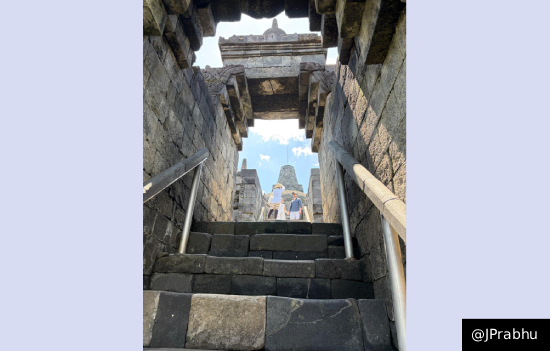 View of Great Stupa (centre) whilst climbing the steps.
 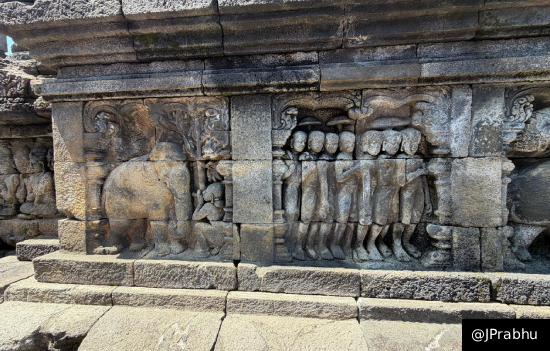 Reliefs.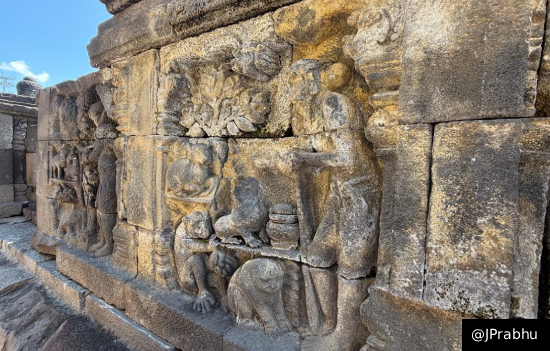
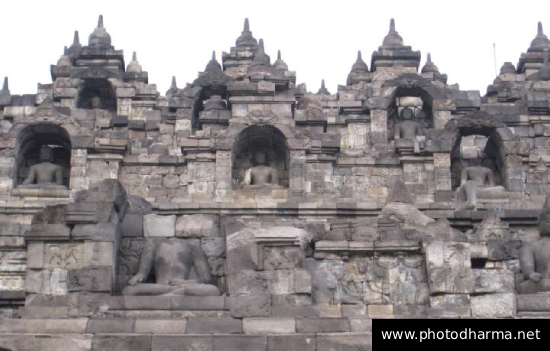 Many Buddhas.
 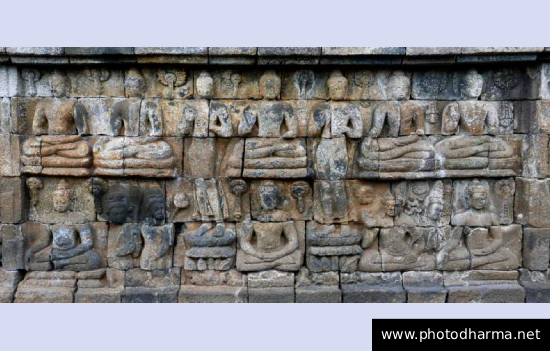 Ten Buddhas. “The first relief depicts the Buddhas of the ten directions.”
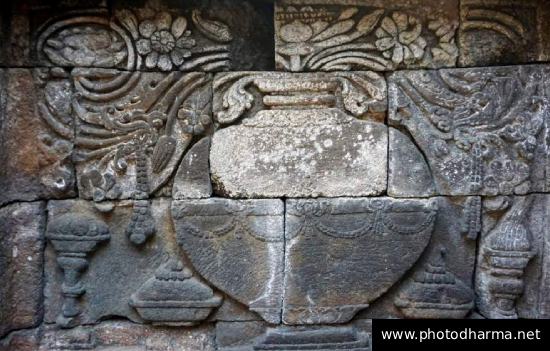 Photographer calls its Flower Vaze. Looks like a Kalash.
 To read travelogues by author Ankur Gupta
Bordubudur Stupa – 4 levels to the Final Truth
Ganesha Temples in
Indonesia
Video Everything you need to know whilst
visiting Borubudur
12.53 minutes
Yatra to Mount
Bromo, named after Brahma
Album Prambanam
Temple in Indonesia
Close-up pic of
Borubudur is from Wanderlust
magazine and courtesy Shutterstock