- This article makes a case for the Buddhist Circuit Tourist Train, run by the Indian Railways, to include Sanchi near Bhopal. “Sanchi, the oldest Buddhist sanctuary dating back to the 3rd century BCE under Emperor Ashoka, stands as the architectural prototype that inspired stupas across Asia.”
In 2024 author Namrata W wrote
wonderful
experience with the Buddhist Circuit Tourist Train The seven day rail trip
covers places associated with Buddha in Uttar Pradesh, Bihar and Nepal. The key
places covered in this order were Gaya, Rajgir, Nalanda, Sarnath (Varanasi) Lumbini,
Kushinagar, Shravasti, Agra ending at Delhi. IRCTC link Agra not associated
with Buddha.
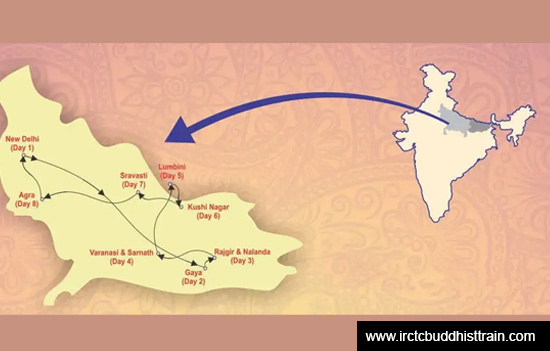 Map shows route.
The 2026 Annual Budget announced Buddhist Circuit in Northeast India that would cover six states namely “a planned
network of Buddhist pilgrimage sites across Arunachal Pradesh, Sikkim,
Assam, Mizoram, Tripura, and Manipur.” The places covered would include Tawang in Arunachal, Rumtek Monastery, Enchey Monastery in Gangtok, Assam has Hayagriva Madhava Temple in Hajo, Kalachand Temple in Tripura and Mizoram has many Buddhist sites.
My 2013/14 visits to the Northeast included Tawang, Hajo temple and Mahamuni Monastery. Honestly, Tawang is worth a visit as much for its scenic views and monastery. The monastery has geo-political significance for sure. Hajo, Assam and Tripura monastery are nothing much to write about. See albums and decide–
1. Tawang
Monastery
2. Hajo Temple i.e.
about two hours drive from Guwahati.
3. Mahamuni
Pagoda i.e about 2 to 3 hours drive from Agartala.
4. Pic 11 to
14 is Rumtek Monastery
None of these places were
associated with Buddha or Buddhism in earlier times. Unless the government is
sending a message to Buddhist countries or to Ambedkarites
who call themselves Buddhist. There could be better ways to promote tourism
to the scenic northeast.
Instead, Indian Railways could include
Sanchi in its Buddhist Circuit by either removing Agra from its itinerary or
extending the number of days by one.
Why SANCHI must be included in the Buddhist Circuit Tourist Train?
Vijay Dubey, Assistant Director, Sanchi University of Buddhist-Indic Studies says that, “Sanchi, the oldest Buddhist sanctuary dating back to the 3rd century BCE under Emperor Ashoka, stands as the architectural prototype that inspired stupas across Asia. Surrounded by Satdhara, Sonari, Andher, and Murelkhurd, it narrates the evolution of Buddhist art from the Mauryan to the Gupta period. From this sacred ground, Mahendra and Sanghamitra carried the message of Buddhism to Sri Lanka, establishing Theravāda traditions that later spread to Myanmar, Thailand, Cambodia, and Laos. As the gateway of Buddhism to the world and a central hub amidst more than 200 Buddhist sites, Sanchi deserves formal recognition within the Buddhist circuit to honor its unparalleled historical and cultural significance.”
Noted Art Historian and Photographer Benoy K Behl wrote, “At Sanchi, on a low hill next to Vidisha, are the finest surviving early Buddhist stupas. Halfway up the hill, is a stupa which contains the relics of prominent Buddhist teachers of the Mauryan period. The Vedika made around the stupa dates to around 100 BCE. The Vedika has medallions and half-medallions which contain sculptural relief. The deity of prosperity and abundance Lakshmi is seen with elephants pouring water over her.”
“The greatest surviving Buddhist stupa of the BCE period is on top of the hill at Sanchi. It is likely to have enshrined the relics of the Buddha. The stupa was originally made in the third century BCE. There is an Ashokan pillar at the southern entrance of the stupa. In the middle of the second century BCE, it was doubled in size and its previous wooden Vedika was replaced with a massive stone one.” To read
full article with photos
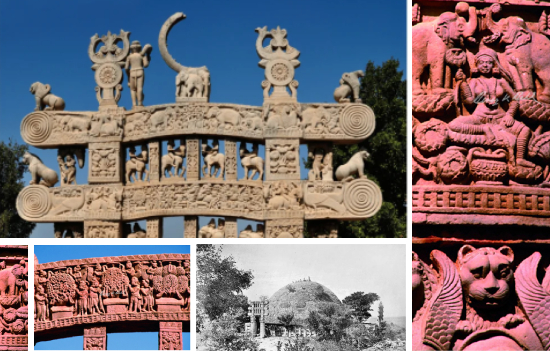 Picture by Benoy K Behl.
Benoy added, “Made in Sunga times, the reliefs on the
Vedika of this stupa are among the oldest Buddhist art in the world. These
depictions continue the rich visual lore of the land and show the roots of the
specific Buddhist imagery to come in later centuries.”
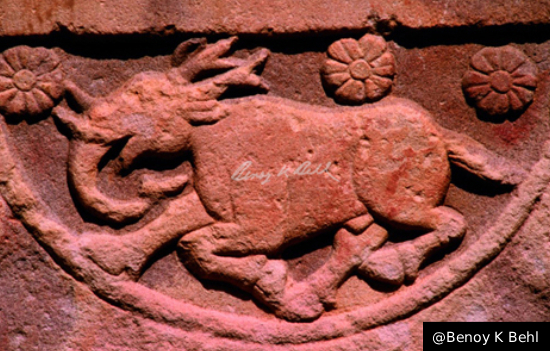 Composite Creature, Stupa II, Sanchi c. 100 BCE. Photograph by Benoy K Behl.
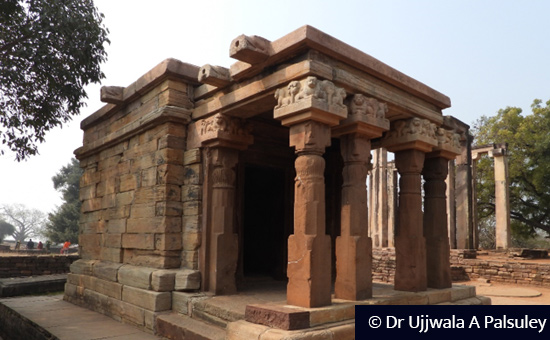 Gupta period temple at Sanchi.
Suggested route for Buddhist Circuit Train
One can follow the Two-Circuit Model i.e. Core Circuit: Sites directly associated with Buddha’s life (Gaya, Sarnath, Kushinagar, Lumbini) and Heritage Circuit: Sites like Sanchi, Nalanda, Ajanta-Ellora, Udaygiri, which represent Buddhist art and spread of the faith.
North–Central Corridor -A route connecting Nepal (Lumbini) → Uttar Pradesh (Shravasti, Kushinagar, Sarnath) → Bihar (Nalanda, Rajgir, Bodh Gaya) → Madhya Pradesh (Sanchi, Vidisha) → Delhi. This would balance geographic spread and authenticity. The same train could take a night journey from Bhopal to Delhi.
If the government wants to maintain status-quo tourists can spend half a day at Sanchi and the rest at Udaygiri Caves at Vidisha or Bhopa.
Hope the government
promotes Sanchi instead of the heavily promoted Taj.
Also
see albums
1. Sanchi
represents the Art of Vibrant Life
2. Who
made Sanchi Stupa
3. Nalanda University
4. Rajgir
5. Bodh Gaya Temple 1
6. Bodh Gaya Temple 2
7. Bodh Gaya Temple 3
8. Great Buddha Statue
9. Buddhist Caves Ellora
10. Sarnath
11. Sukhothai National Park,
Thailand
12. Kandy, Sri Lanka
13. Read about Gupta Empire