- Q&A
covers who is a Refugee as per U.N. Is India a signatory to the 1951 Refugee
Convention? Are illegal immigrants entitled to legal protection as Indian
Citizens? Should Taxpayers money be spent on then? What are key provisions of Immigration
and Foreigners Bill 2025?
“The Supreme Court on December 2 delivered a sharp response while hearing a habeas corpus petition alleging that Rohingya refugees in India were “going missing.” The bench questioned whether the judiciary was expected to extend extraordinary safeguards to individuals who, according to the government, had entered the country unlawfully.” Source
While
the SC will hear the case on merits, the petition raises issues.
1. Who is a Refugee according to the United Nations?
“The 1951 Refugee Convention defines a refugee as a person who "owing to well-founded fear of being persecuted for reasons of race, religion, nationality, membership of a particular social group or political opinion, is outside the country of [their] nationality and is unable or, owing to such fear, is unwilling to avail [themself] of the protection of that country.” Source
UNHCR site
The site adds, “The 1951 Refugee
Convention and its 1967 Protocol are the key legal documents that protect refugees. They provide the universal definition of who is a refugee and outline the minimum standards for their treatment. The cornerstone is the principle of non-refoulment* which states that refugees have a right not to be sent back to their country of origin if their life or freedom would be at risk.”
“Countries that have signed the Convention are obliged to treat refugees according to the standards outlined.”
2. Has India signed the 1951 Refugee Convention?
NO. Therefore,
it is not compelled to follow standards laid down by the UN.
So, is Indian government responsible for
the welfare of Rohingya immigrants?
If India had signed the 1951 UN
Convention and the government was no adhering to it then there could be a case
for judicial intervention.
Was it right for the SC to have in, February 2025, directing the government to provide
education to Rohingyas. “Children’s education should not face any discrimination, said the Supreme Court on Wednesday, as it directed the petitioner-NGO to submit the detailed address proof of Rohingya immigrants in Delhi. The Court said it will pass orders to the Centre and the Delhi government to grant Rohingya refugee children in the city access to public schools and hospitals.” New Indian Express They are Illegal Immigrants
not refugees.
Should not Taxpayers money be used for Indian Citizens only?
3. Have Rohingyas entered India on a Valid Visa?
NO.
4. What is the difference between a refugee and a migrant?
According to the UN site, “A refugee is someone who was forced to flee conflict or persecution and has crossed an international border to seek safety. The term ‘migrant’ does not have an international legal definition.
However, it is commonly understood to refer to someone who has chosen to leave their home to start a new life in another country. A migrant can return home without risking their life or freedom. The movement is understood to be voluntary.” Source Site
5. Where have Rohingyas settled?
According
to media reports they have settled in Jammu, Hyderabad, Delhi, Konkan, Mumbai
etc. To see a FB video of
Rohingya settlement in Hyderabad
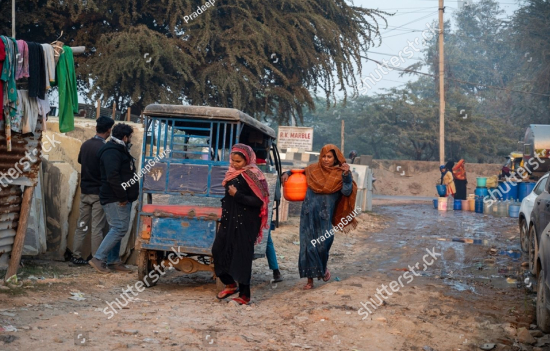 Rohingyas in Delhi. Thanks Shutterstock.
6. Is there any known case of Rohingya indulging in criminal
activity?
Yes. Recall that the 11 August 2012 rally to protest violence against Myanmar's Rohingya at Mumbai's Azad Maidan turned extremely violent. The key conspirator was a Myanmar national, Yusuf
Khan (Hindustan Times, 11 August 2013). To read HT report on damage to Amar Jawan Jyoti
Strategic expert Brahma Chellaney tweeted, “Amnesty International investigation confirms what was reported last year — that Rohingya Islamists from the Arakan Rohingya Salvation Army executed almost 100 Hindus in one massacre.” Read All
you want to know about Bangladeshi infiltration into India
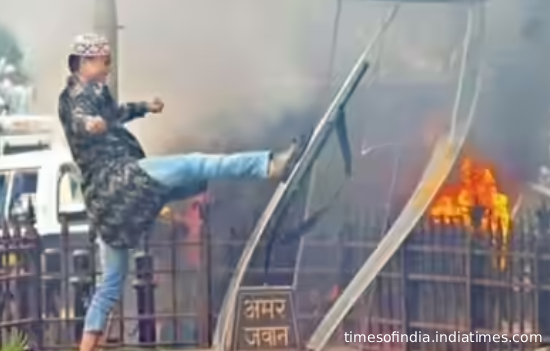 2012 August 11 Mumbai. Attack on Amar Jawan Jyoti. Pic courtesy Times of India.
7. The Constitution is for the People of India, Not illegal
immigrants!
The Preamble starts with, “WE, THE PEOPLE OF INDIA,”
8. India gave refuge to Tibetans, why not to Rohingyas-Equality
before law?
First, it is the Government of India’s decision and being a policy matter, cannot be subject to judicial review. Two, the
fourteenth Dalai Lama and his Tibetan followers fled to India in 1959. They
were given refuge because India and Tibet are tied by Buddhism and the
centuries-old cultural and spiritual ties. Three, equality before
law is a myth Four, law is for Indian citizens, not
illegal immigrants.
Majority
of Afghans who have settled in India are Hindus and Sikhs, escaping from
persecution. Some Muslim Afghans are in India for geo-political reasons. Government
of the day decides, not Courts. Read India is the only
home of the Followers of Dharma.
Also
note the population of Muslims in the Myanmar state of Arakan was 5 per cent in 1869, 21 per cent in 1901, 29 per
cent in 1983, 40 per cent in 2014 and 60 per cent if oversees Muslims from
Arakan are also counted. It can be safe to say that the increase in population
after 1983 cannot be accounted for by new births alone. Read
by Brahma C The Roots of the
Rohingya Crisis
With a population of over 140 crs, the
financial resources of GOI are inadequate for Indian citizens!
9. Are Rohingyas being treated this way because they are
Muslims? Article 15-Prohibition of discrimination on grounds of religion, race
--------
There is nothing wrong in excluding those who belong to a
specific religion. India was divided on religious lines in 1947. Those Muslims
who wanted to live in Pakistan left India, a decision they voluntarily made.
Just because some of them are being persecuted today does not give them the
option of returning to India, a country their fore fathers left for good. India
is already home to millions of illegal Bangladeshis. Read Equality before
law is a myth in India
10. If Nepalis are allowed to enter India without Visa, why not
Rohingyas?
The Indo-Nepal Friendship Treaty of 1950 permits
Nepalis to live and work in India. We have no equivalent treaty with Myanmar/Bangladesh.
It is a misnomer that all Nepalis in India are Hindus. During the recent
Gorkhaland agitation, a large number of protesters were Nepali Muslims.
11. What are some key provisions of the Immigration and
Foreigners Bill 2025?
1. The Bill places the
onus of proving legal
status on individuals rather than the state.
2. The Bill provides that on arrival in
India, foreigners must register with a Registration Officer. 4
3. Every University and Educational Institution or any other institution admitting any foreigner shall furnish information to the Registration Officer in respect of such foreigner.” This should prevent cases like Osama, Pakistani national who studied in India as referred to above.
4. According to lexology.com the
proposed bill strengthens national security. Excerpts, “any foreigner deemed a threat to India’s integrity will be denied entry or permission to stay.” “Foreign nationals must register upon arrival, and restrictions may be imposed on their movements, name changes, and access to certain areas.”
5. Who is a
foreigner under the 2025 Bill? One who is
not a citizen of India.
6. “The Indian Bill’s emphasis on digital identity similarly creates what some call biometric borders. In other words, the surveillance infrastructure, without checks and balances, can reframe migrants as security risks.” 5
12. Article 21 – “No person shall be deprived of his life or personal liberty except according to the procedure established by law.”
“It is said that for foreigners core guarantees such as Article 14 and Article 21 of the Constitution.” 6 Article 14 Equality before law is a myth as stated above. “Similarly, the lack of any statutory appeal or review against an immigration officer’s decision has been criticised as violating natural justice and Article 21.” 6
Is India the Dharamshala of the
world?
Why should Articles 14 and 21 apply to Illegal Immigrants?
Does India face the same national security and illegal
immigration threats today as it did in 1950 when the Constitution was adopted?
Is
the Executive or Judiciary supposed to evaluate those threats and respond? Does
the writ of the SC apply to those who are not citizens of India?
Only Citizens of India should be allowed to Vote and take refuge under the country’s Constitution.
Also read
1.
Equality before
law is a myth
2.
India is the only
home of the Followers of Dharma
3.
The Roots of the
Rohingya Crisis
4. PRS Research on
Immigration and Foreigners Bill 2025
5. Critical Analysis
of 2025 Bill
6. Human Rights is a
Western Policy Tool says former FS Kanwal Sibal
7. All you want to
know about Bangladeshi infiltration into India
8. BBC on India’s Refugee Policy