- Key
points of SC order while transferring case back to MP HC. State government
relying on a 1980s report in 2025/6. OBC Central List includes SC converts to
Christianity and Muslim Groups (27). Instead of reservations, based on Caste/OBC
that divide Society reserve for Economically Weaker Sections.
Ever
since the January 2026 UGC Circular we shared three articles on Reservations
i.e. Can
India become a Casteless Society and UGC Circular, 19
years old student from Jabalpur gets SC relief in Medical College Admission
under EWS and Reservations
in India Explained
Soon
thereafter was a hearing in the Supreme Court (SC) on 73% reservations in the
state of Madhya Pradesh (MP). SC order is courtesy and copyright the Supreme
Court.
This
piece shares parts of SC order, looks at definitions in the Colonial
Constitution and points from MP government affidavit in SC.
1. “The 1994 MP Act provided for 14% reservation for “Other Backward Classes” in public employment for all posts, while providing 16% for Scheduled Castes and 20% for Scheduled Tribes.”
2. Vide an
ordinance dated 8.3.2019, reservations for OBC was increased to 27% meaning
27+16+20 = 63%. The Act was amended and notified in December 2019 to provide
for 27%. Challenged in the MP High Court (HC) that granted a stay.
3. While the matter was in HC,
advertisements for posts based on 27% were issued vide corrigendum dated
16.11.2021 and 24.1.2022 thereby enhancing the OBC reservation to 27%.
4. “On 02.09.2021, the State’s General Administration Department issued an order that, except for the recruitments challenged through Writ Petition(s), in all vacancies/recruitments, 27% reservation will be given effect.” This was challenged in the HC.
5. Vide HC “order dated 04.05.2022 restraining the State Government from providing reservation for OBC category beyond 14% the recruitment initiated by various advertisement and given effect by corrigendum came to be passed.”
6. In early 2023,
the MP government made an application for transfer of matter to SC. Accepted
vide court order dated 20.8.2024.
7. Due to the HC stay, “The State Government could not proceed with the appointment and selection for various posts for which the recruitment process had already commenced by virtue of various notifications.”
8. The MP state government asked for similar relief as granted by SC, order dated 1.5.2023, to the Chhattisgarh state government that had asked for enhanced reservation percentages. SC had allowed it to go ahead with recruitment based on conditions, one of which was, “All appointment and promotion orders shall
specifically mentions that such appointments and promotions are subject to the
final outcome of the present proceedings.”
9. The MP state
government argued that the percentage of reservations shall vary from state to
state depending on the social fabric/composition of the State.
10. SC order states that the view taken in the state of Chhattisgarh followed by the CG HC Order cannot be the “solitary guiding principal for considering the legality and validity of affirmative action in the state of Madhya Pradesh.”
11. SC order stated that thus the “challenge in the present Writ Petition(s) should first be considered and examined in detail by the High Court.”
12. We request the
Chief Justice to constitute a Special Bench and dispose of the matter within
three months from today i.e. 19/2/2026.
To download SC order in PDF click on PDF Copyright Supreme
Court.
DECOLONISE – who are ST, OBC, SC?
1.
Constitution allows reservation only for socially and educationally
backward classes but it has become caste-based reservation in India.
According to a December 2024 SC order on Untouchability authored by Dr Dhananjaya Y Chandrachud, CJI, “Both Articles 15(4) and 16(4) do not enable reservation based on castes but only on classes. The absence of the use of “caste” in Articles 15(4) and 16(4) when coupled with its use in Articles 15(2) and 16(2) led the courts to hold that caste cannot
be the sole basis of reservation.” Para 192, Pg 128 of SC order. Source Also
read 12 para 6.1 for another SC
observation
2.
Why Reservations in India?
It is supposed to correct denial of education to SC/ST for thousands of years. According to research done by Gandhian Dharampal SC were the
maximum number of SCHOLARS in Pre British India
The British started this denial of education to divide India, the Congress carried it forward post 1947 and the BJP has joined them.
3. What is the origin of Reservations in India?
According
to vajiramandrravi.com, “Instead of separate electorates, the Poona Pact established a system of reserved seats for the Scheduled Castes within the general electorate. The promises of the Poona Pact regarding the reservations found a reflection in the Indian Constitution.”
According
to GOIMonitor.com, “1942: Viceroy's Executive Council recommends 8.5 per cent reservation for Scheduled Castes in civil services. B R Ambedkar was a member of the council.”
ST who convert to
Islam and Christianity continue to be treated as ST by the government.
4.
Who are Scheduled Castes (SC)?
Dr Ambedkar used the word
Depressed Classes. In the early 1930's Gandhi coined the word Harijan or Children of God to describe untouchables. The Government of India Act 1935 introduced the term 'Scheduled Caste' for the depressed classes. It is subsequent to such classification that Ambedkar formed a Scheduled Caste Federation. It is only since the 1990's that the word Dalit entered mainstream public discourse.
Example
of discrimination. D Keer wrote in Life
and Mission of Ambedkar, “The original surname of Bhim’s father was Sakpal, a family name. Bhim drew his surname Ambavadekar from his native village Ambavade. A Brahmin teacher in the High School, whose surname was Ambedkar, took such a liking to Bhim that he changed his surname to his own Ambedkar, in the schools records.”
Every election, the list of SC/ST/OBC keep on expanding. For the BJP/Congres the trio form a key vote bank.
5.
Who are Scheduled Tribes (ST)?
The word ST was first
introduced around 1949. In Indic terms people living in the forests are
called Vanavasi. STs differ from region to region. One cannot
compare northeast STs, who have mostly converted, with those in Chhattisgarh
and Himachal. Read Who
are ST
Gond tribe in Madhya
Pradesh are not urban- English speaking but their paintings are Wow and
expensive.
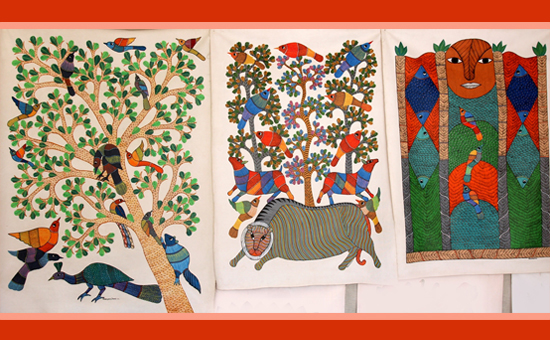 Paintings by Gond Tribe
Read about Gond
ST Palace near Jabalpur (Ram Nagar Fort).
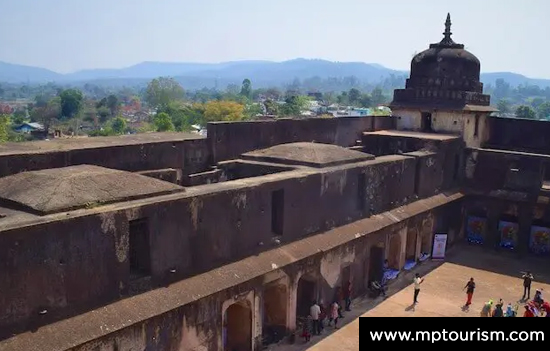 Moti Mahal, Gond ST Palace ruins near Jabalpur
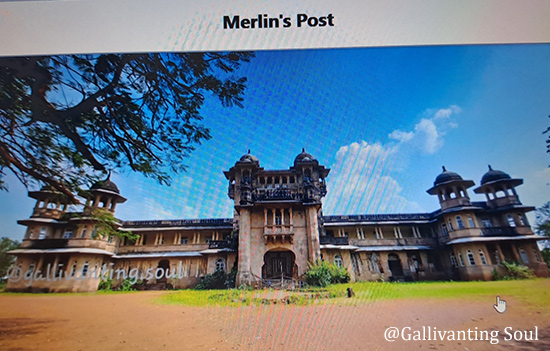 Jai Vilas Palace Jawhar Dahanu near Mumbai, owned
by a Vanvasi king.
Jai Vilas Palace Jawhar Dahanu near Mumbai, owned
by a Vanvasi king.
6.
Who are Other Backward Class?
Section 2 of the 1993 National Commission for Backward Classes (NCBC) Act defines “backward classes” as backward classes of citizens other than the Scheduled Castes and the Scheduled Tribes as may be specified by the Central Government in the lists.” This is a strange definition i.e. based on exclusion of SC and ST.
 Ahilyabai Holkar community are considered OBC in MP, want to be ST.
The
Gurjar-Pratihara dynasty produced a number of great kings. Forget the current
controversy on whether Mihir Bhoja was a Rajput or Gurjar- a perfect
example of how caste divides and creates tensions between Hindus. Read OBC
Kings of India
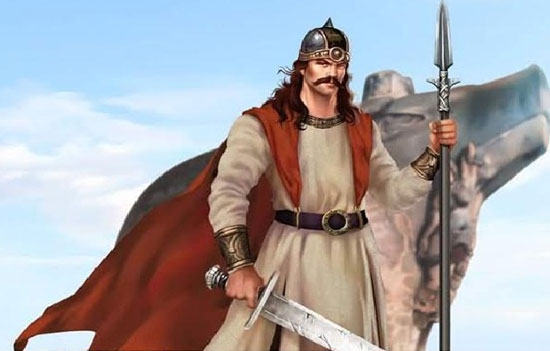 Raja Mihir Bhoja
7. List
of OBCs in MP-Central List includes SC converts and Muslims
List
of OBCs in MP-Central List downloaded on 27.2.26 at 3.59 pm. Serial 58 is Scheduled Castes who have embraced Christianity. Serial 59 is titled ‘Islamic Groups’ and has 27 entries. Explained – OBC
Reservations in India
If you peruse the
list of OBC classes, you will that find SC Converts to Christianity and Muslim included
under OBC.
So when one looks at OBC Population numbers, as presented by a state government,
it might include Christians and Muslims too?
Is this a way to Encourage Conversions?
Points from MP State
government Affidavit
dated 23.9.25 downloaded from Jaipur Dialogues site and Here
According to Indian
Express report, “It said that “the Mahajan Commission (appointed in 1980 and 1983 report), after extensive field studies across the State, recommended 35% reservation for OBC, having found them to be socially, educationally, and economically backward. Its detailed survey constitutes valid and quantifiable data supporting the increase. The State Backward Classes Commission has also reaffirmed this position, listing 94 OBC castes/sub-castes engaged predominantly in traditional, menial, and agriculture-related occupations, reflecting their continuing marginalisation.” 1
How relevant is a 1983
report in 2026, 43 years later?
1. The MP
government asked officials to collect information of backward class communities
based on nine indicators of development i.e. Per Capita Income, Inadequate communication network particularly in
rural areas, Low industrial growth, Mostly subsistence level of agriculture, Lack of irrigation facilities, Low literacy
levels, Low rural electrification, Low urbanisation, A high percentage of
people living below the poverty line.
Even though parameters are not all based on individuals,
the State government could not find any Brahmin, Rajput, Business community etc.
who was backward.
2. “By its interim order dated 19.03.2019, the High Court stayed the enhanced reservation from 14% to 27%, but restricted this stay only to the field of medical education.”
3. “The High Court passed a significant order on 04.05.2022, restraining the State from providing OBC reservation beyond 14% and staying the December 2019 Rules.” Para 1.27
4. “This resulted in large-scale stagnation in recruitments, leaving nearly 865 Madhya Pradesh Public Service Commission posts (approximately as on date) and more than 3867 Employee Selection Board (ESB) posts vacant.” Para 1.29
5. “Historical data capture the systemic deprivation that continues to persist across generations, and therefore remain relevant for affirmative action even decades later.” It is time that Dharampalji’s work is shared with SC/HC
Reservations across States is such a
complicated and divisive issue that the British who started it might be
laughing at us.
If one looks at the indicators of
development in point one above, then go for Economic backwardness only.
Once a person starts
earning well, other issues get taken care of like education, health.
Also
read
1. Indian
Express report on MP state government affidavit