- Fought at 16,000 feet this is not merely a story of war; it is a testament
to the indomitable human spirit, a narrative of Major Shaitan Singh (Jodhpur) of
13 Kumaon who stood by his men until his last breath, becoming an eternal
sentinel of the Himalayas.
This is eight in a series of PVC awardees, the first six being on Major Somnath Sharma, Piru Singh Shekhawat, Rama Raghoba Rane Karam Singh , Captain
Gurbachan Singh Salaria, Lt Col Dhan Singh Thapa and Subedar
Joginder Singh
In 2016, visited Rezang La War Memorial in Ladakh where Maj Shaitan Singh
and fellow soldiers of the 13th Kumaon Regiment laid down their
lives. It was very cold in August, November when the war was fought must be
colder. Editor.
This article was
first published in the Bharatiya Vidya Bhavan Journal.
Abstract
History is often written in ink, but occasionally, it is written in blood on the frozen canvases of the world’s highest battlefields.
In the annals of military warfare, few chapters evoke as much awe,
reverence, and sorrow as the Battle of Rezang La. It was here, in November
1962, that a small contingent of Indian soldiers, outnumbered nearly thirty to
one, decided that the safety of their motherland was more precious than their
own lives. At the heart of this epic stand was a man of steel and compassion,
Major Shaitan Singh.
“Standing at 16,000 feet amidst the unforgiving peaks of Ladakh, Major Shaitan Singh did not just command the Charlie Company of the 13th Kumaon Regiment; he became its soul. Facing a massive Chinese offensive with limited ammunition and no artillery support, he orchestrated a defence so fierce that it halted an enemy invasion in its tracks. This is not merely a story of war; it is a testament to the indomitable human spirit, a narrative of a leader who stood by his men until his last breath, becoming an eternal sentinel of the Himalayas.”
The story of this extraordinary valour began on December 1, 1924, in the
sun-drenched sands of Rajasthan. Shaitan Singh was born in the village of
Banasar, in the Jodhpur district, into the illustrious Bhati
clan of Rajputs—a lineage steeped in the martial traditions of India. He was the son of Lieutenant Colonel Thakur Hem Singh Bhati, a decorated veteran who had served with distinction in France during World War I and was awarded the Order of the British Empire
(OBE).
Growing up in a household where the uniform was revered, young Shaitan imbibed the virtues of duty and honour before he could even walk. His name, Shaitan (which translates to ‘Devil’ or ‘mischievous’), belied his true nature. He was a quiet, contemplative, and deeply disciplined child. The values instilled in him by his parents were clear: a warrior does not fight for hatred of what is in front of him, but for the love of what is behind him. He learned that true nobility lay in protecting the weak and standing firm in the face of injustice. These early lessons in integrity and dharma (duty) would later become the bedrock of his leadership at Rezang La.
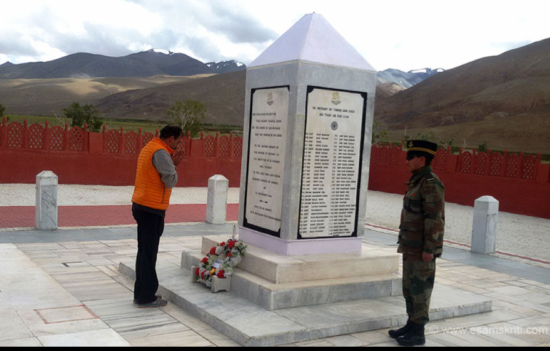 Paying tribute to the brave soldiers of Kumaon Regiment. 2016.
Selection to Become an Army Officer
Shaitan Singh’s journey into the armed forces began with the Jodhpur State Forces. He was commissioned as an officer on August 1, 1949. He possessed a natural flair for military strategy and an innate ability to connect with the troops. When the princely state forces were integrated into the Indian Army, he was transferred to the Kumaon Regiment, one of the most decorated infantry regiments in the Indian Army.
Before the fateful winter of 1962, Major Shaitan Singh had already proven
his mettle. He had gained significant operational experience in the Naga Hills
during counter-insurgency operations, learning the nuances of jungle warfare
and small-team tactics. He also participated in the 1961
liberation of Goa. By the time he was promoted to Major on June 11, 1962,
he was a seasoned officer.
He was known among his peers as a ‘soldier’s officer’, calm under pressure, approachable, and fiercely protective of the men under his command.
Battle of Rezang La, Ladakh
By late 1962, tensions along the Sino-Indian border had escalated into
full-scale conflict. The 13th Battalion of the Kumaon Regiment (13
Kumaon) was deployed to the Chushul sector in Ladakh, a region vital for the
defence of the airfield that supplied the entire sector.
Major Shaitan Singh was in command of the ‘C’ (Charlie) Company, consisting of approximately 120 men, almost entirely comprised of Ahirs from the Gurgaon and Rewari districts of Haryana. (There is a Ahir Dham at the Ladakh Memorial).
While historically administered under Jammu and Kashmir, Rezang La is a
mountain pass on the southeastern approach to Chushul Valley in Ladakh, sitting
at a breath-taking altitude of 16,420 feet.
The terrain is barren, the air is thin, and in November, temperatures plummet to -30 degrees Celsius. The wind howls with a ferocity that can freeze exposed skin in minutes. The Charlie Company was positioned on a ridge that was geographically isolated from the rest of the battalion. High peaks blocked the line of sight for the Indian artillery located behind the ridge, meaning Major Singh’s men would have to fight without heavy fire support. They were on their own.
The Attack by the Chinese People’s Liberation Army (PLA)
On the morning of November 18, 1962, a Sunday, the silence of the Himalayas was shattered. At 03:30 hours, Chinese troops were spotted advancing through the dry riverbeds (nullahs). The Chinese People’s Liberation Army (PLA) launched a massive attack with the intention of overrunning the Chushul airfield.
The First Wave: The Chinese attacked
the forward platoons (Platoons 7 and 8). Major Shaitan Singh had prepared his
defences meticulously. As the enemy came within range, the Kumaonis unleashed a
volley of rifle, Light Machine Gun (LMG), and mortar fire. The discipline of
the Indian soldiers was absolute. The first wave of the enemy was decimated, littering
the nullahs with bodies.
The Second Wave: Undeterred, the
Chinese regrouped and launched a second, larger wave. Again, the Charlie
Company held their ground, repelling the assault with fierce determination.
The Saturation: Realising that a frontal
assault was suicidal, the Chinese changed tactics. They began a heavy artillery
bombardment on the Indian positions. With no Indian artillery to counter-fire,
the Kumaonis sat in their trenches as shells rained down, destroying bunkers
and burying men alive. Following the barrage, the Chinese attacked from the
rear, utilising their overwhelming numerical superiority (estimated at over 3,000 troops against 120).
Leadership in the Heat of the Battle
It is in the chaos of this encirclement that Major Shaitan Singh’s leadership transcended into legend. With the enemy attacking from three sides and his platoon positions separated by hundreds of meters, staying in a secure bunker would have been the safer choice. But Major Singh knew that his men needed to see him. Unmindful of his personal safety, he moved out of cover. He dashed from one platoon post to another, crossing bullet-swept open ground.
At every post, he reorganised the defences, redistributed the dwindling
ammunition, and tended to the wounded. His presence was electric. Men who were
frozen, bleeding, and exhausted found a renewed reserve of strength when they
saw their Major standing amidst them.
He shouted words of encouragement, “You are the Kumaonis! You are the Ahirs! We do not retreat!” He did not command from the rear; he led from the front, sharing the same danger, the same cold, and the same destiny as his riflemen.
The Ultimate act of Bravery and Final Words
As the battle raged on, the inevitable toll of numbers began to show. The
Charlie Company was running out of ammunition. They had no grenades left. The
Chinese were closing in for hand-to-hand combat. While moving between posts to
shore up a crumbling defence, Major Shaitan Singh was struck by a burst of
heavy machine-gun fire. A bullet tore through his arm, and another ripped into
his abdomen. The pain must have been blinding, but he refused to be evacuated.
He tied his arm to his body to keep it from swinging and continued to direct the
fire.
Eventually, the loss of blood overpowered even his iron will. He collapsed.
Two of his loyal soldiers, Sepoy Phool Singh and Sepoy Jai Narain, rushed to
his aid. They tried to carry him down the snowy slopes to safety. Major Shaitan
Singh, realising that carrying a wounded man would slow them down and likely
result in their deaths, made his final command. He ordered the soldiers to
leave him. They refused. He then commanded them in the name of the regiment and
their duty to report the battle to the headquarters.
“Leave me here,” he reportedly said. “Save
yourselves so the world knows how we fought.” Reluctantly, they placed him behind a boulder, sheltered from the wind. They placed his weapon in his functioning hand. The last they saw of him, he was still looking towards the enemy, his finger on the trigger, waiting for the end.
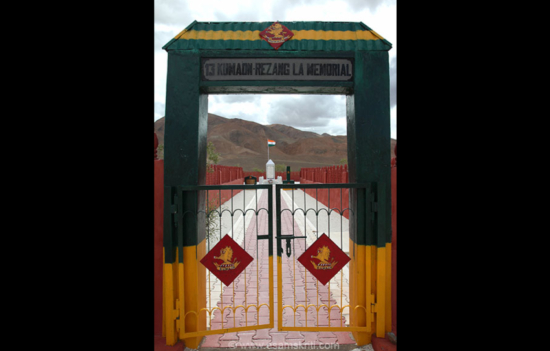 Entrance to the Rezang La War Memorial 2016.
A Lasting Salute
The battle ended with the near-total annihilation of Charlie Company. Out
of 124 men, 114 made the supreme sacrifice. However, they had taken a toll so heavy
on the enemy, killing an estimated 1,300 Chinese soldiers, that the Chinese
advance on Chushul was halted. The Chinese declared a ceasefire shortly after.
For three months, the high peaks of Rezang La held the bodies of the fallen in a frozen embrace. In February 1963, a shepherd wandered onto the battlefield and alerted the Indian Army. When the recovery parties arrived, they witnessed a sight that stunned the world. The soldiers were found frozen in their trenches, weapons still in hand. The medical orderly was found with a syringe and bandage in his hands, frozen while treating a comrade. And there, behind the boulder, was Major Shaitan Singh. His body was preserved by the snow, still in the fighting position. He had died as he had lived, fighting for his country. It was a tableau of valour frozen in time.
Award of the Param Vir Chakra
For his conspicuous bravery, inspiring leadership, and supreme sacrifice, Major Shaitan Singh was posthumously awarded the Param Vir Chakra (PVC), India’s highest wartime military decoration. The award was notified in the Gazette of India on January 26, 1963.
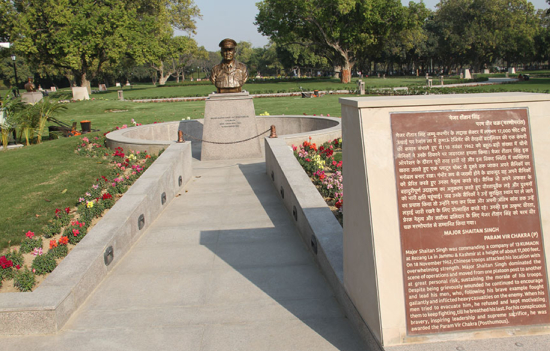 At National War Memorial, New Delhi a bust of Maj Shaitan Singh.
Memorials
A grateful nation has ensured that the memory of Rezang La and Major
Shaitan Singh never fades.
1. Rezang La War Memorial: Located in the Chushul sector of Ladakh, near
the actual battlefield, it serves as a pilgrimage site for soldiers and civilians
alike.
2. Ahir Dham: The memorial includes a section dedicated to the brave Ahir
soldiers of the Kumaon regiment.
3. Jodhpur Statue: A prominent statue of Major Shaitan Singh stands at the
central square in Jodhpur, his hometown.
4. Maritime Honour: The Shipping Corporation of India named an oil tanker,
MT Major Shaitan Singh, PVC, in his honour.
5. Major Shaitan Singh Park: A park in a serene location on Mount Abu of Rajasthan is named after him.
Lessons from his Life
The life of Major Shaitan Singh offers profound lessons that extend far
beyond the battlefield:
1) Courage is a Choice: Bravery is not the absence of fear, but the decision
to act despite it.
2) Resilience: Fighting with inferior equipment against superior numbers
proves that the human spirit is the most potent weapon of all.
3) The Power of Purpose: He fought not because he hated the enemy, but because he loved what was behind him—his nation and his people.
4) True Leadership: A leader eats last, sleeps last, and stands in the line of fire first. His refusal to be evacuated underscores that the safety of the team comes before the leader’s safety.
A Legacy of Courage
The Battle of Rezang La is often compared to the Battle of Thermopylae,
where 300 Spartans held off the Persian army. Major Shaitan Singh is the
Leonidas of India. His legacy forced a modernisation of the Indian Army, highlighting
the need for better equipment for mountain warfare. But more importantly, he
left a legacy of invincibility.
The Chinese troops, despite winning the ground, were so demoralised by the
ferocity of the brave Ahirs that they never attempted a major incursion in that
sector again.
Influence on Future Generations
Generations of Indian military officers study Major Shaitan Singh’s tactical decisions and moral courage. He serves as a beacon for the youth, reminding them that ordinary men can perform extraordinary feats when driven by duty. In the villages of Haryana and Rajasthan, folklore about him is passed down, inspiring young men and women to join the armed forces.
He represents the ethos of the Naam, Namak,
Nishan (Name, Salt, and Symbol) of the regiment.
Major Shaitan Singh’s story is a poignant reminder of the cost of freedom. He was a man who walked into the valley of death with his head held high, transforming a tactical defeat into a moral victory that saved Ladakh.
Major Shaitan Singh did not just die for his country; he defined what it
means to live for it.
This article was first published in the Bhavan’s Journal, June 16-30, 2026 issue. This article is courtesy and copyright Bhavan’s Journal, Bharatiya Vidya Bhavan, Mumbai-400007. eSamskriti has obtained permission from Bhavan’s Journal to share. Do subscribe to the Bhavan’s Journal – it is very good.
To
see album of Rezang La War Memorial, Ladakh
Rezang
La is about 3 hours drive from Pangong Lake, to see
Lake album
To
see album of Jaswantgarh War Memorial