- What is the concept of Religious Denomination
in the Colonial Constitution and its origins? Why
menstruating women not allowed in Sabarimala Temple? Diversity in religious traditions is not discrimination.
The issue menstruating women having darshan of
Swami Aiyappan was heard in SC around 2018-19. That time esamskriti had shared
articles - Hindus cannot be governed by the
Christian concept of Religious Denomination, All you wanted to know about
worship of Swami Aiyappan, Sabarimala is also connected with
Tamil Culture and album
of Kerala’s Only Women Festival Attukal Ponkala.
As
per February 2020 SC order, a nine-judge was to be constituted to dwell on the
Sabarimala issue. The proposed hearing in April 2026 is a result of that order.
Background
Legal Aspects - Post
September 2018 Sabarimala order Arghya Sengupta, research-director of Vidhi
Centre for Legal Policy wrote in The Times of India, “By refusing to hold the worshippers of Lord Ayyappa as a
‘religious denomination’ they deny the existence of a group right in the first
place.”
Article 26 Freedom to manage
religious affairs - Subject to public order, morality and health, every
religious denomination or any section thereof shall have the right. 3
For a sect or sub-sect of a religion to
qualify as a religious denomination, it must be designated by a distinctive
name and have a common faith and a common spiritual organisation. Further, there is no 'sect' or 'sampradaya' called 'Ayyappa Sect'/Sampradaya. Any individual who follows the stated rules of vrata to get darshanam at Sabarimala is referred to as 'Ayyappa Swami' - likening the person to Shri Ayyappa, in whose presence the devotee seeks to be in.
The cause
of Article 26 is its Western origin. Read on.
According to respected senior advocate Arvind Datar, “Article
26 is derived from Article 44 of the Irish Constitution, 1937. This Article 44, in turn, was
based on Article 114 of the Constitution of Poland, 1921.” The term religious denomination
is of Judeo-Christian origin and used in the context of defined denominations
that exists in Christianity. To read more Christian concept of religious
denomination
How relevant are Judeo-Christian concepts in a Hindu majority country?
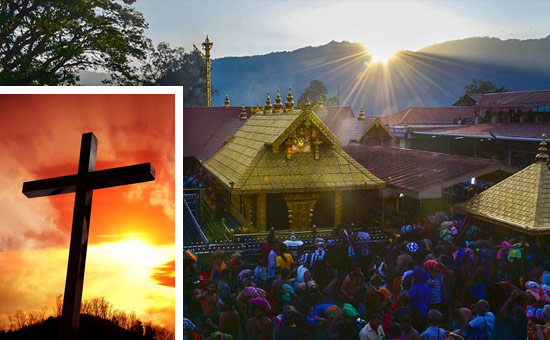
A constitutional amendment of 1987
provided for an ‘Authoritative
Text of the Constitution in Hindi Language’. The equivalent Hindi word
for religious denomination, according to T.R.
Ramesh, President, Temple Worshippers Society Chennai, “is Sampradaya”.
Sampradaya is a School of thought or
lineage you belong to within Sanatana Dharma. When a Swami states he belongs to
a Sampradaya it means a continuous tradition of knowledge and
practice transmitted properly from teachers to students, gurus to shishyas.
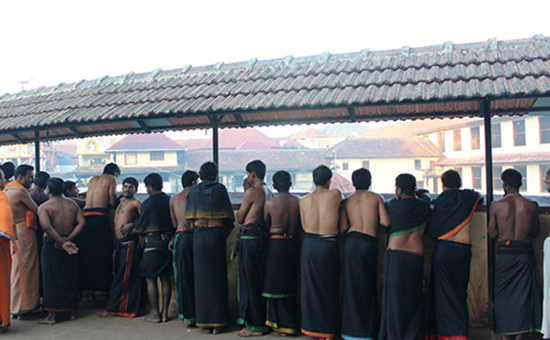 Male devotees identifiable by black lungis, at Krishna Udupi Temple. 2011.
Some argue
against this tradition quoting Article 14- Right to
Equality. One of the biggest myths in India’s colonial constitution is Art 14.
Read Why for e.g. why
is the Kerala government managing Hindu temples.
Also read Legal structure Or Comparing Inheritance Laws
for Hindu and Muslim women and Registration of Muslim
Gifts (Hiba) not done per Sharia but Hindus register
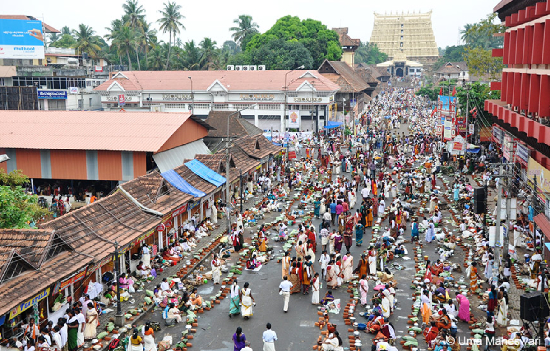 Attukal Ponkala is an all women festival in Kerala, men not allowed.
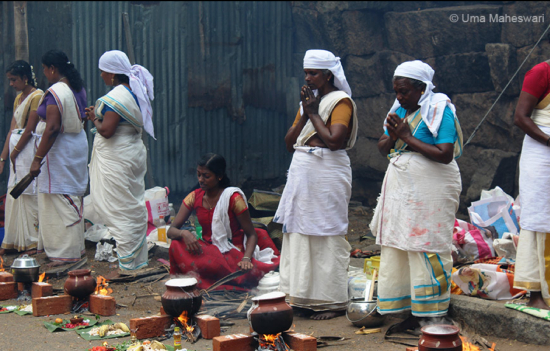 Women praying during Attukal Ponkala, Trivandrum. Festival pics by Uma
Maheshwari.
Women praying during Attukal Ponkala, Trivandrum. Festival pics by Uma
Maheshwari.
Article 25 is about free practice
and propagation of religion. The restrictions at the Ayappa Temple do not
prevent Hindus from practicing their religion. There is only a restriction of
women during a certain age. They can have darshan
of Swami Ayappa before and after that age.
“Diversity in religious traditions is not
discrimination.”
Any attempt to make Indic
Faiths uniform, one fit all, would be a serious setback to diversity i.e. one
of the corner stones of the Bharatiya Civilization.
Origin of
keeping menstruating women away from shrine
Shri Ayyappa in Sabarimala is in the form of a
Naishtika Brahmachari. Therefore,
women in reproductive phase of life are not allowed into the temple. The
energy-sphere of the deity is believed to not be conducive for such girls/women
due to which the restriction is imposed.
However, there are other Ayyappa temples across Kerala and other parts of India, where all girls/women can visit and take darshanam, irrespective of their age. He is not a 'Naistika Brahmachari' in these temples. In many South Kerala temples, he is worshipped in married state with his wives, Devi Poorna and Devi Pushkala.
In fact, all female devotees of Shri Ayyappa respect this rule specific to Sabarimala. Their devotion is reflected in the successful completion of the vrata and darshanam by the menfolk in their families. The opportunity to visit Sabarimala in particular is a deeply sought-after journey, which includes the 'shraddha' or dedication and patient wait involved for women in the process.
Further, Bhawani
Rajagopal wrote about probable origin
of the strictures placed on women between 10 and 50 keeping away from the
temple, “Upon the defeat of Mahishi, it was
revealed that the demon was actually a beautiful young woman who had been
cursed to live the life of a demon. The defeat set the woman free who, in turn,
proposed to Lord Ayyappa.
He refused saying that he had been ordained
to go to forest and answer the prayers of devotees. But, the young woman was
persistent. So, Lord Ayyappa promised to marry her the day new
devotees (kanni-swamis) stop visiting him with their prayers at Sabarimala. The woman agreed to wait for
him at a neighbouring temple.”
Must add that inspite of there being different
versions of the reasons, the restriction in case of Sabarimala is as aligned
with the swaroopa of the deity.
Summary
Temple restrictions are not for all women and
for a particular age group. A woman is worshipped in a neighbouring temple. Attukal Ponkala is an all women
festival in Kerala. Lastly, concept of religious denomination in Christianity,
source of constitutional provision, is alien to Sanatana Dharma.
Possible arguments and responses -
One, the argument in favour rely on Article 25 and whether
the rights of a religious denomination under Article 26 are, apart from the
clauses mentioned in Art 26 referred to above, subject to any other Provisions.
It
needs to be known that the Sabarimala Temple is open to all classes and types
of Hindus except to women between a certain age.
Two, it is for the SC to decide whether the belief in
Sabarimala is genuine and held as part of the profession or practice of
religion. It might wish to consult scholars and followers of Ayappa for an
informed view.
Was this process been followed by Muslims, whilst
considering entry of women into mosques, denial of equal inheritance rights for
their women not to forget rights of Parsi women.
Allowing
women of a certain age group to visit the Shri Ayyappa temple at Sabarimala, must not be construed to be social
reform!
Three,
can a non-Hindu or a person not belonging to a religious denomination, question
a religious practice of another religion or denomination, file a PIL?
It is important to know the background and religion of the persons filing the PIL.
Ishwar
Buddhi Dee. Love and Light. It is not my intent to malign or defame any
individual or community.
As
always, am happy to stand corrected.
Also read and
References
1.
How Muslim women
are discriminated in inheritance as compared to Hindus.
2.
Tax Laws should be
the same all citizens
3.
Constitution of India, downloaded from
Link
on 22.3.26 at 1.36 pm