- Six reasons why WB Elections important for India. These include again producing great thinkers/spiritual leaders, reducing infiltration, securing Siliguri Corridor, Closure of Citizenship issues. WB must become an engine of growth for eastern India. Expect Innovations e.g. political workers dressed up as Paramilitary Forces. Brothers and Sisters of WB, please vote wisely.
West
Bengal (WB) assembly elections esp. revision of electoral rolls has dominated
the news during the last few months. Earlier articles on WB were Violence in West Bengal Elections-A Primer , Why has West
Bengal stopped producing Great Leaders , Bangladeshi
Infiltration into West Bengal , IDEAS for the BJP
in West Bengal Elections and Matuas of Bengal – A Primer
Assembly
polls being held in Assam, Tamil Nadu, Kerala and Puducherry too but none has
attracted as much media attention, partially to the very aggressive Chief
Minister. This WB election is going to be fierce. Expect innovations this
summer for e.g. political workers dressed up in uniform of Paramilitary Force.
Background to the state of West Bengal
1. The Congress
ruled WB for 22 years i.e. 1950-1977 followed by CPI (M) for 34 years i.e. from
1977 to 2011 and Trinamool Congress (TMC) for 15 years from 2011 to 2026. Table
1 has the details.
Table 1 - Which political
party ruled West Bengal since Independence?
|
Period
|
Party
|
Chief Minister
|
|
Aug 1947-Feb 1967
|
Congress
|
P C Ghosh etc.
|
|
Feb1967-Nov1967
|
United Front
|
AKMukherjee
|
|
Nov1967-Feb1968
|
|
P C Ghosh
|
|
Feb 1968-Feb 1969
|
President Rule
|
Governor
|
|
Feb 1969-March 1970
|
United Front
|
AKMukherjee
|
|
March 1970-April 1971
June 1971-March 1972
|
President Rule
|
Governor
|
|
1972-1977
|
Congress(PD Alliance)
|
S S Ray
|
|
1977-2000
|
Communist Party (Marxists)
|
Jyoti Basu
|
|
Nov 2000-May 2011
|
Same
|
BBhattacharya
|
|
May 2011 onwards
|
Trinamool Congress
|
Mamta B
|
Source Wikipedia
2. A Bengali
observer says that WB of today is like Bihar of the 1990s when Laloo Yadav was
Chief Minister (CM).
WB’s economy moved southwards due to British policies/famines and shifting of national capital to Delhi. Post- independence the Congress in the Centre reduced the state’s share of jute export duty, jute being the main cash crop of WB. Disillusionment with achievements post-independence and due to communist rule the labour situation was beginning to get out of hand starting the mid-1960s. Read more about WB’s step-motherly treatment
Things got from bad to worse.
When
I worked for a Kolkata based company in the 1990s found it strange that
employees were always looking for holidays due to bandhs, strikes etc.
A Bengali professional working
in Mumbai says, “The commies ripped the soul out of Bengal, impoverished its mind and body. And then Mamta killed its soul with street tactics. Many clear thinking Bengalis left Bengal. Spiritual leaders come out of nourishment of mind, body and soul. Rise of electricity cuts, lack of jobs, despondency, street politics and political sloganeering substituted preaching and enlightenment.” Read Bengal’s never-ending night of political killings
Director,
Vidhi Centre for Legal Policy Arghya Sengupta
wrote in The Telegraph, “West Bengal’s share of national GDP has nearly halved, from over 10% in 1960 to its lowest ebb today. Total industrial output relative to other states in India has also halved. Manufacturing is yet to recover from three decades of Left-sponsored, officially sanctioned laziness. Insufficient private capital and inadequate state capacity make for a wretched combination.”
He adds, “The Bengali film industry has shrunk in size
over the last decade. There has also been a sharp drop in the number of Bengali
films to have won the national award in the best-film category. High culture
can no longer justifiably remain the last vestige of a waning state.”
According
to a friend in Kolkata, today the city has
become an old age home because the youth are moving to other States.
Aspirations have fallen. Local residents are not motivated enough. The
education and healthcare systems have broken down. In a lighter vein, she says
Kolkata is getting closer to Bangladesh!
Another Kolkata friends says, “The deepest pathology is the institutional architecture bequeathed by 34 years of CPI(M)-led Left Front rule (1977-2011) and repurposed rather than dismantled by the TMC after 2011. Party has become part of society meaning civil-society intermediation is absorbed into party structures. So panchayats, PDS shops, local clubs, trade unions all become an extension of the ruling party.” Our building security guard was employed in WB but not being part of the party extension, was forced to leave.
3. During
Partition, Punjabi refugees settled in Punjab and Delhi and Muslims from North
India moved to Pakistan. Matters got over by 1950 unlike WB where issues linger
on. More so, due to non-stop persecution of Hindus in Bangladesh where else
will the Hindus go? Refugees during the
1971 War and Infiltration from Bangladesh, supported by politicians, only
complicated matters further. Read Righting the
neglect and wrong for decades
Columnist
Pratim Bose wrote in Moneycontrol.com, “For a state that suffered so much in the Partition, such gross demographic change was destined to create social tension. And, it is on the rise. It will rise if the government doesn’t prevent further demographic change.”
As a result, WB
has stopped producing a galaxy of thinkers/spiritual masters that it had
earlier. The Leftists and TMC could not stop the rot. Both these parties have focused on why WB is different/unique and in a way prevented the state’s integration with the rest of India. This is not to state that good work was not done.
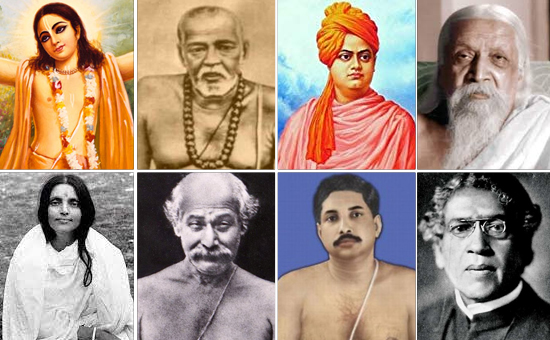 Leading Thinkers and Spiritualists from West Bengal 1800 onwards.
Why do West Bengal
elections matters to all of India?
1. Infiltration of Bangladeshis and Rohingyas
Over twenty years ago, a senior Intelligence Officer told a Fauji friend that infiltration through WB was India’s biggest internal security threat. WB is considered the gateway to Bangladeshi/Rohingya into India from where they get lost in India’s hinterland. With Assam’s Himanta Sarma taking action against illegal immigrants WB is perceived to be the favourite gateway.
While TMC is right that the border is guarded by the BSF (Border Security Force) the reality is that a non-cooperative state government makes BSF’s job more difficult. The BJP government at the Centre, as part of its wooing Sheikh
Hasina
approach, has not taken significant action against illegal immigrants. It
raises the issue before elections. It is only in BJP ruled Maharashtra that
party leader Kirit Somaiya is fighting a battle against Bangladeshis (has state
government support).
Bangladeshis
are now present all over India, taking away jobs and changing demographics
significantly. Once in India they, become a Minority, avail of various
government schemes/scholarships/free homes for Muslims. Political parties
across the spectrum declare them as OBC (Other Backward Class) so they avail of
reservations in educational institutions and government jobs.
Data
from an earlier article, await 2027 Census
Table 2: Percentage of Muslim Population in border districts.
|
Population
|
Birbhum
|
Malda
|
Murshida
bad
|
24 Parganas
|
West Dinajpur
|
|
1971
|
29.19
|
43.12
|
56.34
|
44.03
|
35.89
|
|
1981
|
30.97
|
45.27
|
58.65
|
55.38
|
35.79
|
|
1991
|
33.06
|
47.49
|
61.39
|
63.59
|
36.75
|
|
2001
|
35.08
|
49.72
|
63.67
|
NA*
|
38.47
|
|
2011
|
37.00
|
51.27
|
66.27
|
NA*
|
49.92
|
Note:
* 24 Parganas was divided into North and South 24-Parganas, hence the figures
are not comparable. To read Bangladeshi
infiltration into West Bengal
2. West Bengal has stopped producing Great Leaders who
inspired India
Bengali leaders of the 18-20th century
were thought leaders, social reformers and educationalists whose thoughts had
an impact across India. Perhaps, they defined modern India, contemporised
Sanatana Dharma and spoke of nationalism as few others did. Personally
speaking, I am inspired by the thoughts of Swami Vivekananda and Maharshi
Aurobindo.
Swami Vivekananda continues to inspire millions
within and outside India even 123 years after he gave up his body.
Some of the bright leaders, starting the 18th century were, Sri Ramprasad Sen (1718 -1775-This great mystic poet composed thousands of songs about the Divine Mother Kali.), Lahiri Mahasaha Baba (1828 to 1895 – revived Kriya Yoga worldwide), Mahasaha’s chief monastic disciple Swami Sri Yukteshwari Giri (born in Serampore, WB in 1855). His disciple was Paramhansa Yogananda, born as Mukunda Lal Ghosh in Gorakpur in 1893 (author of Autobiography of a Yogi), Sri Ramkrishna Paramhansa (1836-1886), Sri Byamakhyapa (1838 to 1911), Swami Vivekananda (1863 to 1902), Maharshi Aurobindo (1872 to 1950), Ma Anandamoyee (1896 to 1982), Sri Anukul Thakur (1888 to 1969), Bankim Chandra Chatterji (author of Anand Math), Srila Prabhupada (1896 to 1977-founder of ISKCON), Jagadish Chandra Bose (1858 to 1937), Rabindranth Tagore (1861 to 1941), Netaji Subhash Chandra Bose. To read about
their lives, contributions and others
West
Bengal can produce such a galaxy of leaders only when there is resurgence of
Sanatan Dharma. That seems impossible under those who ruled WB.
Spirituality
requires peace, law and order, an open mind and to an extent economic
prosperity. Bengal became impoverished during British rule. Kolkata was the
centre of trade, commerce, arts and culture and an economic hub around 1970!
Further, “Communism does not allow you to believe in God. They will destroy anything religious. It demands complete loyalty. The problem the communist fathers figured out was religious people looked upon god as the ultimate authority i.e. higher than the communist party.”
3. Hindus who fled Bangladesh should be given citizenship – CAA
Because of vote-bank politics citizenship of Matuas is inadequately addressed. Matuas are Scheduled Caste under India’s colonial constitution yet parties are inadequately concerned. Read Why are Hindu
Bengalis celebrating notification of CAA
4. India needs more contribution from the eastern states and
Kolkata is the hub of the Northeast. If corporate investments and sentiment
revive, shall benefit all.
Hope fully attitudes will change. A corporate leader (Bengali working in Delhi) tells about attitude of resident West Bengalis, “Cholche cholbe (it is ok to carry on this way). Lack of inertia for hard work when living inside Bengal. Political bent of mind. They try to read politics in everything instead of "economics". Poor leadership. Historically the state did not get a good motivational and benevolent leader.”
5. Importance of Siliguri Corridor and its Demographics
Senior
journalist Shekhar Gupta did a very good piece on the importance of the
Siliguri Corridor and complexities thereon. Read Here Every state government must support the Centre’s efforts, given that the region connects rest of India with the Northeast and is close to the border with Tibet.
6. Reduction in Cow Smuggling
It
is true that cows smuggled through the West Bengal border to Bangladesh do not
originate in WB. Because, smuggling is remunerative cows are kidnapped across
North India and seamlessly move through states to WB. This needs to stop,
atleast significantly reduced.
7. Personal Experience
Years
ago, met a businessperson from Kolkata on a flight to Delhi. He said was into
import export with Bangladesh. He explained that there was no exchange of
currency but a Barter System means equivalent goods were given for what was
exported.
People
need to realize that Bangladesh is a separate country not a part of India.
India allows easy border crossings by Nepalis by virtue of the 1950 India Nepal
Friendship Treaty.
India has no such treaty with Bangladesh.
West
Bengal needs a Sanatan Dharam resurgence. That is very important for Bharat.
Brothers and Sisters of WB, please vote wisely. A lot is at
stake.
Also read
1.
Second
Generation in WB polls
2. Bangladeshi
infiltration into West Bengal
3.
Congress
eyes revival in Punjab
4.
SIR – Useful distraction
5.
Violence
in West Bengal Elections-A Primer