- Introduction to growing of raw Pashmina in Changthangi district of Ladakh. For India to become a leading producer of Pashmina, it needs an integrated approach that involves neighbouring countries, other Hill States and think Big.
For over twenty-two years, my journey with
Pashmina and Cashmere has been more than a business pursuit. It was a quiet
mission to reclaim India’s textile heritage that belonged naturally to Her once.
India is among the oldest textile cultures in
the world. Yet today, in one of the most prestigious luxury fibres known to
humanity, our presence remains disproportionately small.
The story of Pashmina began in the
high-altitude Himalayan ecosystems of our region centuries ago.
The fibre travelled from Ladakh through
Kashmir into the courts and trading systems of the world. Over time, however,
the value chain moved elsewhere. European mills industrialised finishing and
luxury positioning. China and Mongolia built scale, fibre ecosystems and
processing infrastructure.
India, despite possessing extraordinary
artisanal knowledge and while Ladakhi Changthangi Pashmina is among the most respected ultra-fine Himalayan cashmere fibres in the world, slowly India became a marginal player in a category deeply linked to its own heritage.
Today India contributes less than 1% of global
cashmere fibre production. Yet the Ladakhi Pashmina fibre, obtained from the
Changthangi goat, is widely regarded among the finest in the world in terms of
fineness and hand feel.
This contradiction should make us pause. We
possess:
1. High-altitude terrain suitable for these
breeds,
2. Hand skills in spinning, weaving, dyeing,
embroidery and finishing,
3. Centuries of textile memory,
4. And over 200 Geographical Indications
across textile traditions.
Yet we have not built a fully integrated modern luxury fibre ecosystem.
The issue is not a lack of heritage or talent.
It is the absence of long-term systems thinking.
Luxury is built today through the integration of:
1. fibre science,
2. breed development,
3. processing consistency,
4. micron grading,
5. traceability,
6. authentication,
7. design innovation,
8. machinery calibration,
9. branding,
10. And global market positioning.
There must be a perfect amalgamation of knowledge and skill, man and
machine, tradition and technology.
Over the last few years, encouraging steps
have begun. Dehairing infrastructure was established in Leh. Standards such as IS
17269 have emerged. Discussions around a formal Pashmina Mark and stronger
authentication systems are underway. The Ministry of Textiles, CWDB and local
administrations have shown seriousness and intent.
These are important beginnings. But
implementation is critical. The challenge before India is not merely to sell
more shawls.
The challenge is to rebuild an entire mountain-to-market ecosystem:
1. protecting pastoral livelihoods,
2. supporting Changpa and other Himalayan
communities,
3. strengthening fibre quality and
traceability,
4. modernising processing,
5. enabling design-led innovation,
6. And positioning Indian Pashmina as a
globally respected heritage luxury.
As India expands its fibre ecosystem to include regions such as Himachal Pradesh and Uttarakhand, it becomes important to create transparent grading systems based on measurable fibre characteristics such as micron count, staple length, yield and dehairing quality. This allows different Himalayan fibres to find their rightful place in the market without diluting premium Changthangi positioning.
This needs to be viewed strategically too.
The Himalayan pastoral communities are not
merely producers of fibre. They are ecological custodians and frontier
communities living in some of the harshest terrains in the world. Sustaining
these livelihoods is linked to craft preservation, and also to ecology,
migration, cultural continuity and border resilience.
India has all the ingredients necessary to
become a serious global leader in specialty fibres and luxury textiles once
again.
What is required now is
continuity of vision, patient institution-building and the confidence to
benchmark ourselves not against local limitations, but against the very best in
the world.
Another critical area requiring urgent attention is traceability and
authentication. The global market today is flooded with products falsely
marketed as ‘Pashmina,’ diluting both consumer trust and the livelihoods of
genuine Himalayan producers. India must therefore build a robust authentication
ecosystem combining fibre testing, QR-based traceability, GI enforcement and
anti-counterfeit systems. Every genuine product should ideally be traceable
from raw fibre source to spinning, weaving and final finishing.
In the future, luxury value will not come only from the product
itself, but from provable authenticity, transparent sourcing and trust.
The opportunity is economic and civilizational.
Perhaps, after centuries, the time has finally come for Pashmina’s finest
chapter to be written once again in Bharat.
Ladakh produces 40–50 metric tons of raw Pashmina annually
from nearly two lakh goats. For production to increase
manifold it must make economic sense for the people of Ladakh to rear more Changthangi
goat. The government can motivate them through pride of local culture,
financial incentives (a bit like PLI-production linked incentive scheme for
industry) and setting up a transparent hassle free system to buy goat wool.
May be a cooperative framework on
the lines of AMUL,
where producers of raw cashmere fibre sell it to the co-operative who
consolidates the buying and sells larger quantities to buyers, may help the
goat growing communities to get a better price for their fibre. Payment done
immediately to their bank accounts. The All
Changthang Pashmina Growers Cooperative Marketing Society exist. May be it
needs to be scaled up with increased support.
The Union Territory of Ladakh recently created
new districts, one of which was Changthang. With a smaller district, hope the growth of cashmere wool gets more attention.
To achieve scale the government must explore
the hills of Himachal Pradesh (esp. Spiti Valley) and Uttarakhand to check if
weather conditions similar to Changthang in Ladakh exist so that
either the Changthang goat or similar goat varieties can be reared there.
Size of pasture lands in Ladakh might be a constraint to
increase number of Changthangi goat so a presence in
other hill states would help.
During a 2012 visit to village Darkot near
Munsiyari, Kumaon, Uttarakhand a local weaver said that getting genuine cashmere
fibre was a problem. There were numerous fake or blended products
sold. The government needs to address this. She also said, earlier the fibre
came from Tibet, that had stopped.
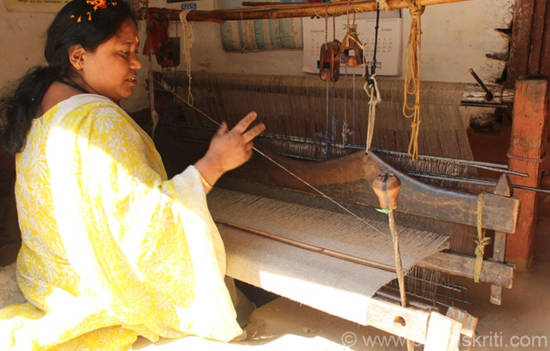
Ladakh can be known worldwide for Pashmina Wool and be its
Identity. The geopolitical implications of this are significant too.
The
future of Indian luxury textiles cannot lie only in nostalgia for handcraft or
in purely industrial production. It must emerge through a careful blend of
artisan knowledge, fibre science, modern machinery, design innovation and
long-term brand building.
Now some general information culled out by Editor.
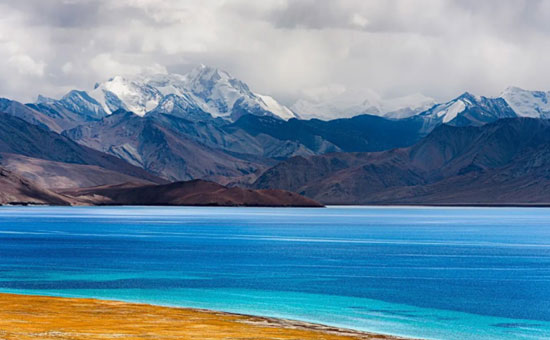 Tso Morirri Lake. Pic by Umesh.
Q1. Where is Changthang in Ladakh?
It is in
eastern Ladakh, close to Tibet. Pangong Lake and Tso Moriri Lake form part of
the Changthang plateau.
According to an article in Downtoearth.org,
“Spanning approximately 35,000 square kilometers, the Changthang Plateau is a prominent
geographical feature in both Ladakh and Tibet.
This elevated plateau stretches from the Indus River in
the west to the Tso Moriri Lake in
the east. The flora of the Changthang Plateau includes hardy grasses and shrubs
that have adapted to the extreme climate. These plants play a crucial role in
supporting local wildlife and the nomadic pastoralists who inhabit the region.
Yak wool, highly prized for its warmth and durability, is a significant
economic resource for the local communities.”
Q2. Who
is the biggest producer of Pashmina wool in the world?
China. They produce app 9,000 tons per annum.
A search
states that, “China is the largest
producer of raw pashmina/cashmere wool in the world, accounting for roughly 70%
of global production. While Ladakh (India) produces the finest quality raw,
hand-combed pashmina from the Changthangi goat, China dominates the overall volume,
followed by Mongolia, Afghanistan and Nepal. Maximum production in China are in
the Inner Mongolia and Tibetan regions.”
Q3. Can processing of raw wool in say Delhi or
Chandigarh?
Yes. This will make the processor closer to key
consumer markets.
What is required is a processing unit that brings
economies of scale. It should ideally be in the private sector though close
association with and support of the government is a pre-requisite. This unit
can receive raw pashmina from all the hill states. So,
location in NCR or Chandigarh would be preferred.
Q4. Are processing machines available in China
only or does the West produce?
Chinese machines are cheaper as compared to those
from Europe. One needs to check which machines would work better in a NCR type
of climate.
 Stargazing in Ladakh. Pic by Rishi Agrawal.
Q5. How can a consumer identify a genuine
Pashmina product?
It is difficult for a consumer to ascertain
genuineness. They have to rely on declaration by the manufacturer or brand.
Q6. Can India collaborate with Nepal and
Afghanistan to increase raw pashmina/cashmere wool?
This needs to be explored by the External
Affairs and Commerce ministries.
Q7. Which goat is used to produce pashmina?
Only CAPRA HIRCUS LANIGER Goat. It is called
Changthangi goat. Media reports that use of Chegu goat is being explored.
For
India to become a leading producer of Pashmina Wool, one needs an integrated
approach that goes beyond Ladakh. It should involve neighbouring countries and
other hill states.
Government of India needs to think big with an integrated
approach.
Also read
1. Some
facts about Pashmina
2. Ladakh’s
Looms of Life
3. To
visit Changthang and Here
4. Story of Weaving near Leh
5. Tribune
Chandigarh article on Pashmina Wool
6. The
AMUL Cooperative Way
7. To
see 43 ALBUMS on Ladakh
Author Sameer Mehra is founder of Ezma Fine Cashmere
Sunny Narang contributed to this article.