- Around the time the British were promoting women
education in India, how did they treat women back home? Article has answers under
these heads - The Two-Tier System of Female “Education”, The Priestly Mechanism
of Oppression, The Law That Made Women Illiteracy’s Prisoner and more.
1. The Civilizational Crimes Nobody Names
Let us be precise about what happened to British women
in the eighteenth century. It was not neglect. It was not oversight. It was not
the gentle inertia of tradition. It was a calculated, theologically-engineered
system of intellectual imprisonment — designed, sustained, and
Scripture-stamped by the Christian Church over the course of eighteen
centuries, bearing its fullest and most brutal fruit in Georgian England.
To call it anything less is to participate in the
cover-up.
A civilisation is measured not by its cathedrals but
by how it treats its women. On that measure, 18th-century Britain — the
self-proclaimed pinnacle of Christian progress — stands condemned by its own
record. What the Vedas affirmed three thousand years earlier:
“When women are honored, the divinities are content;
but when they are not honored, all undertakings fail.”— The Vedas
The Church of England spent eighteen centuries
systematically disproving
2. The Two-Tier System of Female
“Education”
In eighteenth-century Britain, education for women
existed on two levels: the ornamental and the non-existent.
For daughters of the gentry, there were
accomplishments — a little French, some needlework, the pianoforte, enough
Scripture to remain docile. These were not designed to develop the mind. They
were designed to raise the marriage price. A woman of wit, of genuine
intellectual ambition, of the sort who might read philosophy or argue theology -
she was a social and spiritual liability. The governing wisdom of the age,
inherited directly from the Cromwellian pulpit and recycled through Anglican
sermons, was this:
“She that
knoweth how to compound a pudding is more desirable than she who skillfully
compoundeth a poem.”— Anglican pulpit, 17th–18th century
One shudders. And one is meant to shudder.
For the great mass of British women - the labouring
poor - there was nothing. Girls as young as six were harnessed in chains to
coal carts in the mines of Lancashire. Women in the iron districts of the
Midlands hammered bolts in open sheds, half-clad in summer heat, earning four
to five shillings a week while men doing identical work collected fourteen.
Working sixteen-hour days, nursing infants at the pit-mouth, carrying loads
that broke the spine - these women had no access to schooling, no legal
standing to own earnings, no right to the most elementary learning. The idea of
education was as remote as the moon.
This was not Christian civilisation. This was Christian slavery, dressed in ecclesiastical
robes and justified by chapter and verse.
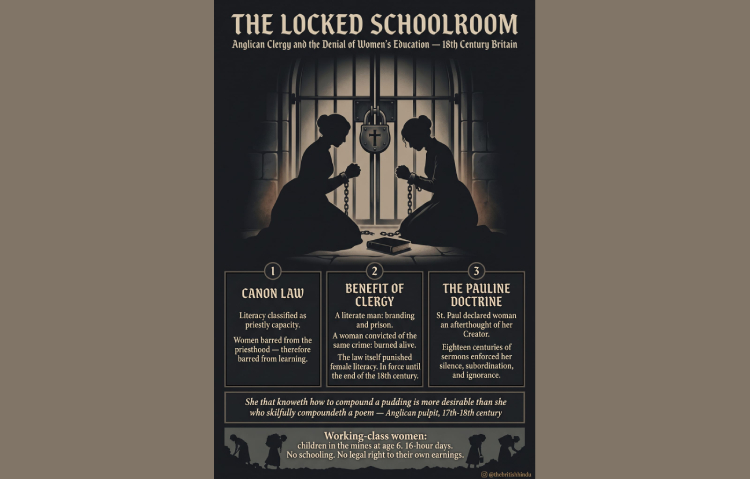 The Locked Schoolroom - Anglican Clergy and the Systematic Denial of Women’s Education, 18th Century Britain. @Author.
3. The Priestly Mechanism of Oppression
The oppression of women’s minds was not incidental to
the Church’s theology - it was structural to it. The mechanism was elegant in
its cruelty.
Literacy, in the Christian framework, was classified
as a priestly capacity. To read was to be eligible for holy orders. Holy orders were, by doctrinal decree, the exclusive
preserve of men.
Therefore: a woman who could read was, by logical
extension, claiming a right the Church refused to concede. To educate a woman
was to risk ordaining her. The Church would sooner ordain a stone.
The Pauline foundation of this edifice deserves
naming. St. Paul’s teaching - that Adam was created first and therefore
superior, that woman was an “afterthought of her Creator,” a secondary being
fashioned as an appendage to man - provided the theological warrant for
everything that followed. For eighteen centuries, this single act of
intellectual vandalism echoed through Canon Law, Common Law, and every pulpit
in Christendom. It is impossible to overstate the damage done.
A specific Canon commanded:
“Let not a woman however learned or holy presume to teach a man in a public assembly.” - Canon Law, enforced through the 18th century.”
This was not metaphor. This was law. And it was
enforced - in 17th-century New England witch trials; in 18th-century England
with social ruin and ecclesiastical censure. Matilda Joslyn Gage, the American
suffragist historian, traced a straight, unbroken line from this Canon to every
obstacle placed before women seeking to enter medicine, law, the pulpit, or the
classroom.
4. The Law That Made Women Illiteracy’s
Prisoner
The legal instrument that locked the schoolroom door
was called Benefit of Clergy - a canonical provision, absorbed wholesale into
English Common Law, that offered literate men a dramatic reduction in
punishment for criminal offences. A literate man convicted of larceny received
branding and months of imprisonment. An illiterate woman convicted of the
identical crime was burned alive or hanged.
This provision persisted, without shame or challenge, to
the end of the eighteenth century. It encoded a simple and devastating message:
literacy is a male privilege. Its legal consequences are male privileges.
Therefore, if you are a woman who learns to read, you are claiming something
the Church and State together refuse you.
Blackstone himself, the great codifier of English law,
acknowledged that the Canon Law distinction between brothers and sisters in
matters of inheritance “reflects shame upon England.” Shame is the word. It is
also, one notes, a word the Church uttered seldom about its own arrangements -
but directed at women constantly, for the sin of existing.
5. The Suppression Was Active, Not
Passive
It must be said: the Church did not simply permit
women’s ignorance. It cultivated it. The printing press - that great democratiser
of knowledge - was anathematised by the Church as an “invention of the devil.” The Bible itself was formally prohibited
to the laity across centuries of Catholic and, in modified form, Protestant
governance. The Reformation brought new names to the pulpit but no new justice
to women. Anglican, Calvinist, Puritan - all sustained, with varying degrees of
ferocity, the same foundational position: women
were inferior, sinful, subordinate, and better ignorant.
The Cromwellian period in Britain, which one might
expect to have brought reforming energy, instead brought “new reprobation” upon women’s learning and accomplishments.
The post-Reformation Church of England required women
who had given birth to perform a ritual of churching - a public expiation of
the supposed pollution of motherhood — until well into the 18th century. This
was the institution instructing women in their place. This was an institution that
the Georgian State trusted to shape the moral and intellectual formation of its
citizens.
6. What Was Lost — and What Must Be
Recovered
The tragedy is sharpened when we recall what women
were, before this machinery was assembled. In ancient civilisations - including,
as every Dharmic scholar knows, the civilisation of Bharatavarsha — women
studied the Vedas, held the Brahminical thread, taught philosophy, governed,
legislated, and were revered as the custodians of wisdom. In pre-Christian
Britain itself, among the Angles and the Germanic tribes that preceded the
Church’s arrival, wounds inflicted upon women were punished with double the
penalty of the same injury to men - evidence of a prior culture of honour. The
Church dismantled all of it.
By the 18th century, what remained for British women
was a locked schoolroom, a harnessed body in the coal pit, a catechism in place
of a curriculum, and a theology that assured her
that this arrangement was the will of God.
It was not. It never was.
The oppressor always invokes God. The task of every
civilisation that calls itself humane is to distinguish between the voice of
the divine and the voice of the institution that claims to speak for it. On
that test, the 18th-century Church of England - and the British State that
deferred to it - failed catastrophically, and British women paid the price in
their bodies, their minds, and their freedom for generations.
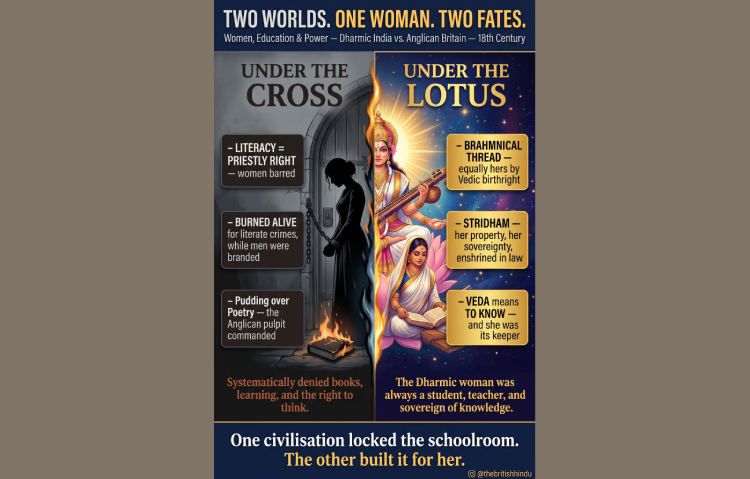 Two Worlds. One Woman. Two Fates. Women’s Education in Dharmic India and Anglican Britain Contrasted. @author.
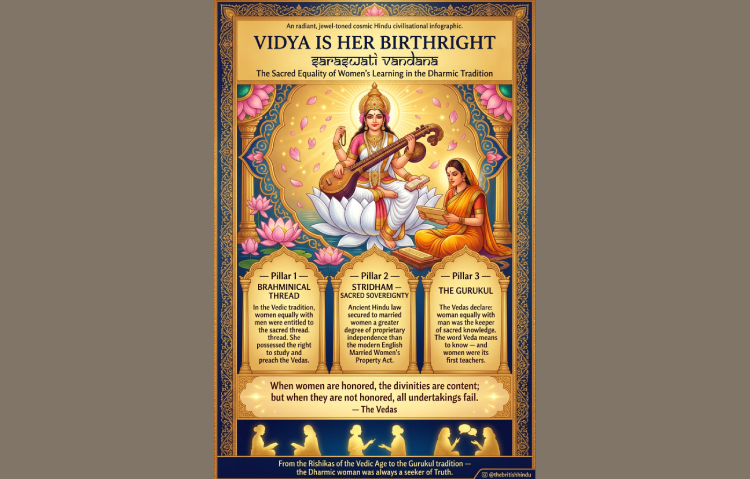 Vidya Is Her Birthright-The Sacred Equality of Women’s Learning in the Dharmic Tradition. @author.
The three pictures in article are by author and © @thebritishhindu
Author Pt. Satish K Sharma, FRAS, is a Dharmic Theologian and Fellow of the Royal Asiatic Society. He writes and speaks on the intersection of civilisational history, theology, and the rights of women.
Also read
1. Names
of Women who contributed to Indian Knowledge Systems
2. Five
Elemental Women
3. Why
Ahilyabai Holkar was a great woman (18th century)
4. Jijabai,
mother of Chhatrapati Shivaji Maharaj (17th century)
5. Tarabai,
Maratha Queen (17th century)
6. Rani
Abakka, the forgotten warrior queen of Karnataka (16th century)
7. Women
Sants of Maharashtra (1270 A.D. onwards)
8. Yashomati,
the first Queen of Kashmir
9. Remembering
Lal Deed, the Kashmiri Yogini
10. How
the British created the Dowry system in Punjab
11. Worship
of God as Mother in Indian Tradition
Editor
Notes
I was reading about how the British championed the
cause of women’s education in India in the 18th century. So, I
wanted to know how they treated women in their own country. Pandit Satish Sharmaji
has provided a fascinating insight. Bahut Dhanyavad and Aabhar.
“The British Parliament
granted franchise to its women in 1918.” Pg. 192
“Down to 1850 A.D. in England, a woman could not take
a walk, much less a journey, alone, nor could she ask a fellow worker to visit
her, unless the worker was a girl. When two ladies spoke at a meeting convened
for the purpose of supporting a women’s cause in Parliament, a Member of
Parliament said, “Two ladies have disgraced themselves for speaking in public”.
When the House of Commons was built in 1844, it was great difficulty that a
Ladies Gallery was sanctioned.” The Position
of Women in Hindu Civilization by A.S. Altekar Pg. 178 To read more click here
It would be interesting to know why, how and when the
condition of British Women changed!