- About
Diljit Dosanj and Producers/Director of Satluj. How many died in Khalistan
related violence? How many Hindus killed by Sikh militants? Why do Khalistanis
dislike KPS Gill? Those accentuating a Hindu Sikh divide must note 7 facts. Why
were Jat Sikhs victims of Police Action in Punjab? What is the political angle
to the movie?
This
India Today report states, “Satluj tells the story of activists Jaswant Singh Khalra, played by Diljit Dosanjh. Khalra began piecing together evidence of thousands of alleged illegal cremations carried out during Punjab's militancy years - the '90s.” The movie was removed from Zee5 (PIL filed).
Around 1995 S Rushdie book “The Moor's Last Sigh, featuring "Raman Fielding"—a fictional clearly modelled on Shiv Sena’s Balasaheb Thackeray.” Source I recall an interview where Thackeray was asked why he did not protest against the book he replied that he was not there to promote sales of Rushdie’s book. Any ban gets people curious, becomes a marketing tool.
Terrorism in Punjab started in the 1980s and continued till the mid-1990s. At the outset state, Father’s Ma or Dadi was Sikh. Our family temple had Guru Nanak Dev till the early 1980s till the Khalistanis made us Hindu. I worked in Rajpura, Punjab 1988-1990 when terrorism was at a near peak and in 2016 wrote on a mini-book on the Khalistan Movement
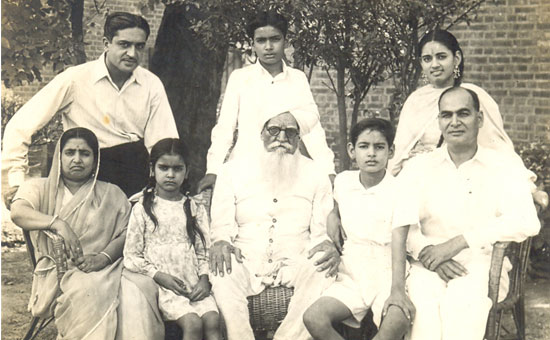 My great grand-father (paternal) 1948.
Who produced and directed movie Satluj?
Movie co-produced by Ronnie Screwala (producer
of Uri), Abhishek
Chaubey (Director Udta Punjab) and Honey Trehan (Director is ‘regarded as one of Vishal Bhardwaj’s closest collaborators.’ Times
of India )
About Diljit Dosanj
As per media reports he is the son of a Punjab Roadways driver who earned Rs 5,000/ per month. Due to limited resources, he moved to Mama’s home. Mama was a well-known Kirtanakaar so Dosanj took to singing. During school days, he sang kirtans in local Gurudwara. Today, he is a U.S.
citizen residing in California.
According to a Google search, “In 2004 was released debut studio album, Ishq Da Uda Ada. In 2005 achieved his
first major breakthrough in the Punjabi music scene with Smile. In 2009, sang The Next
Level. In 2011 he made his acting debut in the film The Lion of Punjab and released the hit track "Lak 28 Kudi Da". In 2016, he made his Bollywood debut with Udta Punjab (directed by A
Chaubey now co-producer). In 2020 released the album G.O.A.T., which became his
biggest success at the time. In 2025 co-starred with Pakistani
actress Haniya Amir in Sardar Ji 3. Coming after Pahalgam terror attack, the movie drew protests.”
A search shows, “Ravinder Bittu accused Dosanjh of supporting Khalistani agendas. This followed the release of the song ‘Rangroot’ (from the film Punjab 1984). Bittu also objected to the song ‘Putt Jatt Da’.” Source Video, TOI, Bhaskar
How many died in Khalistan related violence in 1980-1990s?
J
S Sekhon wrote in The Tribune, “The violence began with a bloody conflict between some followers of the Sant Nirankari Mission and adherents of Akhand Kirtani Jatha and Damdami Taksal, Mehta on April 13, 1978. It acquired serious dimensions in the subsequent years.”
Ajay Sahni, Executive Director, Institute for Conflict Management, wrote in The
Tribune, “A total of 21,532 persons were killed between 1981 and 1995 in connection with Khalistani terror, including 8,090 categorised as terrorists; 11,696 civilians, almost all killed by the Khalistanis, but including some who lost their lives in ‘crossfire’; and 1,746 security force personnel (1,415 of the Punjab Police alone) killed by the terrorists.”
No mention of Hindus massacred by Sikh
terrorists.
About 35% of 11,696 civilians killed were Hindus
i.e. app 4,100.
Which were the key Hindu massacres?
In 1982, protests by the Akali Dal took place at Delhi’s border during the Delhi Asian Games. Bhindranwale’s strategy was to cause communal tension so that Hindus left Punjab in fear. He hoped a Hindu backlash elsewhere would make Sikhs realise they were safe only in Punjab
Bomb blasts occurred across North India including those called “tiffin” and “transistor bombs”. (shown in TV serial Hum Log).
On
23 April 1983, Deputy Inspector General of Punjab, A.S. Atwal was shot dead in
the Golden Temple.
By
March 1984, Bhindranwale and his men began fortifying the Golden Temple. Sandbag
emplacements were seen on either side of the clock tower. Young Sikhs with
automatic rifles had taken up positions on top of the tower.
In April 1984, a prominent Sikh man in Delhi, H.S. Manchanda shot in broad daylight. BJP’s prominent politician Harbans Lal Khanna killed in Amritsar.
In
June 1984 took place the unfortunate but probably needed Operation Blue Star.
All
over Punjab, doctors, industrialists and businessmen moved to safer locations.
People were compelled to sell their land and property for a pittance.
In
1985, the bombing of Air India aircraft Kanishka killed 329.
On
10-11 May 1985, 20 bombs exploded in Delhi and 18 bombs in other parts of North
India, leaving 82 dead.
The
Rajiv-Longowal accord signed in 1985. Sant Longowal was killed in August 1985.
Terrorists
inside Golden Temple were evicted in 1988 by the Punjab Police and security
forces. Operation Black Thunder was under supervision of K.P.S. Gill.
The
Punjab Police under Gill, supported by other armed forces and under the
political leadership of Congress Chief Minister Beant Singh, broke the back of
the terror movement. Peace returned to Punjab in 1994.
Punjab witnessed a
complete breakdown of the judicial system then.
Beant
Singh (grand-father of Ravinder Bittu) was killed in a bomb blast in 1995.
Why are Khalistanis after K PS Gill?
Ajay Sahni wrote in The
Tribune, “Why are the police leaders of the periods preceding and intervening between Gill’s tenures never mentioned by the Khalistanis, despite the far greater loss of life — in all categories — under their command? Why is Gill the supposed ‘butcher of Punjab’?
The
Khalistani ire against Gill is not because more people were killed under his
leadership, it is because he exposed, shamed and comprehensively defeated the
Khalistanis.
Gill led the media into the cavernous ‘tehkhanas’ of Akal Takht, where corpses of women — raped and tortured for months, and brutally executed — were discovered. The recovery of mutilated corpses in sewers around the Golden Temple had become routine in the prelude to Operation Black Thunder (as before Bluestar earlier). On all this butchery and defilement of the Golden Temple, the vociferous advocates of ‘Khalistan’ maintain silence.”
Was Punjab always a tinderbox of politics like
what we see?
Post the 1857 Mutiny in which Sikhs supported the British
they reduced number of Bengali soldiers and replaced them with loyal Sikhs and Punjabi Muslims. It however, insisted that only Kesadhari Sikhs could join the army i.e. those who sported the five k's. It was part of their policy to divide Punjab
into Hindu and Sikh. Briefly the sequence
of events was -
Kahan Singh Nabha’s book, Ham Hindu Nahin Hain
was published in 1898. It focused on why Sikhs were not Hindus
In
1902, was founded the first Sikh political organization, Chief Khalsa Diwan. It
was a coordinating body for the Singh Sabhas.
Although the Singh Sabha movement died out in the 1920's, it awakened the Sikhs. They questioned why the job of a granthi
(scripture reader) was done by members of the Udasi order (believed in murty worship, not followers of Khalsa)
even though it was the practice since the Mughal times.
The
Akalis took control of the gurudwaras after throwing out the mahants.
The
success of these protests produced two institutions that dominate Punjab today-Shiromani
Gurdwara Parbandhak Committee (SGPC) and the Akali Dal.
The
more radical elements organised a semi-military corps of volunteers known as
the Akali Dal (army of immortals) to fight for SGPC causes. Its aim was to give
expression to a revived sense of Sikh identity.
The Akalis entered into a dispute with the British for the control of
Sikh gurdwaras. In 1925, the Sikh Gurdwaras Act was passed. By virtue of its
control over gurdwara affairs and revenue, SGPC became an important body. The Akalis are yet to relinquish
control of SGPC since 1925.
Notwithstanding loss of power by the Akalis, control of Sikh religious affairs, through the SGPC, is the key to power in Punjab. In all probability, screenings of Sutluj in rural Punjab were organised with local gurdwara support.
Congress trying to gain control over SGPC for decades. On becoming chief
minister in 1972, Giani Zail Singh tried his best to wrest control of the SGPC
and used every opportunity to placate Sikh religious sentiments and assert Sikh
identity. In order to regain the initiative, the Akali Dal Working Committee
passed the Anandpur Sahib Resolution in 1973.
In
2017 Congress won the Punjab assembly elections. Like earlier Congress leaders,
Captain Amarinder Singh wanted to reassert Sikh identity and control SGPC. Kartarpur Corridor was an excellent opportunity
for the Congress to seize centre stage in Sikh religious affairs. After all,
the Akalis never achieved this! AAP too trying but unsuccessful.
Thus, this pattern of politics/competitive communalism is the
hallmark of Punjab.
Actually
this mixing of politics and religion was started by Guru Har Govind (1606 to
1644), after the martyrdom of his father Guru Arjun, who hung two swords by his
side signifying Piri and Miri, one symbolised spiritual power and
the temporal (political). This assertion
of identity worked well when the British wanted Sikhs on their side to fight
the Afghans but in independent India!
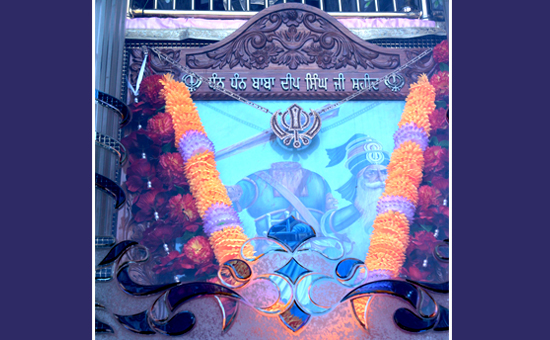 Baba Deep Singh Ji, head cut off in fight with Jamal Khan. Holding head
in hand & swaying his sword he reached Golden Temple.
Baba Deep Singh Ji, head cut off in fight with Jamal Khan. Holding head
in hand & swaying his sword he reached Golden Temple.
Some are hell bent on creating and accentuating a Hindu Sikh divide. Note
that:
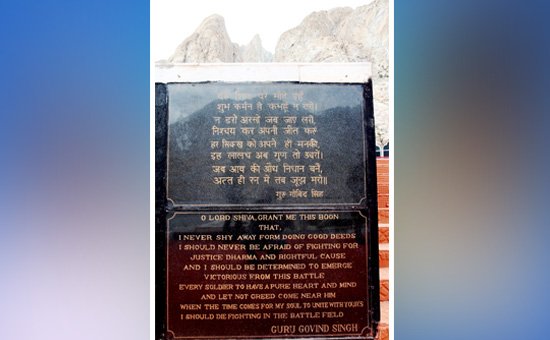 Plaque at Siachen War Memorial. Guru Govind Singhji prayer to Shivji. 2016.
1. The Kartarpur
gurdwara was renovated by Lala Sham Lal in 1911-1912 and again in 1920 by
Maharaja Bhupinder Singh of Patiala.
2. The 16th
Generation descendant of Guru Nanak Baba Vikramaditya Bedi does not sport the
5Ks (i.e.
Kesh (long hair), Kangha (comb), Kirpan (sword), Kara (steel bracelet), Kachcha
(knickers) because his great grand- father believed
5Ks were only for time of war. 1
3. Guru
Nanak went to important Hindu places of pilgrimage Ayodhya, Puri,
Amarkantak, Rameshwaram, Pushkar, Burhanpur, Kashi, Jabalpur etc.
4. Twelve kms from
Amritsar is Ram Tirth, where Sita gave birth to Luv/ Kush. According to Amritsar.nic.in, “The Bedis of Punjab (Guru Nanak a Bedi trace their descent from Kush and Sodhis (Guru Govind Singh was a Sodhi) from Luv.”
5. The first F.I.R. on Ram Mandir was filed in 1858 when a Nihang Sikh entered the Babri Masjid, took Shri Ram’s name and organised a havan there. Source Tweet
6.
Maharaja Ranjit Singh donated gold for the Kashi Vishwanath, Jwalamukhi and
Golden temples.
7.
The first major expression of Indian anger against cow slaughter was given by
the Kukas (Namdhari Sikhs) around 1870.
The problem in Punjab is Mixing of Religion and
Politics. A section of Sikhs is trying to break association with Sanatan Dharama.
The more Sikhs run away the more they realize how closely the two are connected.
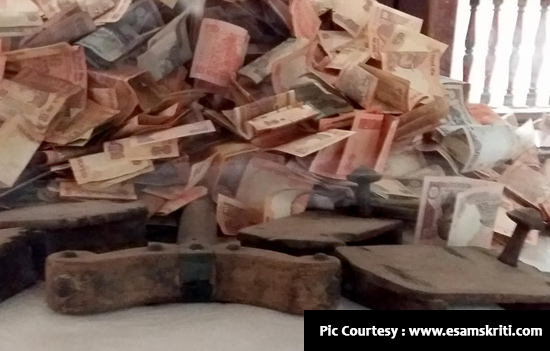 Charan Padukas of Guru Nanak and son Sri Chand at Lakhpat Gurdwara, Kutch, Gujarat, 2018.
Why were Jaat Sikhs victims of Police Action in Punjab?
J
S Sekhon wrote in The Tribune, “But the actual number of deaths was much higher and remained unreported in public records. The numbers of Sikhs, particularly Jat Sikhs who became victims of violence on both sides.”
Jaats
were the biggest proponents of the Khalistan Movement, dominate rural Punjab, are
the biggest landowners, control SGPC and political power.
Since
Punjab formed in 1966, it probably had only two non-Jaat chief ministers i.e.
Giani Zail Singh (from the carpenter community of Ramgariya Sikhs) and
Charanjit Channi (from the Chamar community of Ramdasia Sikhs). Chamars are
followers of Sant Ravidas.
Such
is their power that Kanshi Ram (Guru of Mayavati), a Ramdasai Sikh chose to
implement a social revolution in U.P. not in his home state of Punjab.
What is the political angle to the movie Sutluj?
When
Udta Punjab was released in 2016, Punjab was ruled by the Akali Dal, now by AAP
with a weakened Akali Dal hoping to return to power sans the BJP.
Movie
shall give vent to rural Sikh anger and makes
terrorists heroes. On killings shown in movie they might be told Delhi
rulers did this. It shall make rural Sikhs (Jaats) support the Akali Dal, who
could project themselves as the sole protectors of the Sikh Panth. Consolidation
of Jaat votes shall strengthen Akali hands if they explore election tie-up with
the BJP and counter BJP moves to woo Ravidassias.
Shekhar
Gupta explained political part well in National
Interest column.
In response to Gupta’s 2023 column, wrote Truth
about Sikh Alienation in Punjab Intent of article was to refute the VICTIM CARD that some Sikhs have got used to playing.
Punjab needs a leader who thinks beyond vote-bank politics and stops farmer appeasement whilst addressing genuine concerns.
Errors
if any are unintentional and without malafide intent. It is not my intent to
defame any person living or dead or any political party.
Also read
1.
To read all
articles on Sikh History
2.
Story of the descendants of Guru
Nanak
3.
How the British divided Punjab into
Hindu and Sikh
4.
Why Dera Sacha Sauda draws
followers
5. Oh, That
other Hindu riot of passage by Khushwant Singh
6.
Caste
in Sikhs
7.
Is
Modern day Sikhism a Colonial Construct
8.
Why
was the First Son made a Sikh
9.
Real
Problems in Punjab
10.
Why
Bhakra Nangal Dam was made
11.
History
of Akal Takht