- FAQ
includes origin of Nihangs, are they spiritually inclined, headquarters, is
Shastra Vidya unique to Nihangs, origin of Hola Mohalla (also see pictures) attended
by Nihangs & Who are Nirmalas. Use of swords in public was required during Mughal
times and Afghan invasions but today!
Nihangs
(blue coloured dress) are in the news again. This time for brandishing swords
at the CJP Jantar Mantar protests. Early this year, some Nihangs got into a
fight with locals in Garwhal, Kumaon. They were visible during the Farm Laws
protest too. In 2020 Nihangs cut off the hand of a Punjab Police ASI
This
piece briefly covers their origin/history and pictures of Nihangs at Hola
Mohalla i.e. held annually at Anandpur Sahib where Khalsa was founded in 1699.
1. What is the origin of Nihangs?
“The origin of Nihangs or Akalis is not known although they claim to be true representatives of 10th Guru Govind Singh and consequently the true
Khalsa. During the 18-19th centuries they were known as Akalis and feared as determined warriors. In the time of the misls, they usually fought for the Shahid misl. Under Ranjit Singh they were renowned for their bravery and total lack of discipline except when controlled by the Akalis.” 1 Pg. 153 Also read 4 Pg. 199/243
“After the death of their famous leader Phula Singh in 1823, they dwindled in importance. They have two vices, as seen by others, namely fondness for bhang (cannabis) and their habit of not paying for anything they require.” 1 Pg. 154
“Nihangs are divided into four armies (dal), each under its own jathedar. On their heads they wear a high turban known as damala,
surmounted by a piece of cloth called pharahara (standard or flag).” 1 Pg. 154
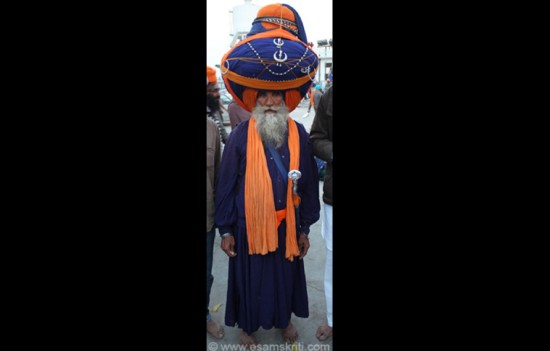 Man with biggest turban. Hola Mohalla 2014.
2. What is origin of the word Nihang?
The word Nihang can
be traced back to Persian nihang (alligator) or to Sanskrit Nishanka (fearless,
carefree).
The
name Nihang (free from worldly concerns) may have been taken from the
pre-initiation name of Akali Phula Singh. 1
Pg. 154
3. Do Nihangs marry?
Earlier,
most were unmarried believing that as true followers of Khalsa they must remain
unencumbered by family ties. Times are changing however.
4. Do Nihangs stay in one place?
Earlier,
they stayed in their deras (camps) attending to cultivation. The balance time,
they would roam around Punjab on horseback, identified by their blue dress and
for the range of steel weapons they carried. 1 Pg. 154
Today,
they have their own Gurdwaras. Sukhbir Badal was recently attacked at a Nihang
gurdwara in Nanded, Maharashtra.
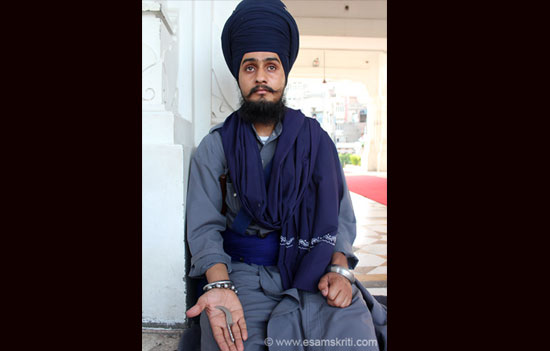 A Granthi at Hari Mandir displaying his weapons. 2012.
In his hand is Sri
Sahib. It is hidden in the pagdi. He said in case someone attacked from behind
the Sri Sahib is used to attack that persons eyes. Left of pic u see brown
stick next to his arm is a sword. Thick bangle in hand right of pic is called
Jangi kara - war bracelet.
5. Are Nihangs spiritually inclined?
Lavanpreet
Kaur wrote in The Hindu in 2026, “A person wearing blue and carrying a weapon may look like a nihang but tradition requires bani (wisdom) and bana (attire), spiritual practice and outward discipline. Daily prayers and meditation, knowledge of Sikh scriptures, following Khalsa code, Shastar Vidya and traditional study of Sikh weaponry, horse riding, seva, physical endurance form part of the ideal.”
According
to OutlookIndia, “Nihangs rise early in the morning and recite nitnem (daily prayers), which include banis from Guru Granth Sahib, the Dasam Granth attributed to Guru Govind Singh and the Sarab Loh Granth, which depicts the fight between good and evil; They recite with passion Guru Gobind Singh’s Chandi Di Var, describing the battle between the gods led by Goddess Durga and the demons.”
Kalarippayattu,
martial tradition of Kerala & Silambam, Martial
art of T Nadu
6. Where are the headquarters of the Nihangs?
According
to ThePrint, “The headquarters of the Buddha Dal is at
Talwandi Sabo, while that of the Tarna Dal is at Hoshiarpur. Earlier, they used
to live in makeshift deras called chhaavni or cantonments. But now permanent deras have come up at many places in the state, where they live learning martial arts like gatka, horse riding and wielding weapons. Most deras house gurdwaras.” Divided into these 2 dals in 1733 says The
Hindu
According
to Indian Express, ““In the recent past, the Nihang chief, Baba Santa Singh, had fallen afoul of the mainstream Sikhs as he went on to rebuild the Akal Takht that was damaged during Operation Bluestar in June 1984.” Read What were the events
that led to Op Blue Star
Today
Nihangs are split into smaller groups and all over Punjab.
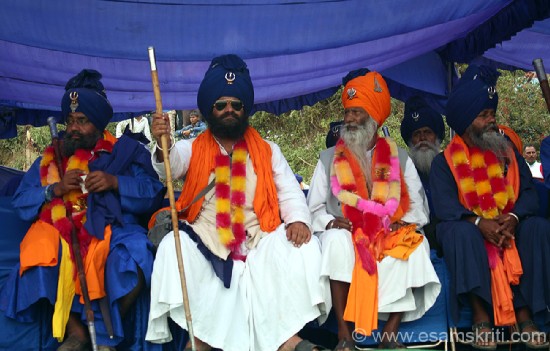 Heads of Nihang groups, Hola Mohalla 2014 held at Charan Ganga stadium.
Speaker treated
every head of each Nihang Group with respect, said good things and then request
them to sit on the stage. Chiefs of different warrior clans all looking
straight.
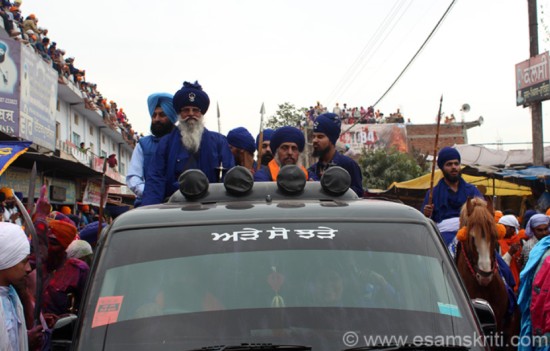 A Nihang group proceeding to stadium. Guns and swords seen.
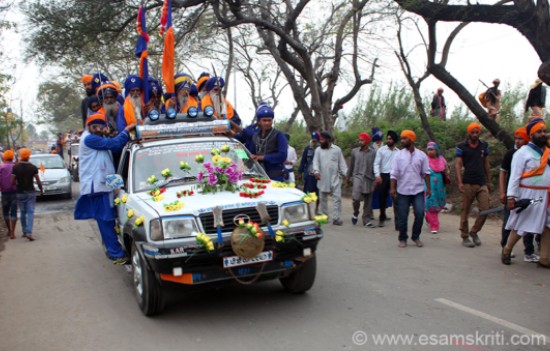 A Nihang group enroute to stadium..
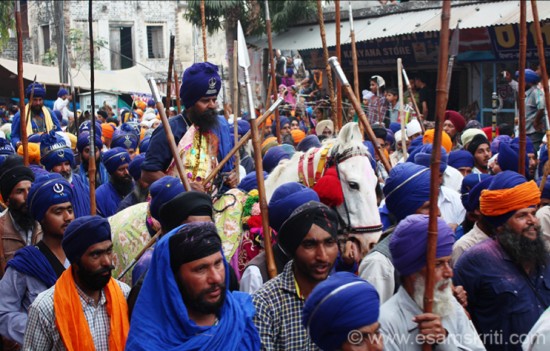 Another Nihang group.
7. Is Shastar Vidya unique to Sikhs?
Yogendra
Singh wrote in Pragyata.com, “According to Sikhan di Bhagat Ratan Mala (written
in the 17th century), Guru Hargobind was taught Shastarvidya by two Rajputs, namely Rao Sigara and Rao Jaita. His great-grandson Guru Govind Singh, the tenth Guru of Sikhs, was taught by Rao Bajjar Singh Rathore, great-grandson of Rao Mandan Ji Rathore. And later Guru Govind’s kids were taught by Rai Alam Singh Chauhan, who, till today is considered as one of the finest generals to have ever lead Sikhs.”
Sangam Talks video, “Guru Nidar Singh Nihang, the sole surviving Guru of the classical Baba Darbara Singh Shastar Akhara established in 1661, gives us a fascinating account of how Shastra Vidya flourished in India till the arrival of the British, who not only banned possession of weapons but subdued and suppressed all native martial traditions. Improvising ways to hoodwink the British to keep their weapons, the brave Nihangs strove against all odds to preserve their closely guarded art which was teetering on the brink of extinction.”
8. What is GATKA that we usually see Nihangs play?
Gatka is a style of
fighting between two or more practitioners, with wooden sticks intended to
simulate swords. The martial art, in which Gatka (wooden stick) is used as a
weapon, is called Gatkabaazi. Source
After the Second
Anglo Sikh War 1848-49 and British Raj, Sikh martial practioners suffered
greatly. British ordered effective disarmament of the Sikh community. It is
because the Sikhs supported the British during the 1857 Mutiny that
restrictions on fighting were relaxed. The old method of sword training was
replaced with sticks. However, swords made a return at Jantar Mantar.
To see my 2014 album on Gatka at Hola
Mohalla, Anandpur Sahib
9. Who and why was festival of Hola Mohalla started?
Guru Govind Singh ji started the festival of Hola Mohalla around 1700. It was started at Anandpur Sahib where Khalsa was founded on 30/3/1699. Intent was “Martial Spirit and Training: To instill the martial spirit and discipline among Sikhs. During this festival, Khalsa Warriors would demonstrate their combat skills, including Gatka, archery, sword fighting, horseback riding, and other military exercises.” Source I saw the same spirit during my 2014 visit (see pics below).
“Hola is derived from the word halla (a military charge) and the term mohalla stands for an organized procession or an army column. The words Hola Mohalla would thus stand for ''the charge of an army.” Read
10. Guru Govind Singh ji also started Nirmalas. Who are they?
Author and former British Council Scholar Dr
Satish K. Kapoor wrote in South
Asian Observer Toronto, “While at Paonta Sahib (Himachal Pradesh) where he composed most of his writings, Guru Govind Singhji sent five of his disciples – Gandā Singh, Karam Singh,Vir Singh, Rām Singh and Saina Singh – investing them with the saffron attire of ascetics, to Kāshī (Vārāṇasī) in 1686, for learning Sanskrit and acquiring knowledge of classical Hindu texts. The chosen Sikhs studied under Pandita Satyānanda for about seven years and acquired the quintessential of ancient Sanskrit literature.”
“After returning to Ᾱnandpur Sahib (Punjab), they were called Nirmalas, meaning pure and spotless. As directed by Guruji they imparted their learning to others, translated works from Sanskrit into Gurmukhi and set an example in righteous living. The Nirmalas keep long hair, flowing beard, and wore turban but do not always undergo the Sikh baptismal rites. They consider Vedānta as most practical and sublime, and are sometime called Vedāntī Sikhs.” Also read 4
Pg. 77
11. Biggest gathering of Nihangs is at Hola Mohalla, Anandpur
Sahib (birthplace of Khalsa). Here are pictures from my 2014 album
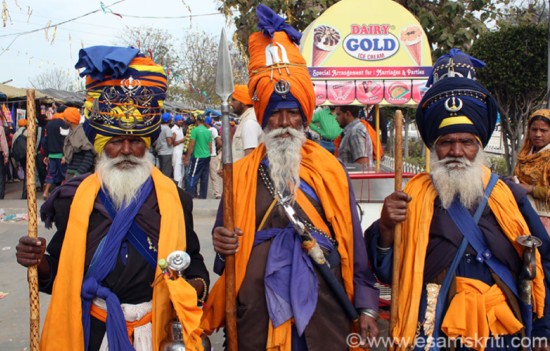
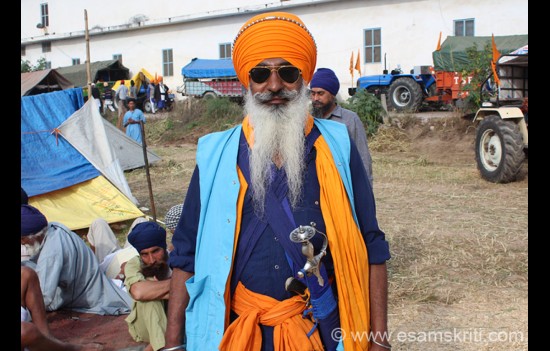 A Nihang whom I met.
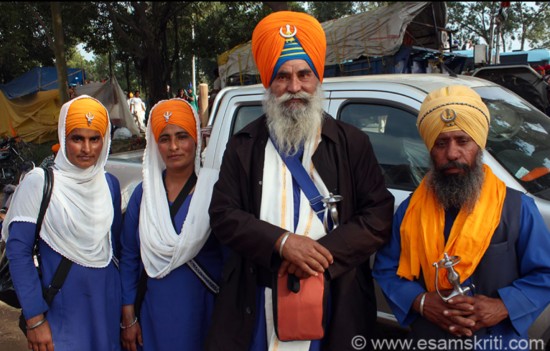 Some more Nihangs.
 Some more Nihangs.
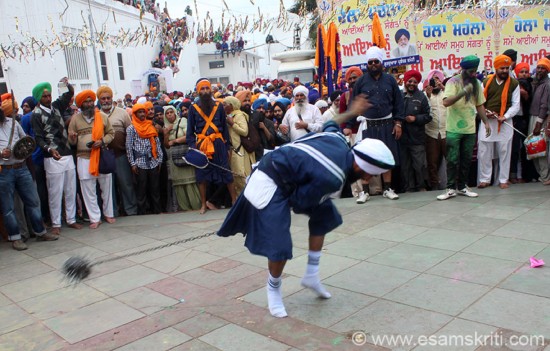 Gatka performance outside Keshgarh Sahib where Khalsa was founded.
I
met a Pharma graduate from Panchkula, Haryana. He was dressed up as a Nihang.
When we got talking got to know he had taken a 2 year break from work to learn
Gatka.
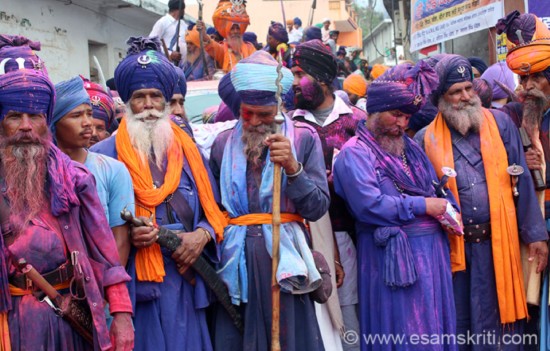 Some more Nihags.
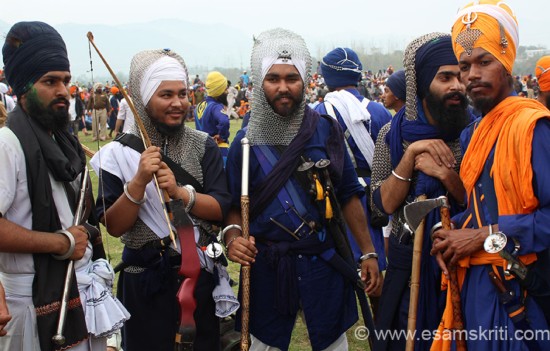 In full gear at Charan Ganga stadium 2014.
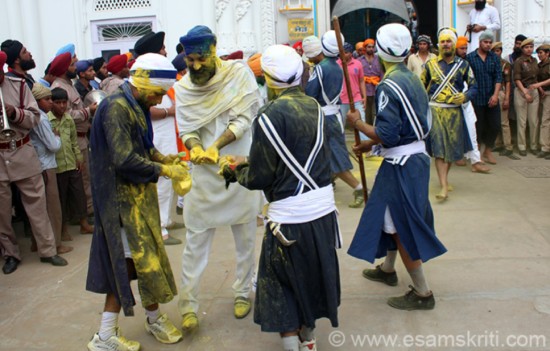 Celebrating Holi at Hola Mohalla 2014.
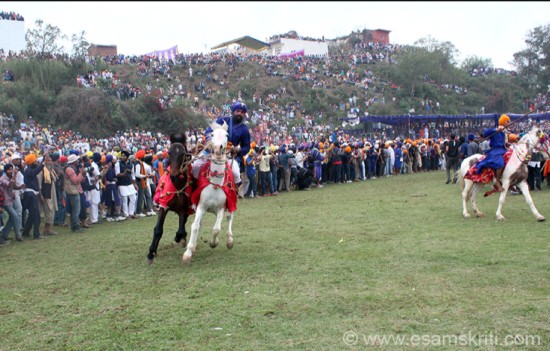 Horse riding at Charan Ganga stadium.
They
ride at great speed with impressive control. We photographers had to stay away
lest we came under the horse. Creditable control.
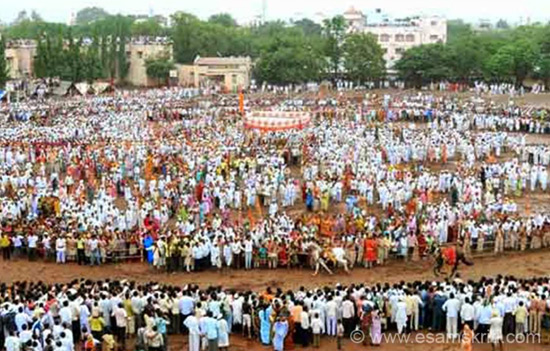 Horse part of Pandharpur Ringan, Maharashtra though used differently. Pic by Milind V.
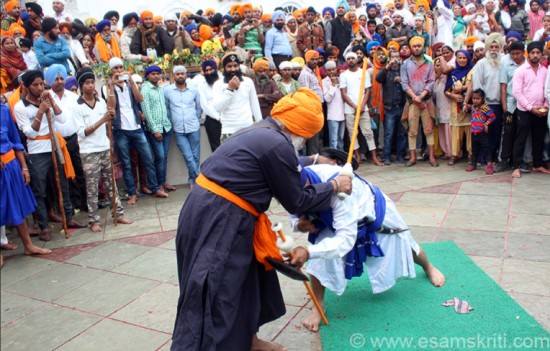 A Gatka student offers respects to his Guru before performance.
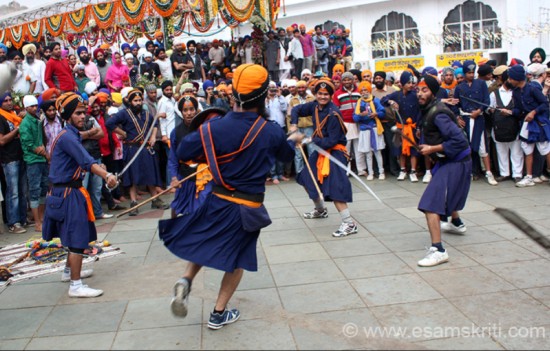 A Nihang fighting with four others. Swords made of plastic.
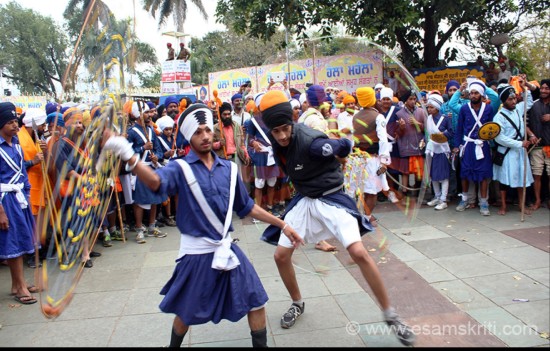 One using a
Chakkar with right hand and another both hands but behind him, tough.
One using a
Chakkar with right hand and another both hands but behind him, tough.
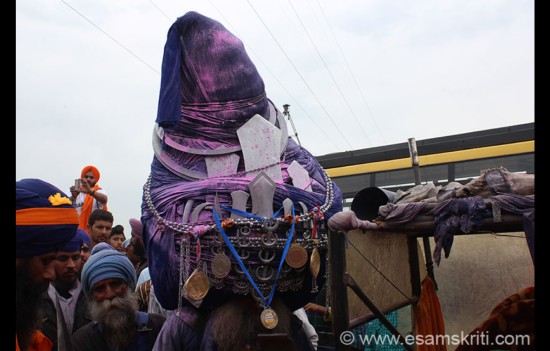 Probably, the most called out person at Hola Mohalla 2014.
To
get a true feel of Sikhi visit Anandpur Sahib during Hola Mohalla. Great
experience.
Also read and
References
1.
Historical Dictionary of Sikhism by W.H. Mcleod.
2.
Sanatan Shastra
Vidya
3.
Video 8 minutes Book Review – Sanatan Shastra Vidya
4. History of Sikhs Volume 1 by Khushant Singh
5.
Is
Kripan essential to Sikhism
6.
Why
do Sikhs wear Turbans
Disclosure – Am Sanatani Punjabi whose Dadi (father mother) was Sikh.