- This
book is devoted to a key event in the history of the Indian Sub-continent,
Direct Action Day Calcutta 1947. It gives the event the importance it deserves.
Alok reviews the book and shares insights. Had it not been for Gopal Patha
response, Calcutta might not have been part of India today. Note Gopal was
Brahmin and a Butcher!
The chronicle of India’s Partition in 1947 is predominantly rendered as a grand diplomatic tragedy enacted within high-ceilinged conference halls, colonial estates, and parliamentary chambers. Mainstream historical narratives have long favored the polished rhetoric of elite political leaders, focusing on territorial bargaining, ideological impasses, and the tragic misery of millions displaced across newly carved borders.
Yet,
beneath these high-level political deliberations lay a raw, visceral reality
that formal historiography has systematically overlooked or sanitized. The
battle for the physical and geographical soul of India was not fought with
fountain pens and boundary commissions; it was fought on blood-soaked asphalt,
down cramped alleyways, and within terrorized urban neighborhoods.
G.O.A.T.:
Gopal 'Patha' Mukherjee, the Meat-Shop Owner Who Saved Kolkata, written by
veteran journalists Abhijit Majumder and Debdutta Bhattacharjee and published
by BluOne Ink, turns its lens directly onto one of the most explosive
flashpoints of modern Sub-continent history. By reconstructing the direct,
organized armed resistance mounted by an unassuming neighborhood meat-shop
owner during the Great Calcutta Killings of August 1946, the authors deliver a
gripping, meticulously researched, and fundamentally challenging reassessment
of how Kolkata survived an existential siege.
To fully appreciate the weight and courage of Majumder and Bhattacharjee’s work, one must first confront the sheer desperation of Bengal’s political landscape in the middle of 1946. World War II had drawn to a close, and the liquidation of the British Raj was an imminent certainty. The Muslim League, led by Muhammad Ali Jinnah and bolstered locally by the Chief Minister of Bengal, Huseyn Shaheed Suhrawardy, was uncompromisingly committed to carving out the maximum possible territory for the proposed state of Pakistan.
In this grand territorial ambition, Kolkata was the ultimate prize. As the largest, wealthiest, and most economically vital metropolis in colonial India, Kolkata, along with its surrounding industrial belts of Howrah and Hooghly, was coveted by the League as an indispensable financial engine for East Pakistan. The major obstacle to this annexation was demographic: out of Kolkata’s population of twenty lakhs, approximately 64 percent were Hindu. To absorb the city into East Pakistan, that demographic reality
had to be forcefully and permanently shattered.
The
spark that ignited this tinderbox was struck on August 16, 1946, when the
Muslim League declared Direct Action Day
to enforce its demand for Pakistan outside constitutional means. Majumder and
Bhattacharjee meticulously document how the provincial state machinery under
Suhrawardy was systematically subverted, neutralized, or weaponized to
facilitate the initial wave of violence. In the months leading up to August,
the police administration was altered; local constables, traditionally
recruited from Bihar and Uttar Pradesh, were intentionally replaced with
recruits brought in from distant districts. Special petrol rationing coupons
were issued to rioting mobs while the general populace faced shortages, and
public transit buses were deployed under official escort to transport armed
mobs into Hindu-majority neighborhoods. Inflammatory pamphlets were distributed
across the city, promising the establishment of an Islamist order and openly
threatening total annihilation.
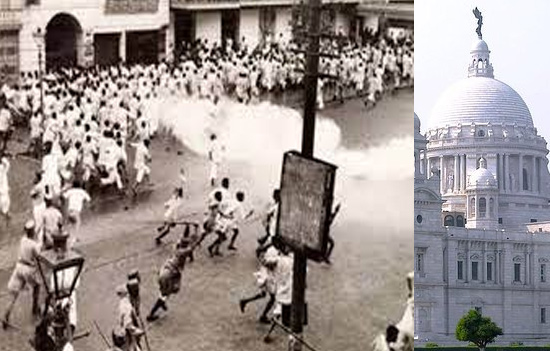
When
the violence erupted, the initial result was an unprovoked, state-sanctioned
massacre. The authors do not shield the reader from the gruesome reality of
those first forty-eight hours, drawing on police archival records, family
testimonies, and contemporary survivor accounts to capture the sheer scale of
the terror. Over 600 Hindus were butchered in the Lichubagan Bustee alone. At
the Ballygunge Sewage Pumping Station, sanitation workers attempting to clear
blockages discovered over a hundred dismembered bodies submerged in the dark
sewage tunnels. In Rajabazar, mobs tortured women and hung their bodies from
butcher shop hooks. Entire generations were wiped out in single afternoons,
such as the horrific assault on a household where twenty-five out of
thirty-seven family members were murdered in cold blood.
For
the first two days, Kolkata’s majority population was paralyzed by shock, caught completely defenseless in the face of a calculated campaign designed to trigger a massive, panicky exodus that would alter the city's demography forever.
It
is precisely within this vacuum of state protection, administrative complicity,
and civic panic that the authors introduce their central figure, Gopal Chandra
Mukherjee. A 33-year-old running a modest meat shop near College Street and
Bowbazar, Mukherjee was known throughout his neighborhood by the moniker Patha,
the Bengali word for a male goat, referencing his family's trade. He was
neither a high-ranking politician nor an ideological theorist. However, he
inherited a deep legacy of anti-colonial defiance; his paternal uncle, Anukul
Chandra Mukherjee, had been an active revolutionary fighter in Bengal's freedom
struggle. When the state apparatus collapsed and the police actively abetted
the violence, Gopal Patha stepped into the void, recognizing that academic
appeals were entirely useless against an advancing mob.
Majumder
and Bhattacharjee brilliantly detail how this humble trade identity was
transformed into a formidable nexus of urban defense. On August 16 itself, as
the first reports of violence began to stream in, Gopal Patha began organizing
local youths. By August 17, as state inaction made the existential threat undeniable,
he formally organized the Bharat Jatiya
Bahini, a disciplined counter-mobilization force comprising 800 to 1,000
young men. This was a structured defense unit made up of local gym-goers,
wrestlers from traditional neighborhood akharas, blacksmiths, laborers,
butchers, and youth volunteers.
Crucially,
it spanned diverse socio-economic and regional backgrounds, uniting Bengalis, Biharis, and immigrants from Uttar Pradesh under a single operational banner.
The authors lay out the clear strategic principle that governed Gopal Patha’s resistance, captured in his famous operational rule that they would never strike first, but if attacked, they would respond with compounding interest. Between August 18 and August 21, this organized Hindu counter-offensive completely turned the tide of the Great Calcutta Killings. Supported by emergency funds raised by Bengali and Marwari business communities, and utilizing the traditional bomb-making expertise retained by local nationalist networks, Gopal Patha’s unit established neighborhood communication lines, fortified vulnerable residential pockets, and executed swift, targeted counter-strikes against key riot organizers.
By
meeting force with superior, organized tactical resistance, the Bharat Jatiya
Bahini broke the momentum of the rioters and forced the provincial government
to finally deploy military units to restore order.
One of the most powerful episodes recounted in the book occurs in the aftermath of the violence, when Mahatma Gandhi arrived in Kolkata to broker peace and requested local defense leaders to surrender their weapons. While many elite political leaders complied for symbolic reasons, Gopal Patha famously refused. He bluntly informed Gandhi’s emissaries that his weapons had been gathered to protect innocent women, children, and defenseless citizens from state-backed massacres, not to launch unprovoked attacks on others. He argued that surrendering those arms while surrounding threats remained active was not an act of non-violence, but an act of cowardice that would leave his community exposed to future slaughter.
Spanning
roughly 146 pages the book has a remarkable narrative momentum. Both Majumder
and Bhattacharjee draw heavily on their decades of combined experience in
investigative journalism, delivering a narrative that is entirely free from the
dry, dense, and opaque prose that often weighs down academic historical texts.
The prose is lean, sharp, and fast-paced, reading with the tension and kinetic
energy of a historical thriller while maintaining a steadfast commitment to
factual accuracy. Every page moves the narrative forward with purpose, driving
the reader through chronological developments without succumbing to unnecessary
filler. This accessibility does not mean the book compromises on historical
depth.
The authors weave together oral histories, family archives, primary documents, police reports, and contemporary survivor statements, such as the harrowing recollections of Noakhali riot survivor Rabindranath Dutta. The sensory detail is deliberately raw and uncompromising. The authors do not sanitize the horrifying sights, sounds, and smells of a city under siege, forcing the reader to directly confront the visceral reality of urban warfare in 1946. This stylistic choice is vital because it contextualizes Gopal Patha’s counter-offensive not as an abstract political statement, but as a desperate, logical response to an imminent threat of total annihilation.
The
true historical significance of G.O.A.T. lies in its unapologetic
challenge to Indian historiography. Majumder and Bhattacharjee explicitly
critique post-independence "court historians" and mainstream
Nehruvian and Marxist academic frameworks for intentionally suppressing or
demonizing figures who engaged in armed self-defense. In standard historical
records, Gopal Patha was frequently reduced to a peripheral underworld figure,
labelled an underworld goonda or a violent street tough, a reductionist
categorization that completely erased his strategic role in saving Kolkata from
demographic engineering and annexation.
The authors build
three powerful central arguments that form the backbone of the book.
First,
they put forward the Partition Geography Argument, convincingly demonstrating
that without the organized armed resistance mounted by subaltern defense
networks between August 18 and 21, the demographic composition of Kolkata would
have been shattered by forced exodus. Had Kolkata been emptied of its Hindu
population, the entire city, along with strategic swathes of West Bengal, would
have been seamlessly incorporated into East Pakistan during the 1947 Partition.
Second,
the authors center the concept of Subaltern Historical Agency, proving that
during moments of total state breakdown, the actual preservation of society
relies on working-class citizens who possess the courage and organizational
capability to defend their homes on the ground.
Third,
the book opens up a profound ethical defense of Retributive Self-Defense,
arguing that when state machinery abdicates its primary duty to protect human
life and actively aligns with aggressors, organized armed resistance serves as
a supreme moral imperative for civilizational survival.
Any
fair and thorough evaluation of the book must also address its specific
ideological stance. The authors write with an explicit revisionist mission, and
their tone occasionally borders on hagiography, presenting Mukherjee in consistently
heroic terms. Readers seeking an entirely detached, neutral academic tone will
easily spot the authors' passionate advocacy for their subject's total
historical rehabilitation. Yet, this passionate framing is precisely what makes
the book such a vital contribution to modern Indian discourse.
By
rescuing a heavily suppressed historical figure from historical amnesia,
Majumder and Bhattacharjee open up crucial debates about how national histories
are constructed, who gets commemorated, and how subaltern heroes are
categorized by political elites.
Conclusion
Abhijit
Majumder and Debdutta Bhattacharjee have crafted an extraordinary, courageous,
and deeply impactful work of historical reclamation. G.O.A.T.: Gopal 'Patha'
Mukherjee, the Meat-Shop Owner Who Saved Kolkata is a compelling,
fast-paced, and brilliant book that restores a long-forgotten subaltern
defender to his rightful place in the annals of Partition history.
Published
at a time when Indian society is actively re-examining its mid-20th-century
history and challenging established orthodoxies, this book serves as a powerful
reminder of the unsung individuals who shaped the nation's borders on the
ground. Unflinching, gritty, and deeply resonant, it is essential reading for
anyone wishing to understand the true, unvarnished story of how Kolkata was
saved in the dark summer of 1946.
About
the Author:
Alok
V Tiwari is Senior Manager (Northern region) - Government Partnership,
Strategic and Knowledge Consulting at Grassroots Research and Advocacy Movement
(GRAAM), New Delhi. His research lies at the intersection of Technology,
Governance and Democratic Decentralisation. He is also Associate Research
Fellow at Dr. Syama Prasad Mookerjee Research Foundation (SPMRF).
To buy book on
Amazon India Read and decide for yourself.
Also read
1.
Direct Action Day
1946
2.
Who was responsible for India’s Partition
3.
Did geopolitics result in India’s partition
4.
Did Ahimsa get
India freedom