- Why were Shekhawati’s Havelis made and by whom? What were the painting themes? Why preservation and restoration of Shekhawati’s Havelis is important? Pics of Shekhawati Frescoes.
Rajasthan is a land where history never quite fades — it lingers in forts, echoes in folk songs, and glows in the golden light of its desert towns. But nowhere does history paint itself more vividly than in Shekhawati, the region often described as the world’s largest open-air art gallery.
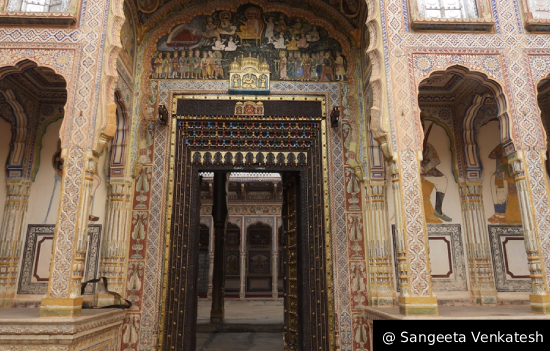
Spread across the districts of Jhunjhunu, Sikar and Churu, Shekhawati’s havelis are draped in thousands of frescoes that turn the walls into canvases of myth, memory, culture, and change.
Walking through these towns is like stepping into a vast illustrated manuscript — every lane holds a story, every mansion a mural, every colour a whisper from the past.
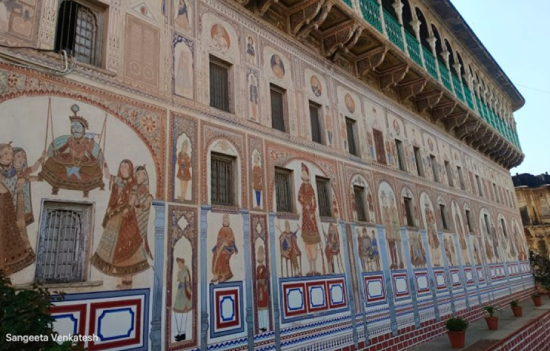
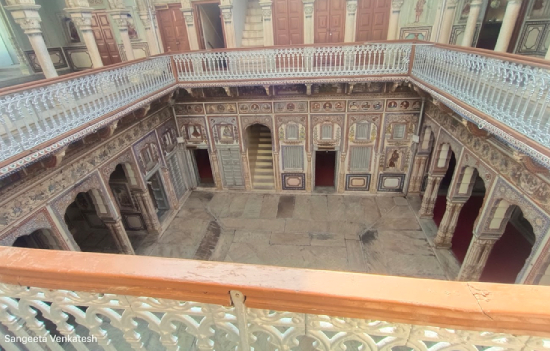
A Region Built by Merchants, Imagined
by Artists
The story of Shekhawati’s frescoes begins with its people — the wealthy Marwari merchants who once controlled trade routes running across Rajasthan. As their business networks expanded from India to Central Asia and beyond, prosperity followed.
With
wealth came a desire to express status and gratitude. Families began building
elaborate havelis with spacious courtyards, carved gateways, delicate jharokhas
and painted facades. These homes were both residences and symbols of success.
To bring these murals to life, merchant families turned to local artisans — the chiteras (traditional painters, often
from the potter community) and chajeras
(masons). Over generations, these artisans refined a distinctive technique that
gave Shekhawati frescoes their hallmark beauty. In days when there were no
photographs or prints to get inspired from, painters relied on loose
instructions given by their patrons.
The Art of Arayish: Colours Embedded
in Time
One of the region’s fascinating traditions is arayish
(fresco-buono), a technique where colours are applied on freshly laid lime
plaster. As the plaster dries, pigments literally fuse with the surface,
creating paintings that withstand harsh desert conditions.
Natural
pigments extracted from minerals, stones, charcoal, and vegetables were
originally used. In the late 19th century, chemical colours arrived from Europe
and expanded the palette.
Yet the essence remained unchanged — bold lines, flat colour planes, decorative borders, and a storytelling spirit that valued narrative richness over realism. Even today, the polished sheen of arayish walls — achieved by rubbing with agate stone — gives many havelis their soft, glowing finish.
Themes on the Walls: From Ancient
Epics to Modern Machines
What makes Shekhawati’s frescoes extraordinary is the sheer range of themes. These were not mere decorations; they were mirrors of life — spiritual, everyday life, and aspirational.
1.
Mythology and Devotion
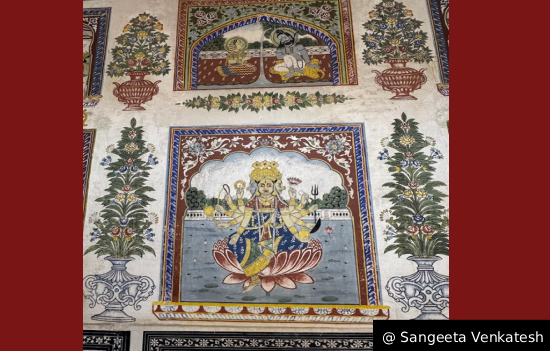
The walls were filled with scenes from the Ramayana, the Mahabharata, the childhood tales of Krishna, Hanuman and various gods and goddesses. These murals embodied faith, served as visual scriptures, and often revealed the devotional preferences of the haveli’s owners.
2.
Daily Life and Social
Scenes
Beyond gods, artisans painted the world
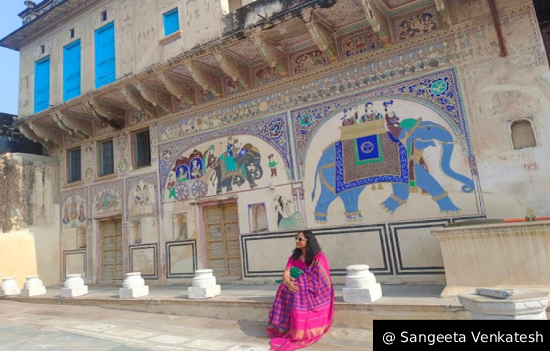
around them: camel caravans, Women with their group of friends, wrestlers and
other forms of games, marketplaces, musicians and dancers and much more.
These
glimpses into everyday life became a valuable social record of 19th-century
Rajasthan.
3.
Romantic and Folk Tales
Ballads
and love stories, particularly the legendary Dhola-Maru riding a camel through the desert, often appeared on walls — blending romance with regional folklore.
4.
Nature, Animals and
Decorative Motifs
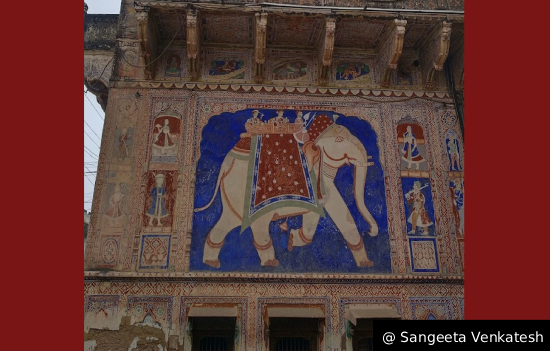
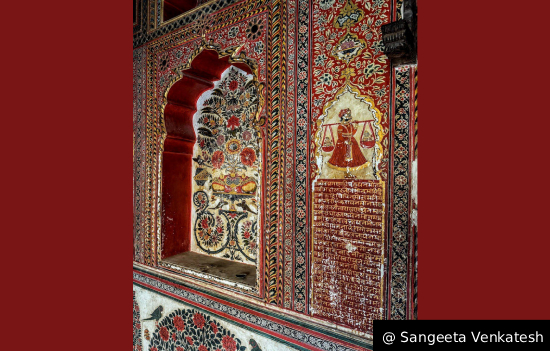
Peacocks, elephants, horses and floral arabesques created ornamental patterns that framed larger panels. These motifs added rhythm, beauty and symbolism — peacocks for monsoon, elephants for royalty, vines for prosperity.
5.
Modernity Arrives
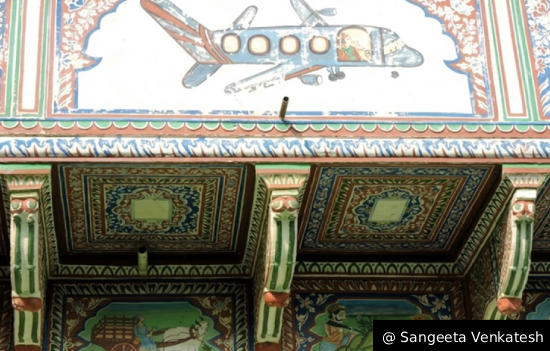
Perhaps the most surprising phase came when Shekhawati’s traders, travelling across the world, discovered new inventions. Their excitement found its way onto the walls: Trains, Early automobiles, Bicycles, Hot air balloons, Telegraph lines and Europeans in Victorian clothing
These images captured the region’s transition from tradition to modernity and showcased the merchants’ global exposure.
Architecture as Grandeur: The Haveli
Aesthetic
The frescoes are only part of the experience. The havelis themselves are masterworks of architecture — designed with precision, aesthetics and climate in mind.
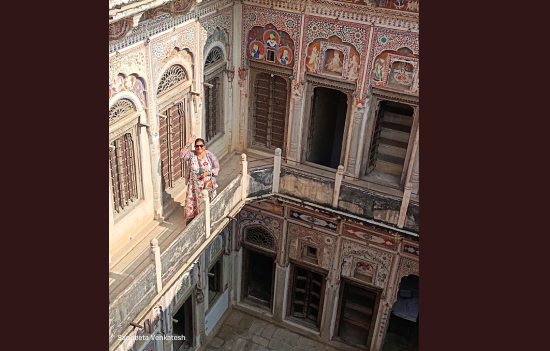
Typical havelis featured: Two or more courtyards — the outer for guests and trade, the inner for the family, Massive carved wooden gates, Delicate jharokhas overlooking the streets, Ornate pillars and arches and Raised platforms (tibas) for seating and meetings.
Every surface — walls and ceilings to doorframes and niches — were viewed as a potential canvas.
The Tragedy of Abandonment - and Why
It Matters Now
Many
Marwari families migrated in the 20th century, setting up businesses in
Kolkata, Mumbai, and across the world. Their ancestral mansions, once alive
with activity, gradually fell quiet.
Today,
numerous havelis lie in neglect: Walls cracking, Colours fading, Roofs
collapsing, Rainwater seeping through and wooden elements decaying.
A
revival movement has begun, but with challenges: The traditional arayish
artisans are now very few, Restoration requires high skill and higher cost and many
properties lack clear ownership
Yet
the importance of preservation cannot be overstated.
Shekhawati’s frescoes are not just art; they are: Historical documents, Cultural memory, Architectural heritage, Stories of migration, faith and modernity and India’s richest repository of painted mansions.
Saving them is saving a unique chapter of India’s cultural identity.
Exploring
Shekhawati feels like stepping through layers of time.
In
Nawalgarh, Mandawa, Fatehpur and Dundlod, each haveli reveals a different world.
Some mansions, such as the Podar, Morarka and Nadine Le Prince havelis, were
lovingly restored. Others stand silent, their beauty fading but still powerful.
Shekhawati is not just a destination — it is a museum without walls, a celebration of imagination, and a reminder of how art can define a region.
The
frescoes of Shekhawati are a spectacular fusion of faith, folklore, craftmanship
and global curiosity. They tell the story of a people deeply rooted in
tradition yet unafraid of the new.
As
visitors and storytellers, we owe it to this region to keep these memories
alive. Because when a fresco fades, so does a chapter of history.
How to reach
Jaipur is the closest airport and
big railway station.
To read all articles by author
Also read
1.
Places
to visit in Shekhawati are Churu, Sikar, Mandawa, Nawalgarh, Fatehpur,
2.
Rajasthan
Tourism site on Shekhawati Khetri Mahal and Rani Sati Mandir nice, Dundlod
village in Jhunjhunu.
3.
About
Shekhawati
4.
History
of Shekhawati with personal angle and pictures
5.
How
to see the Havelis of Shekhawati – good
6.
Vedaaranya Experiences
Shekhawati