- Senior Journalist Sandipan Deb deep dives into and tells you about this book that takes around 30 speeches delivered by Vivekananda across undivided India and Sri Lanka between 1897 and 1901, and contextualizes and annotates them with excellent infographics. Book author is IIT-IIM alumnus.
I don’t think too many people will disagree with my view that Swami Vivekananda was one of the greatest Indians born in the last 500 years. The fact that he was only 39 years old when he passed makes his life and accomplishments even more extraordinary. His appeal extends across all creeds and demographics of the Indic people. Yet most of us, while revering him, may not be fully conversant with the depths and nuances of his inspirational philosophy.
Srinivas Venkatram’s book Awakening
The Nation: Rediscover the Spirit of India with Swami Vivekananda presents the sage’s thoughts on invigorating the ideas of Bharat and Bharatiya pride in a format that is very appropriate to our age of information overload and low attention spans.
It takes around 30 speeches delivered
by Vivekananda across undivided India and Sri Lanka between 1897 and 1901, and
contextualizes and annotates them and explains them in simple accessible
language and visuals.
Vivekananda believed that Bharat, after a thousand years of invasions, loot and colonial subjugation, urgently needed a national spiritual rejuvenation. His message, reiterated throughout his public and private interactions, was “Arise, awake, and stop not
till the goal is reached.”
His was a unique humanist ideology that anchored India’s national identity in its Vedantic heritage while focusing on the social empowerment of the masses. His ideas would inspire generations of leaders, from Sri Aurobindo to C.
Rajagopalachari to Subhash Chandra Bose.
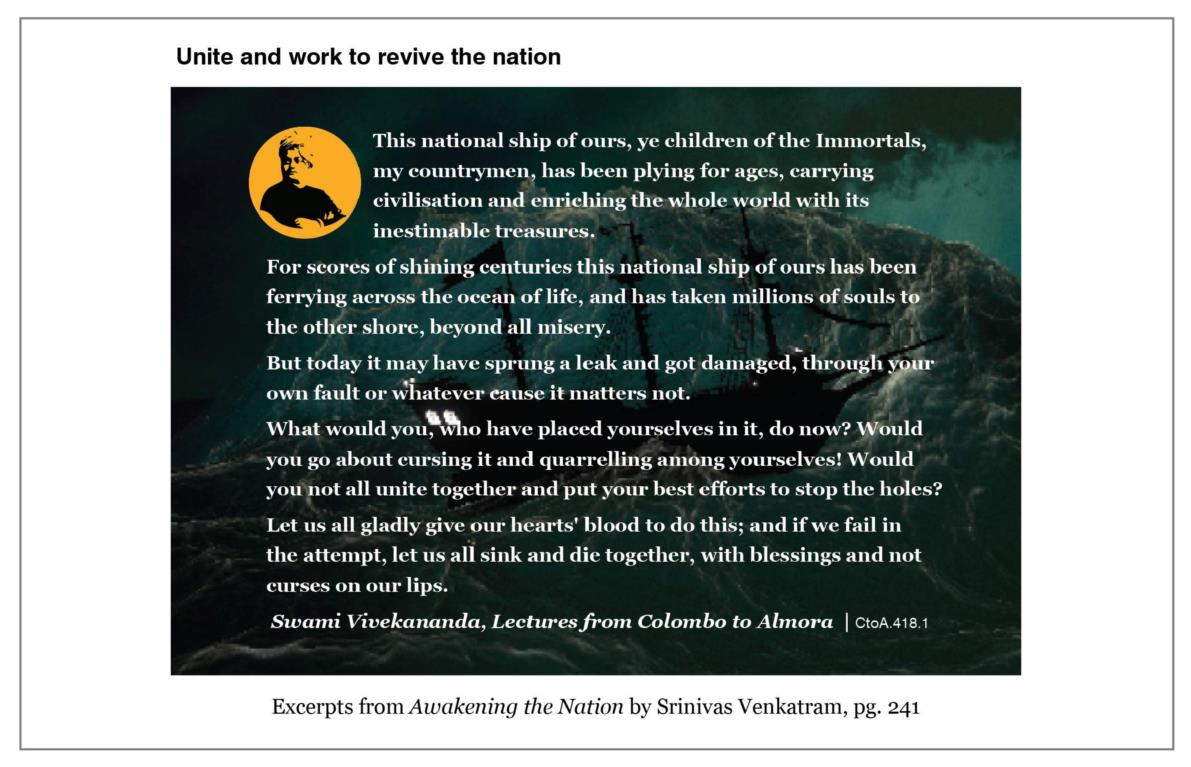
Awakening The Nation is a book crafted logically and meticulously. It drills down into Vivekananda’s words and metaphors and also expands horizontally to add on history, background, perspective, references, data and even interesting trivia.
A few examples:
“Religion is not in books, nor in theories, nor in dogmas, nor in talking, not even in reasoning,” said Vivekananda in a speech on the sages of India. “It is being and becoming. Ay, my friends, until each one of you has become a Rishi and come face to face with spiritual facts, religious life has not begun for you. Until the superconscious opens for you, religion is mere talk, it is nothing but preparation.”
Srinivas simplifies this statement down into a few easily understandable points, cross-referencing other statements made by Swamiji elsewhere. He explains what a Rishi is—one who directly perceives the truth—and why Rishihood, according to Vivekananda, is the ideal state to aspire to, compared with which everything else, even the Vedas, is secondary. This view is supplanted with two short stories—one about the Buddha and one from the Upanishads.
When Vivekananda says that “Hindus had better be called Vedantists” and that this includes “all our various sects, whether dualists or non-dualists”, the book offers a neat bulleted-point history of the principal dualist and monist sects, with information on their major seers.
Swamiji’s speech on Bhakti is broken down to six key ideas, which are explained in terms that any lay passer-by should be able to grasp. When he speaks of Vedanta being the only scripture that is “in entire harmony with the results… (of) modern scientific investigations of external nature”, we get a sidebar on the scientist Nikola Tesla, who was deeply influenced by Swamiji’s lectures in America.
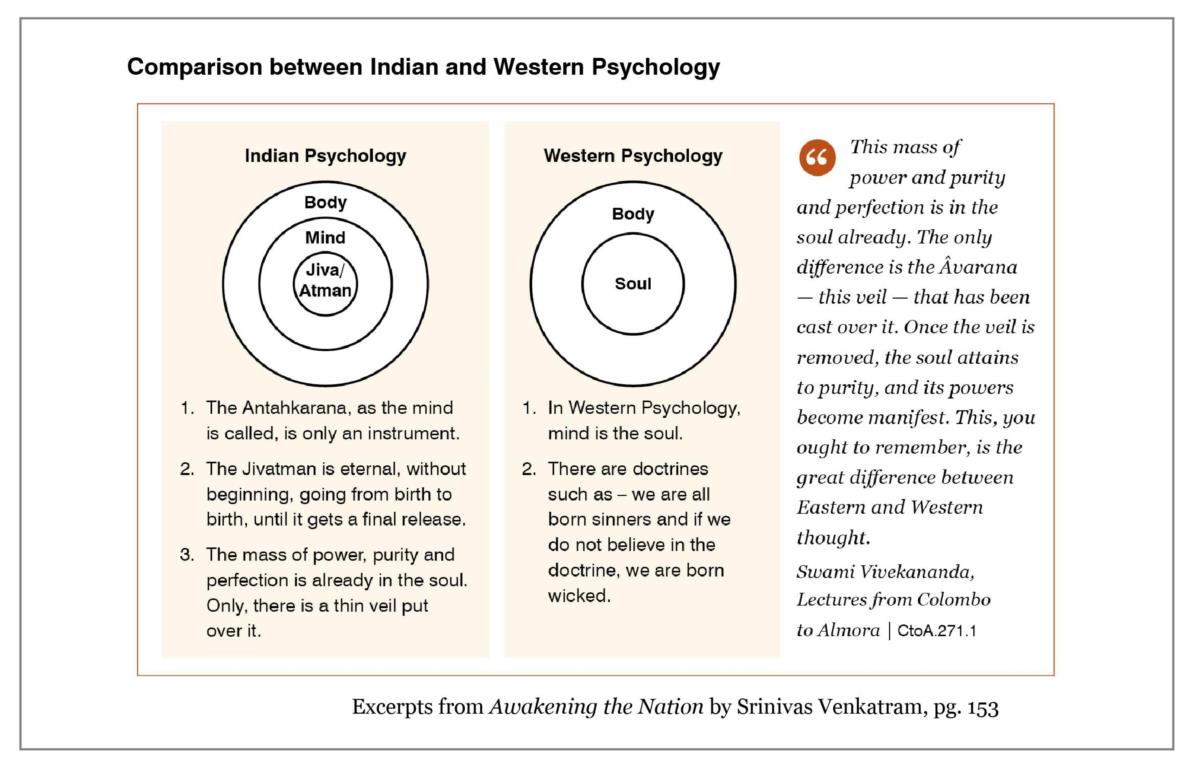
The truly innovative part of
this book is the use of infographics. Srinivas is an IIT-IIM alumnus, so is obviously very experienced in graphical representation of data and information. He makes very creative use of graphs, flowcharts, Venn diagrams and illustrations to visually explain the ideas that Vivekananda wished to convey and also to add information relevant to those ideas.
Of course, a cynic may say that some of the content is summaries in
bullet-form (reminiscent of PowerPoint slides) of deep ideas. But these also
serve a vital purpose, when used correctly—that of quick and easy
communication. And if a bullet-point summary interests the reader enough, Awakening
The Nation provides adequate information next to that to satisfy his
curiosity.
This book is clearly a labour
of both love and devotion. It does service to Vivekananda in an inventive and
modern structure. I can only hope that the most deracinated and disinterested
people among us may just open it on any random page and perhaps grow curious
and learn a bit.
To
hear Video 2.2 minutes A
Bridge between India's past & future | Awakening the Nation Series
To
Buy book online
To read all
articles on Swami Vivekananda
To
see all albums of Swami Vivekananda Inspired Schools
To
see album of original pictures of Swami Vivekananda as displayed at Vivekananda
House, Chennai
To see album of Mayavati Ashram in Kumaon – divine place