- This photo feature tells why Ranakpur Jain Temples are a wonder of the
world and who made this temple. Rajasthan has another hidden wonder Chand Baori
step well near Jaipur.
Images by photographer Suchit
Nanda.
I visited
Ranakpur in 2008. This piece is an update. Details of five day yatra are day
one Ranakpur, Haldighati and Udaipur, day two Chittorgarh by day and Udaipur by
evening, day three Udaipur till 11am, Eknathji, Devigarh and Shreenathji, day
four Shreenathji, Kumbalgarh Fort and Ambaji mandir and day five Mount Abu.
RANAKPUR TEMPLE
It is about an hour’s drive from Falna station, situated at foothills in the midst of nowhere. We drove into a huge wonderfully maintained complex i.e. spotlessly clean, has dharamshalas and a restaurant. The temple is at one end.
We were lucky to
have the temple Pandit show us around. His name is Pandit Jayantilal Sharma. Give
him what you please. If you want to click pictures of the temple inside
(excluding pratimas), timing in 2008 was from 12 to 5pm. For photography, you
need to pay a nominal charge.
History
The
complex has Parshavanath Temple, Chaumukha Temple, Surya Temple and the Amba
Mata Temple. The Chaumukha Temple is the main temple that houses Lord Adinath,
the first Jain Tirthankara.
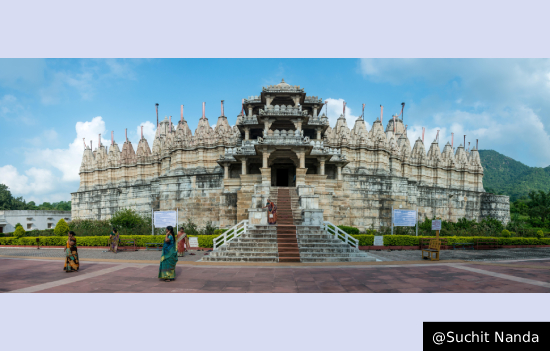 Temple front view. Picture by Suchit Nanda.
“According to a Sanskrit text by the name Soma-Saubhagya Kavya and a copper-plate inscription discovered within the temple complex, this temple dates back to the early fifteenth century. An architectural marvel in its own right, the Ranakpur Temple came from Dhanna Shah, a Porwal from Ghanerao, under the patronage of Rana Kumbha, the then ruler of Mewar.” 4
The temple has three storeys.
Rana Kumbha’s Prime Minister Sanghvi Dharnashah Porwal had a dream of Nalini Gulmohar viman (celestial vehicle) in which he saw trilokhi deepak viman ke aakar ka temples hence this temple. 7 The foundation for this
temple was laid in Vikram Samvat 1433 (1490 A.D.) and completed in 1553. It
cost Rs 15 crores then.
When we saw the
Light & Sound show at the City Palace we got to know that Rana Kumbha had
given a grant for the construction of this temple so it was named after him.
The town was named Ranpur after Rana Kumbha. It is
popularly known as Ranakpur.
Chaturmukha/Chaumukha
Temple dedicated to Adinath, the 1st Tirthankara
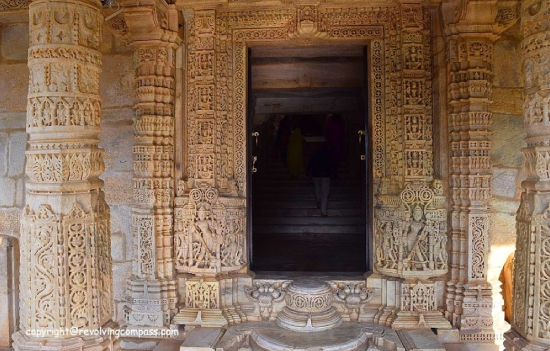 Entrance to Chaumukha Temple. Pic by Neha. 6
The
temple area is 48,000
sq feet. It is known for its 1444 intricately carved pillars, 24 halls who have
80 domes supported by 400 columns. The apogee of this entire temple
architecture is the fact that no two pillars in here are the same! A unique
aspect is that all pratimas face one or other pratimas.
The
temple structure has five spires, each of which houses a shrine underneath, and
it is under the largest spire in the axis of the main entrance (Chaumukha
Shrine) that one can find a six feet tall pratima of Lord Adinath. 4
The temple has
24 Mandaps. Of these 20 mandaps are small. The four big ones are called Megh
Mandaps. They are in four directions i.e. north, south, east & west. The
temple plan was made by Deepaji Mistry, a devotee of Jagdamba Devi.
Every day 1500
masons and 2700 laborers worked on the site. The foundation goes down 35 feet
and filled with Panchdatu. Thus, it can withstand any earthquake. The Shikhar
is made of limestone and brick.
Another
exquisite aspect that has also earned the temple its name is the carving of the
four-headed image of Adinath, sheltered by a 108-headed snake with numerous
tails. The four heads face four directions, suggesting the pursuit of the
Tirthankaras.
“Two of the most famous are the Kalpavriksha (as you enter), the legendary wish-fulfilling tree, and Parshvanatha sheltered by a snake with 1008 heads.” 7
“Another piece of attraction is a stunning marble piece which has 108 snake-heads and various tails carved into it with such intricacy that it is impossible to find the end of the tails. In the main prayer hall, there are two huge bells of 108 kg which create a melodious and symphonic sound.”
Main temple has
Bhagwan Adhinath pratima. The outer wall of temple consists of smaller temples
each having an icon of a tirthankara. Wherever
you stand you can see a Tirthankara, none of its 1,444 pillars ever come in the
way.
As you enter the
temple on your left is a murty of Dharnashah Porwal. It is placed at a
point from where he always gets darshan of Adhinath Bhagwan. There is a 600
year old Ryan tree within the temple premises i.e. similar to the one at
Palitana (Gujarat). Inside the bark there is a Ganesha taking shape.
As you enter
will see Kalpa Vriksha. Panditji said after darshan stand on the step, with
shraddha (faith) ask Adhinath Bhagwan for something and your wish will be
fulfilled.
See Kichak
who has one head and five bodies.
Three Megh
mandaps have pratimas Lord Ganesh at
the lower point of the mandap. After third megh mandap see Sahasthrapana
Parshinath. The murty has 1008 snakes that are intertwined in a way by which you cannot see the snake’s tale. Fourth megh mandap has Ganesh too. Here you will see one pillar is tilted to avoid buri nazaar (evil eye). Look up and you see scene of Krishna
Nag Daman. Nagini is praying to Lord Krishna to leave Kalya Nag since
the Lord was dancing on the Nag. See pic 15 of album
Also, see a pratima
of Marudevi Mata mother of Adhinath Bhagwan. Main Adhinath Bhagwan temple has pratimas
of Lord Brahma, Indra, Shiva
with Nandi and Kuber (dhan ka malik) and Bhairav. In the main temple below
Adhinath ka murty there is Mahalaxmi and Navgraha sitting at the base of the pratima.
The temple had
108 torans of which three are left. Aurangzeb destroyed the balance in 1605.
The temple has two ghantas
(bells) weighing 250 kgs each. The sound of these bells goes up to five kms.
According to Panditji the first sound is OM, one bell is male & the other
female because the noise is different.
According to Veena World, “The Ranakpur Jain Mandir also has 84 bhonyras. Bhonyras are underground chambers that were built in the earlier times during disturbance to prevent the attacks on Jain idols.”
Unique
Fours of Temple
Neha wrote in Revolving Compass, “There are some unique ‘fours’ in the Jain temple of Ranakpur. For instance, the four sides of the inside of this Jain Temple are characterized by similar architecture. Then, the temple has four main entrances. Hence, designated as a chaturmukh (one who has four faces) temple. Also in the main chamber of the temple there are four huge statues of God Adinath. The sanctuaries on second and third floor also have four identical Jain pratimas on all the four sides. Also, there is one marble elephant guarding each of the four entrances. Apart from this, there are seventy-six small shrines, four assembly halls, four principle shrines. And these shrines are stationed facing the four directions on the four walls of the temple.” 6
Surya Temple
“The construction of this sun temple dates back to the 13th century, full 2 centuries before the
construction of Ranakpur Jain Temple. It got desecrated during the time of
disturbance due to repeated attacks and was later reconstructed with the
remaining temple complex. 5
Walls of the Parshavanath
Temple have good carvings.
Happy
we went
I am happy we
went to this spotlessly clean complex and not so known wonder of the world. There
is a great degree of serenity within the temple. As we entered, I could feel
the vibrations. Do not walk through the temple but get someone to explain to
you the significance of each piece of art. This way you can relate with what
you see. The restaurant serves clean wholesome breakfast/meals.
The temple looks
very simple from outside such that you can never such outstanding piece of work
exists within.
In
case of any errors or suggestions, do write back.
How to reach
Ranakpur
is 90 kms from Udaipur that has good air and train connectivity. Kumbalgarh
Fort is app a minute drive - a must see. Ranakpur lies mid-way between Udaipur and
Jodhpur.
Now
temple pictures by photographer Suchit Nanda. eSamskriti is grateful to him for
sharing.
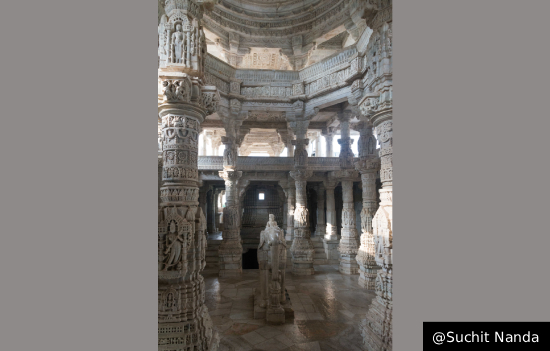 As you enter main Chaumukha Temple.
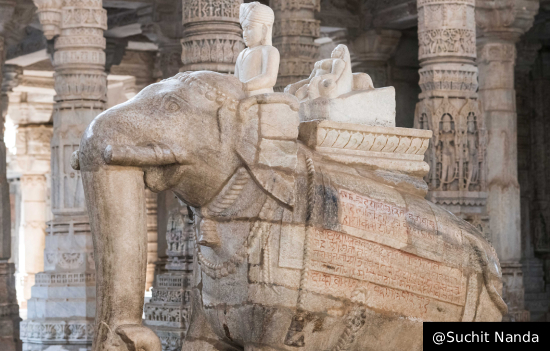 Dharna Shah Porwal. It is placed at a point from where he always gets darshan of Adhinath Bhagwan.
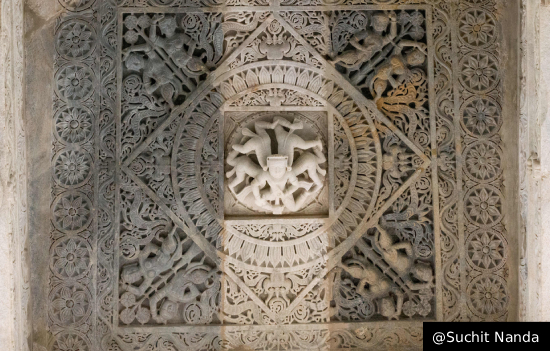
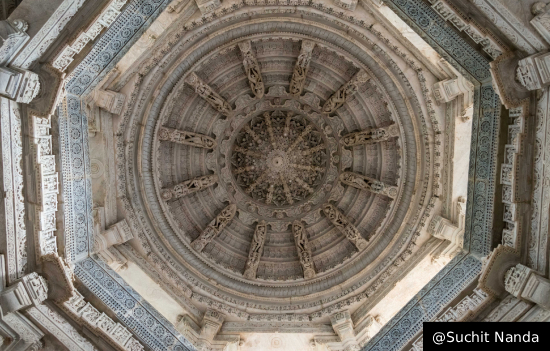 Exquisite carved ceiling. “The ceiling of this temple complex is bedecked with geometric designs and scrollwork.”
Design
seems similar to Dilwara T where it is depiction of the 16 manifestations of Sakti (Vidya Devis) in the
supporting pillars of the marble dome.
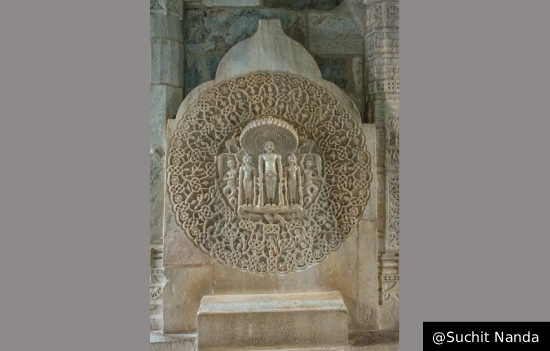 You see
Sahastrafana Parshwanath. A carving on the wall. The icon has 1008 snakes are
intertwined in a manner whereby you cannot know snake ka tail.
You see
Sahastrafana Parshwanath. A carving on the wall. The icon has 1008 snakes are
intertwined in a manner whereby you cannot know snake ka tail.
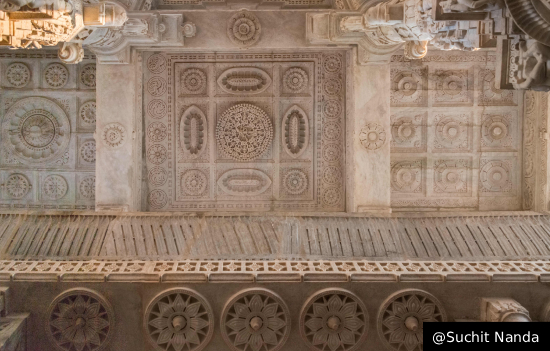 Beautifully carved ceiling.
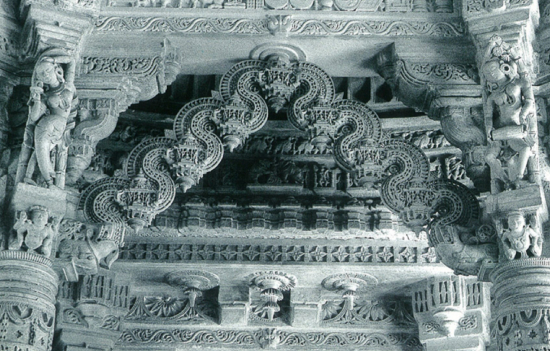
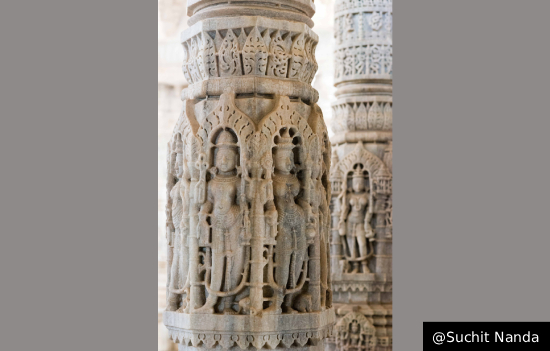 Architectural details inside the temple.
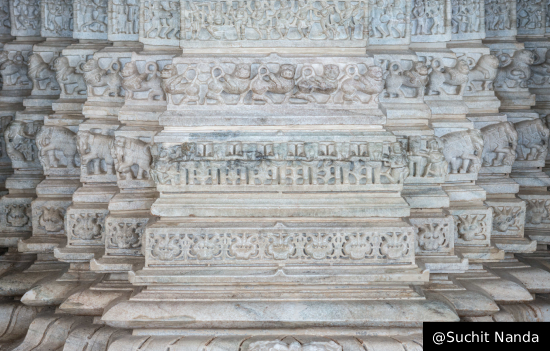 Detailed architectural design at base of temple.
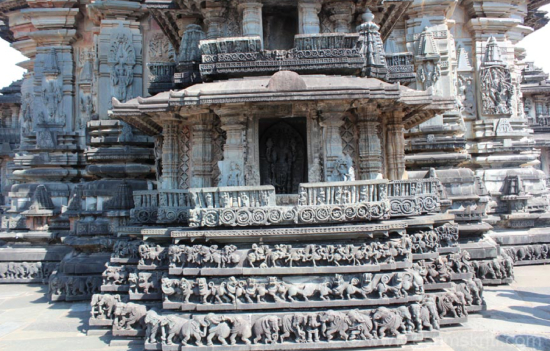 Temple at Belur Karnataka has a similar concept design.
 Kichak who has one head and five bodies.
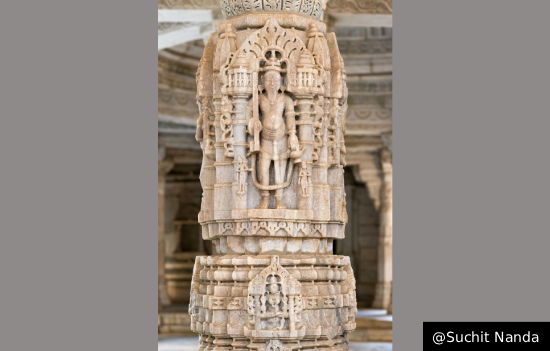 Architectural detail inside I think the Chaumukha Temple.
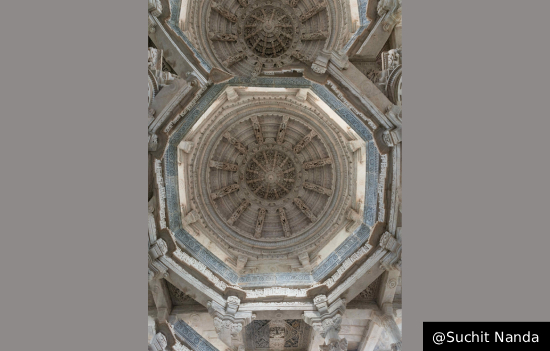 Ceiling details of the dome inside I think the Chaumukha Temple.
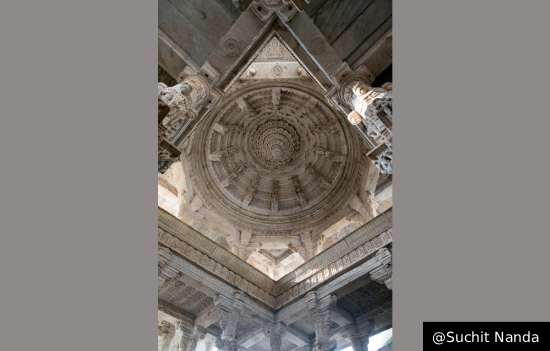 Ceiling details of the dome inside I think the Chaumukha Temple.
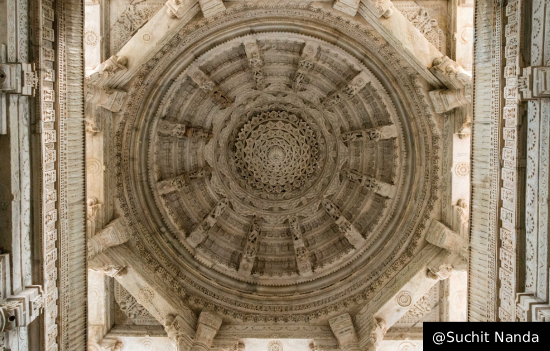 Exquisite carved ceiling.
 Now two postcard
pics to showcase temple. Toran.
Now two postcard
pics to showcase temple. Toran.
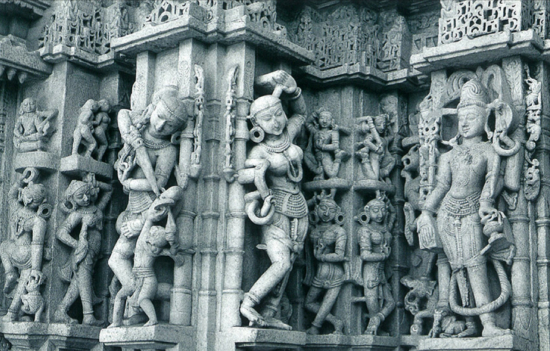 You see dancing figures in the
Parshwanath temple.
You see dancing figures in the
Parshwanath temple.
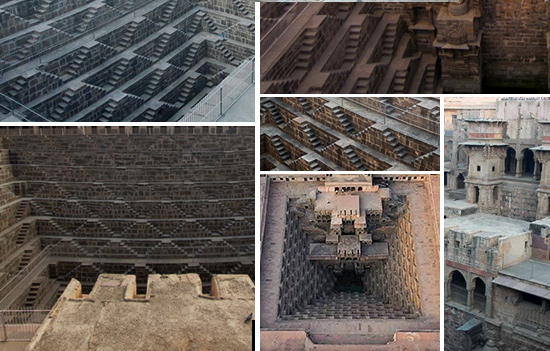 Collage of another
Wonder of the World in Rajasthan. Chand Baori Step-well.
Collage of another
Wonder of the World in Rajasthan. Chand Baori Step-well.
References
1.
Notes copied from boards outside the temple.
2.
Words of local Pandit.
3.
History & Culture of Indian People published by the Bharatiya Vidya Bhavan.
4.
Rajasthan tourism
site.
5.
Veena World write
up
6. Revolving Compass piece
7. For
a good travelogue
8. Piece
gives key temple dates
9. To see all Ranakpur pictures in Suchit Nanda album
To see albums
1. Dilwara
Jain Temples
2. Ranakpur
Temples
3. Kumbalgarh
Fort
4. Chand
Baori Step Well
To
see pictures of Jain Temples across India
To
read articles on Jaina Darsana