- Why Kashi is important to the Indian Civilization includes what learned say about the town, why Kashi was a Centre of Learning, famous saints and authors and what is Pañcakrośī Yatra. Which are the other Kashi’s in India. Plus Kashi photos.
I
visited Kashi around 1992 for work, in 2008 with my wife, in 2013 for Dev
Deepavali and in 2020 when I was reborn. I would return recharged from within. The
lack of Singapore type cleanliness did not matter. Just walking through its
lanes and ghats, visiting the various temples and ashrams not to forget Kashi
Chaat made me happy from within.
During
the 2013 visit getting from the airport to Assi Ghat was a nightmare as
compared to 2020 when it was a breeze. eSamskriti has published many articles/albums
on Kashi for e.g. Why is Varanasi a
pilgrimage destination , albums Dev Deepavali
Kashi and Ghats of Kashi
With improvement in road, rail and air connectivity many people do what I call ‘Darshan Pilgrimage’ meaning they reach a town, have darshan of Kashi Vishwanath Temple-eat, take Prasad and leave. It becomes a short break without absorbing the energy and experience of the town.
Traditionally, a pilgrimage involved physical
hardship but today the 'pilgrim' wants all the luxury of their daily lives in the pursuit of moksha, Star hotels, hot water, multi-cuisine, spewing garbage everywhere they go, making this journey not a pilgrimage but a tourist destination. Their entitlement is taking away the sanctity and sacredness of what should be a pious and pure journey of a devotee.
While improvement in infrastructure and
cleanliness is welcome, hope Varanasi does not become only a tourist
destination. Know why Kashi is important-
23 Welcome to Shiv
Nagari, Kashi says a painting. Pic by Arun Saha.
24 Sunrise at
Assi Ghat. Around sunrise take a boat ride from Assi Ghat to Rajghat, wow
experience. Pic by Arun Saha.
What is written about Kashi?
C P Singh wrote, “In Rigveda the city is referred to as Kasi or Kashi, the luminous city as an eminent seat of learning. The name kashi is also mentioned in the Skanda Purana. 5
Just as certain limbs of the body are purer than others, so are certain places on earth more sacred-some on account of their situation, others because of their sparkling waters and others because of the association and habitation of saintly people.” Bhishma (Immortal India-1 KASHI, 12/9/1954 by J. H. Dave)
Dr
Uday Dokras wrote in Kashi the city of
Lights, “It is city of light; the City of delight ; the abode of Visveswara; the city of the well of knowledge Jnanavapi ; the City of
purity, where the Mother Ganga purifies all who surrender to her in love and
reverence; the City of Maha-smashana the ultimate end of all; and, above all, it is home of the graceful and loving Mother Annapurna.” When we say Light it is in comparison to darkness which is
caused by ignorance. By visiting the various centres of learning in Kashi and
spending time with Sages ignorance gets removed. Hence, light returns.
Swami
Varishthananda wrote in the Prabuddha
Bharata, “Swami Vivekananda once said, ‘Art, science, and religion are but three different ways of expressing a single truth.’ The saints, sages, and savants of Varanasi verily express that single truth in their own inimitable style. The resultant melody is vibrant Varanasi, the city of Shiva.” 1
Swamiji added, “Varanasi is famous for three things - learning, burning, and turning. This is the story of Kashi, the city of light and liberation, which name is derived from the same Sanskrit root as prakasa, which means-kasayati prakasayati iti kasi. The atmosphere of holy spirituality is undoubtedly densest within the precincts of the shrine of Vishwanatha especially in the sanctum sanctorum, yet the whole atmosphere of Varanasi is spiritually surcharged and is especially conductive to religious and scholastic pursuits and spiritual growth.”
In Jaina tradition, four of the twenty
four Tirthankaras - Suparshvanatha (seventh Tirthankara), Chandraprabhu
(eighth), Shreyansanatha (eleventh) and Parshvanatha (twenty third Tirthankara)
were
born in Kashi
For the Buddhists it has a high
significance - it was near Saranganatha (saranga refers to deer) or Sarnath is where Buddha gave his first sermon. Kashi is on
the banks of the Ganga, one of India’s holiest rivers. Can you imagine Kashi without the Ganga? Read India’s Sacred Rivers
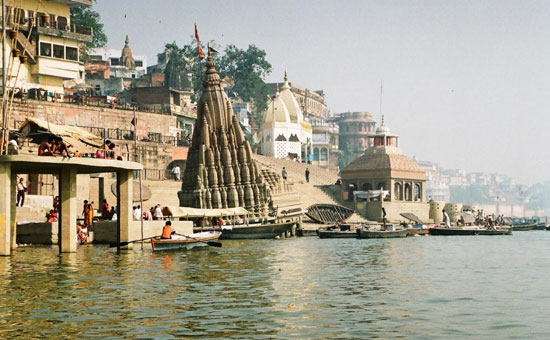 Ratneshwar Mahadev
Temple.
Ratneshwar Mahadev
Temple.
Kashi as Kṣetra, Tīrtha, and Mūrti
Dr
P Mukherjee and Jay Kumar wrote in Kashi
as Kṣetra, Tīrtha, and Mūrti: A Living Indian Knowledge System, “The three Sanskrit terms around which this article is organised kṣetra, tīrtha, and mūrti are not simply religious categories. Kṣetra denotes territory that has been charged, bounded, and made productive by sacred intention; it is the field in which action and knowledge bear fruit. Tīrtha designates a crossing-place, a site where the boundaries between the human and the divine, the living and the dead, the temporal and the eternal become permeable and traversable. Mūrti most often translated as ‘image or form’ refers not to representation in any mimetic sense but to the embodied presence of the divine in material form. Together, these three categories constitute a rich and coherent conceptual vocabulary through which Kashi has understood.”
Ksetra is where an
accumulated presence of divine action and tapas
has energised the place.
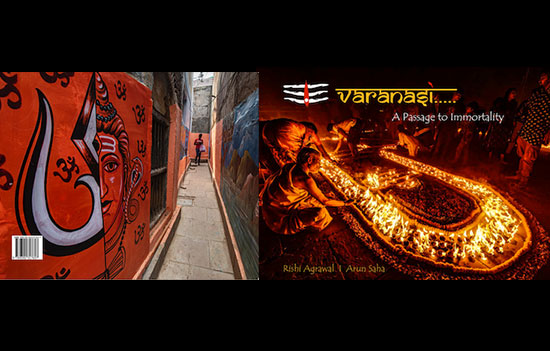 Varanasi-A passage to Immortality by Rishi & Arun. Left of pic is lane.
In Kashi ksetra,
tirtha and murti integrate to form a sacred complex. 6 Murti is the Vishwanath Temple and the Ganga, Tirtha is as I see
it positive karmas of lakhs of devotees who visited Kashi over the centuries.
Ksetra is the presence, felt by many, of the many evolved souls that lived in
Kashi. Telanga Swami is one such soul whose presence I felt when visited his
temple.
Which are Kashi’s across India
People who could not visit Kashi in U.P. could
go to a Kashi closer home.
Chhoti Kashi’s are found across India for e.g. Mandi in Himachal Pradesh, Purmandal (near Jammu),
Jaunpur (U.P.), Hoshiarpur (Punjab), Nanjanagadu
in Karnataka and
Tenkasi (Tamil Nadu). Read The
Many Kashis of India
Wai
in Maharashtra is also called Dakshin Kashi
wrote S Godbole. Like others Wai was a on the banks of a river, had numerous
temples and was a centre of learning. There is also Uttarkashi in Garwhal.
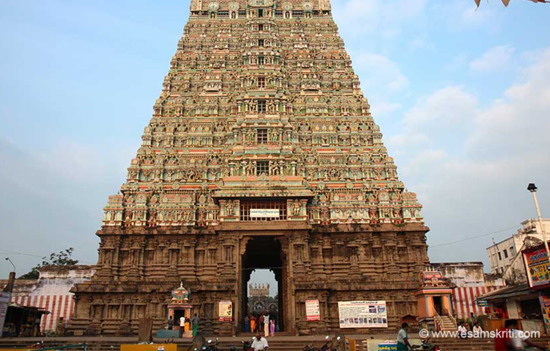 Kashi Vishwanath Mandir, Tenkasi, Tamil Nadu.
Kashgar
in Xinjiang, which was a major Buddhist centre, was also called Kashi-giri. Source
How was Kashi was a Centre of Learning?
Shashi
Shekhar Editor in Chief, Hindustan wrote in Hindustan Times, “The grandeur of Kashi was absolutely unique. Kashi Khand (chapter) of Skanda Purana declares it as India’s highest intellectual seat. The reason was that no new idea or principle would be universally accepted till it was debated and proved by the Kashi Vishwanath temple’s “intellectual committee”. Whether it was Shankaracharya or Ramanujacharya, every philosopher had to present, debate, and prove their hypothesis in this intellectual arena.
The city of Vishwanath was also a great centre for astronomy, astrology, logic, and medicine. The Vishwanath Temple Council was also called Moksh Lakshmi Vilas. The granary of the Ma Annapoorna Temple situated close by ensured no one in Kashi would sleep hungry.” Why Hindus give importance to education
Excerpts from a 2020 paper authored by Shreya Tiwari titled, “Educational Institutions of Kashi: Ancient
to Modern Period”, “For centuries, Kashi, also known as “Sarva Vidya Ki Rajdhani” (Capital of knowledge) 5, a phrase used in the BHU Kulgeet by Shanti Swarup Bhatnagar.
In ancient Kashi, both formal and informal ways of education system
existed. Indigenous education given at homes,
temples, pathshalas, gurukuls etc. Temples played an important role as a
center of learning. The Acharyas provided food to students and treated them as
a family member. 5
The first step in establishing a proper
educational institution was taken by Maharaja Jai Singh of Amber near
Bindu Mahadev Temple built by him in 1585
However, the real step in the direction of establishing formal
Educational institution in Kashi was taken in 1791 when Jonathan Duncan the
agent of East India Company founded the Sanskrit Pathshala to train the servants
of East India Company. It later became the Government Sanskrit College and
since 1958 has been raised to the status of Varanaseya
Sanskrit Vishvavidyalaya. (Sukul,P).
Guru Nanak too visited Kashi 5 like he visited other Indic places of pilgrimage.
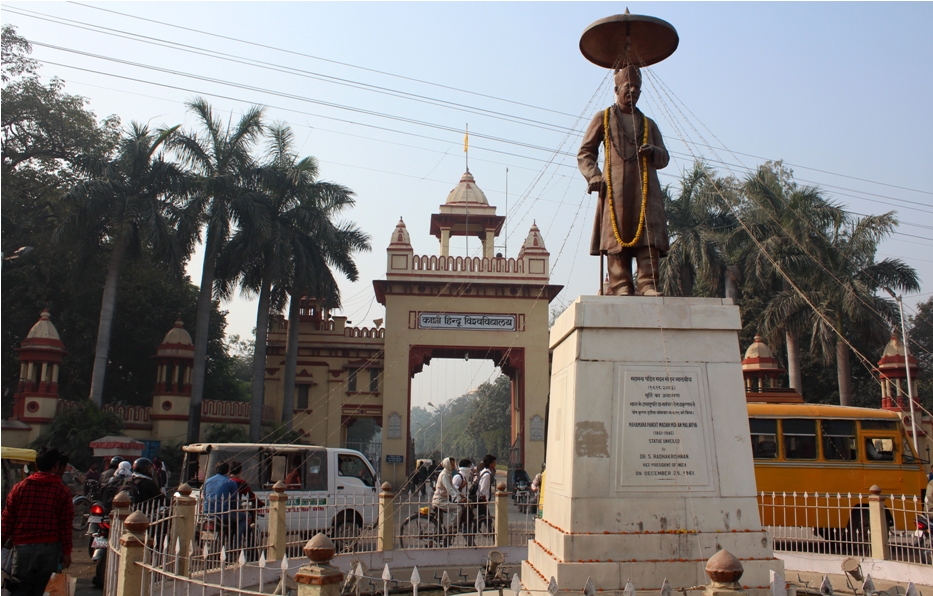 Entrance to Banaras Hindu University. Statue of founder Pt M M Malviya.
BHU was set up in 1916. Another famous institution is The Kashi Vidya Peeth was set up in 1920 by Babu
Shiv Prasad Gupta to provide alternate education arrangement. Central Institute for Higher Tibetan Studies- This University is an autonomous organization by Union Ministry of Culture for studying the Indo-Buddhist Sanskrit Texts that are only found in Tibet.”
Scholars and revered Gurus like Ramanujacharya, Madhavacharya, Tulsidas
and Kabir were enlightened in Kashi. Tulsidas gained knowledge of Sanskrit
grammar, Hindu literature and philosophy, four Vedas, six Vedangas, Jyotisha etc
from his guru Shesha Santana at Panch Ganga Ghat, Kashi. 2
Because education in Kashi was spread over numerous Acharyas and
not consolidated into a Nalanda type of institution, could be a reason why
learning in education in Kashi survived
Muslim invasions.
Do visit the Kalal Bhairava Temple
The
eight Kala Bhairava temples are located in eight cardinal directions of Kashi,
protecting the whole Mandala. These are: Unmat Bhairava, Krodhana Bhairava,
Kapala Bhairava, Asitanga Bhairava, Chanda Bhairava, Ruru Bhairava, Bhishana
Bhairava and Samhara Bhairava.
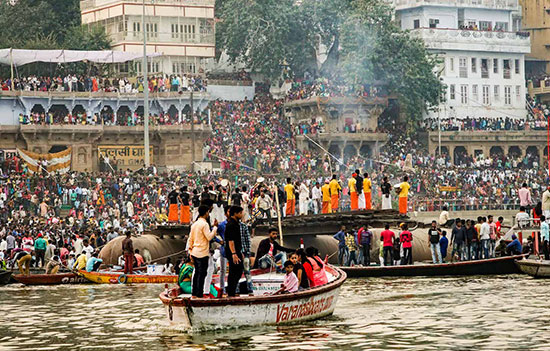 Crowds at Tulsi Ghat to
experience Nag Nathaiya. By Rishi&Arun.7
Crowds at Tulsi Ghat to
experience Nag Nathaiya. By Rishi&Arun.7
Durga Temples and Tirthas of Kashi
Swamiji wrote, “Varanasi has the unique distinction of having separate temples dedicated to all the nine forms of Mother Durga:
Shailaputri, Brahmacharini, Chandraghanta, Kushmanda, Skandamata, Katyayani,
Kalaratri, Mahagauri, and Siddhidatri, as well as to all the nine
manifestations of all the gods and goddesses in their myriad forms.
All the Tirthas too reside in Varanasi. One of the most famous of these tirthas is Kedareshwara. Another important ksetra is the Siddha Kshetra, the’ Field of Fulfillment. Here, above the Scindia Ghat, is the temple of Vireshwara, or ‘Lord of Heroes’. The story of Kashi temples and of pilgrimage to Kashi remains incomplete without a visit to the Kala Bhairava
temple, the guardian angel of Kashi. 1
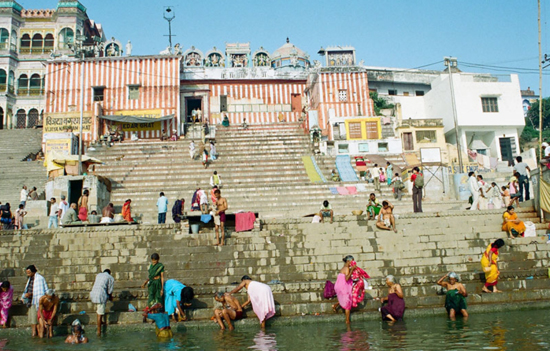 Kedar Ghat.
City of Saints
They
were Harishchandra, Sant Kabir, Sant
Ravidas , Trsilanga Swami (c.1607-1887) famed for his yogic powers, Swami Bhakarananda Saraswati (1833-1899) was also
reputed for his austerity and saintly character. Swami
Karpatriji (1907-1982) is more recent figure. 1 Lahiri Mahasya (Grand Guru of
Paramhansa Yogananda lived in Kashi) Story
of a Great Yogi, TAILANG SWAMI of Varanasi His temple is a very good place
to meditate-powerful.
City of Hindi authors
Bhartendu
Harishchandra (849-1882) is known as the
father of modern Hindi literature. Jaishankar
Prasad (1889-1937) is credited with initiating the chhayavada movement in modern Hindi literature, characterized by
romanticism, mysticism, and symbolism. Munshi
Premchand (1880-1936) is the penname of Dhanpat Rai, one of the greatest
literary figures of modern Hindi and Urdu literature. Pandit
Madan Mohan Malaviya (1861-1946) was a great patriot, eminent educationist, renowned journalist, prominent social and religious reformer, erudite scholar able parliamentarian and eloquent speaker.” 1
What is the Pañcakrośī yatra?
Sadhguru wrote, “he Panchakroshi Yatra is one of the most significant pada yatras done by pilgrims around the sacred Kashi Mandala. Along this route, there are 108 shrines, to which pilgrims travel by foot. There are five major villages, where pilgrims can rest and stay overnight. Even today, choultries built by kings a few hundred years ago are still intact.
As
one travels in a clockwise direction on the Panchakroshi route, all the temples
are located on the right side of the road, marking the outer limit of the
Panchakroshi sphere.
The
Panchakroshi Yatra begins with a dip in river Ganga at Manikarnika Ghat. The
first major temple on this route is the Aadhikarmadheshwar
temple. The Linga here was consecrated by Sage Karmadeshwar.
In
the Kashi Khanda Purana, it is said that yakshas and ganas always lived on the
trees and near water bodies. On this route, their shrines have also been placed
in the same way.
The
second temple on the route is the Bhimachandi
mandir. This Durga temple is said to be established by a Gandharva who
worshipped Devi here.
The
third is Dehali Vinayak temple. This temple
is directly in line with the Kashi Vishwanath temple, marking the halfway mark
of the yatra. It is said that before entering Kashi, Lord Rama meditated here.
The
fourth is the Rameshwaram temple. This
temple is said to be a replica of the Rameshwaram temple in southern India. It
is situated on the banks of the river Varuna, and marks the northernmost point
of the yatra.
It says in the scriptures, that all the lingas of the Kashi Mandala fall under forty-two kinds. In the Kapiladhara temple, all forty-two kinds are there in a single form. The Pasapani Vinayaka and Kapiladhara temples mark the end of the Panchakroshi Yatra.” 3
Think
Can
we modernize Kashi without losing its soul?
Kashi
is a pilgrimage, not a tourist destination.
Do
we need metro city type solutions in Kashi or will local do?
Can
we make the Ganga cleaner than it is?
Love
and Light
Some
Kashi pictures
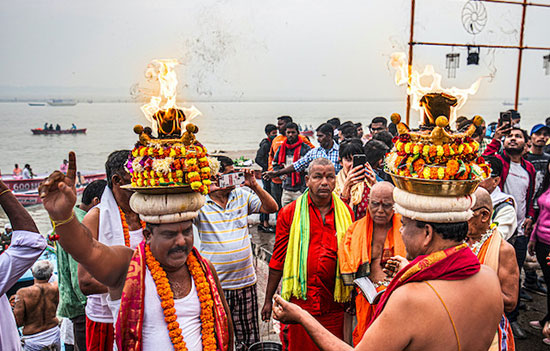 Celebrations by Telegu
speaking brothers on Dev Deepavali.
Celebrations by Telegu
speaking brothers on Dev Deepavali.
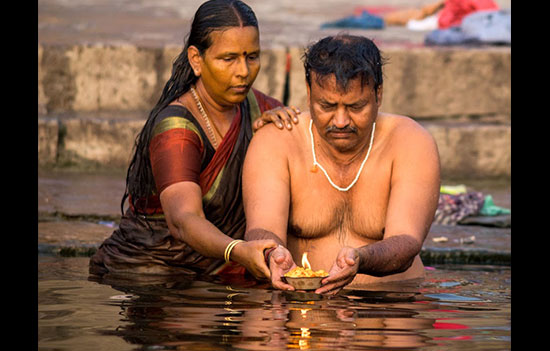 Pic of Husband/Wife leaving a diya in the Holy Ganga is a very common sight.
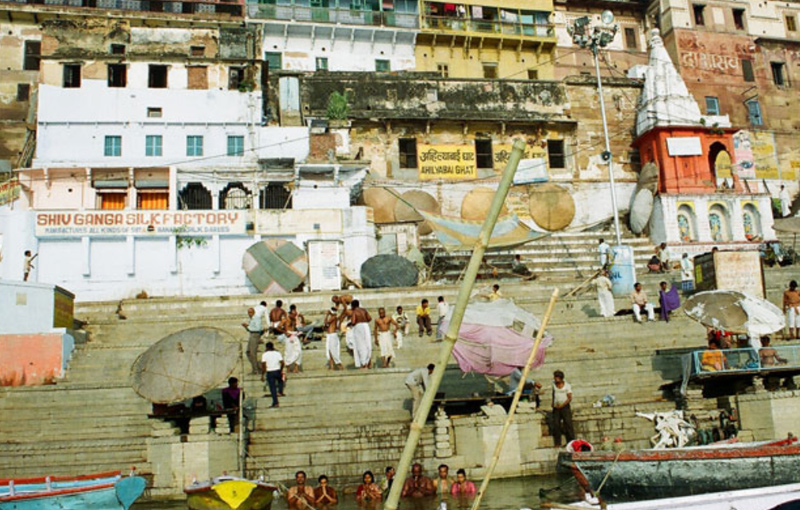 Ahilya Ghat, Kashi.
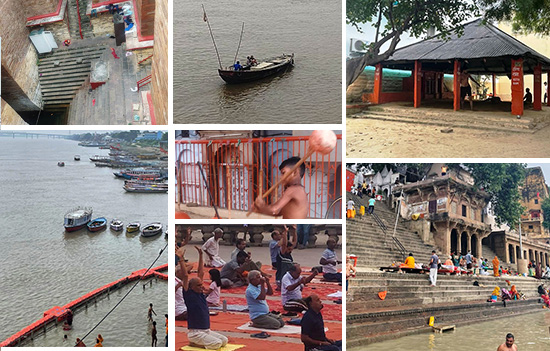 Kashi is a microcosm of Indian civilisation. Collage by Nayan Marphatia.
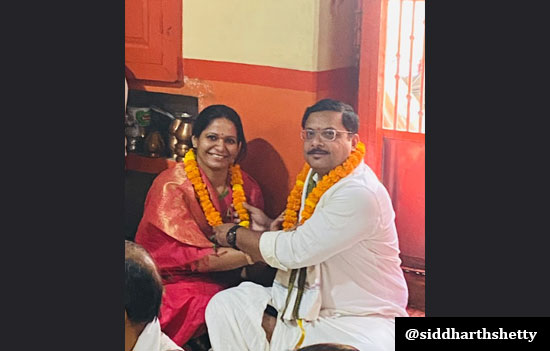 My wife and I performing the “veni-daan” ceremony wrote Siddharth Shetty. The veni represents the three rivers of Ganga, Yamuna
and the now extinct Saraswati
My wife and I performing the “veni-daan” ceremony wrote Siddharth Shetty. The veni represents the three rivers of Ganga, Yamuna
and the now extinct Saraswati
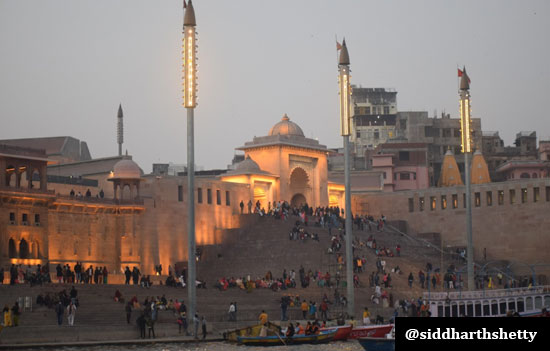 Entrance to Kashi
Vishwanath Corridor from Ma Ganga side.
Entrance to Kashi
Vishwanath Corridor from Ma Ganga side.
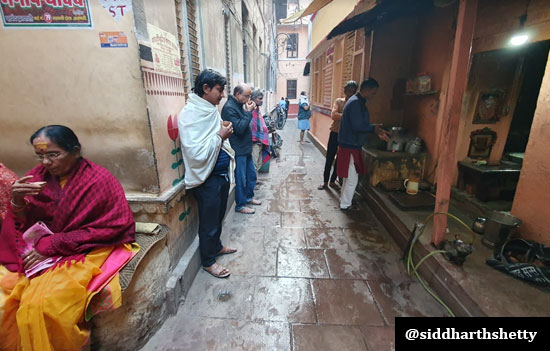 Lanes or Galis of Kashi
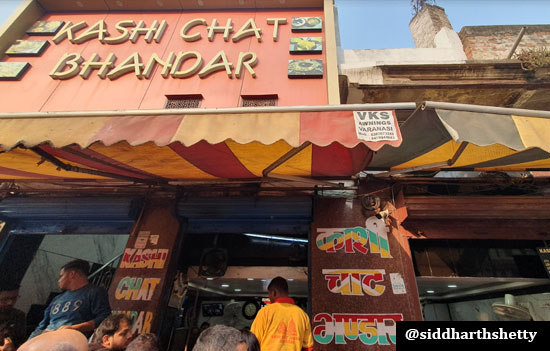 The famous Kashi Chat Bhandar
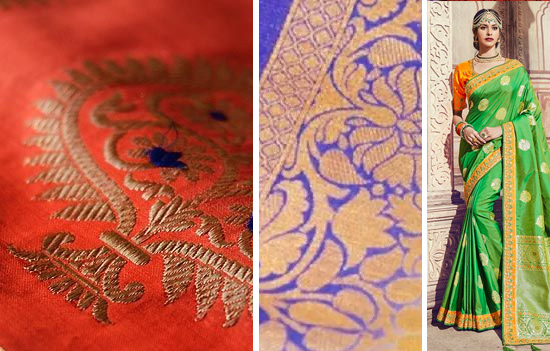 Varanasi Saris famous.
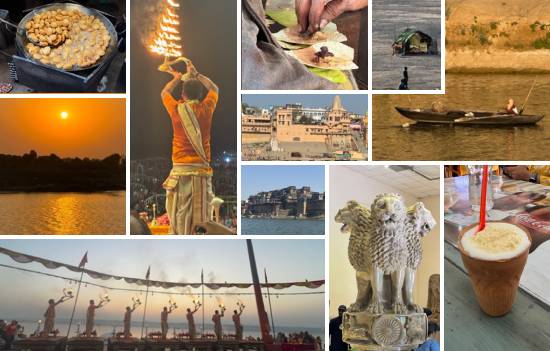 Collage of Cruise on the Ganga by Luis Miranda.
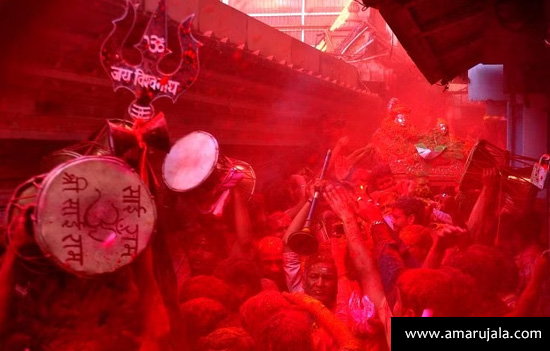 Rangbhari is celebrated in Kashi today as the first day of Holi.
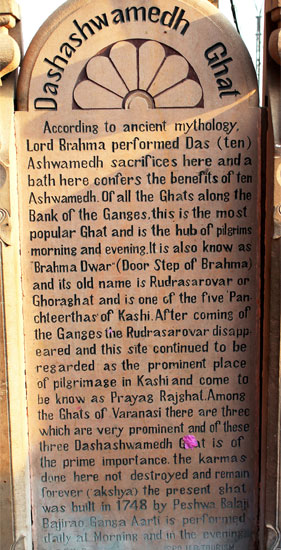 Dashashwamedh Ghat
was made in 1748 by Peshwa Balaji Bajirao.
Dashashwamedh Ghat
was made in 1748 by Peshwa Balaji Bajirao.
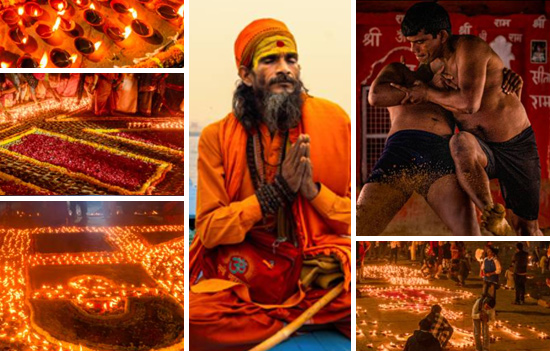 Collage of Kashi by Rishi Agarwal
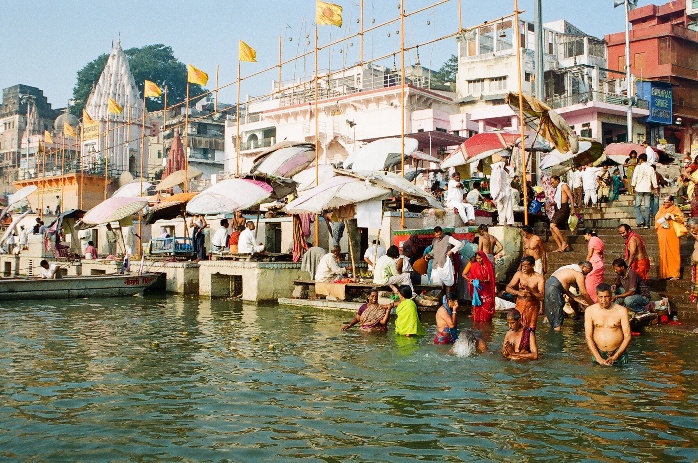 Early morning prayers to Surya, the rising Sun.
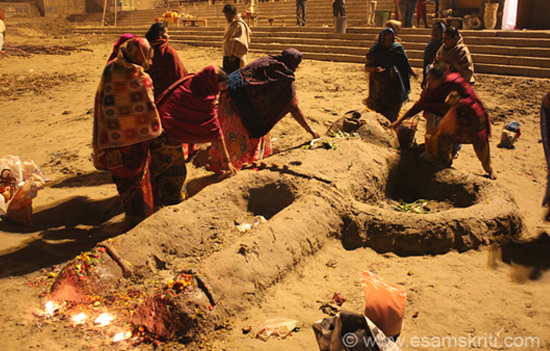 Worship of Bhishma Pitama during Dev Deepavali.
23
Nepal Temple i.e. banks of river Ganga.
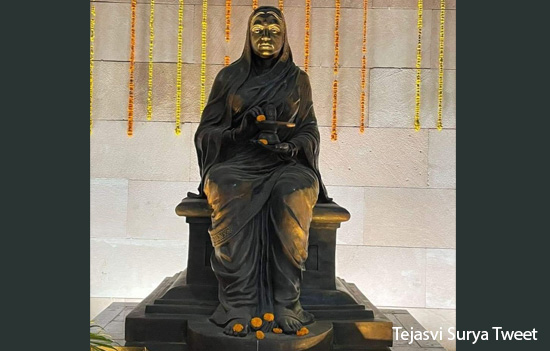 Pranams to Ahilyabai Holkar.
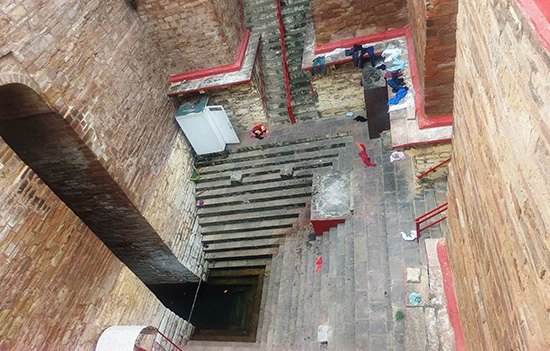 Meeting place of rivers Asi and Ganga, called Lolarka famous for its sun temple.
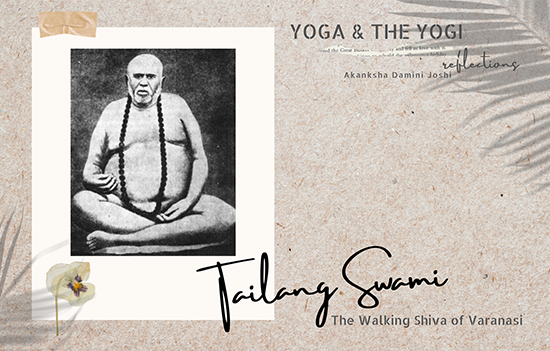 Pranams to Tailanga Swami.
Let us remember Ahilyabai Holkar’s contribution to reconstruction of the Kashi Vishwanath Mandir. Let us thank Maharaja Ranjit Singh for donating gold to the temple. Let us thank all those involved in the making of the Kashi Vishwanath Corridor.
References and
also read
1.
Why is Varanasi a
pilgrimage destination
2.
Educational Institutions of Kashi: Ancient
to Modern Period
3. Kashi – Shiva Tower of Light by Sadhguru
4. Story of a Great
Yogi, TAILANG SWAMI of Varanasi
5.
Educational System of Kashi: From Vedic to the Modern period by Chandra Prakash
Singh
6.
Kashi as Kṣetra, Tīrtha, and Mūrti: A Living Indian Knowledge System
7.
Varanasi – A Passage to Immortality
8.
Maratha Empire -
Cultural contributions to the temple town of Varanasi
9.
Kashi, Ayodhya,
Prayagraj Yatra-A lifetime experience to remember
10.
Banarasi Sari
11.
Kashi Yatra in the
Peshwa period
12.
Kashi Tamil Sangam
13.
Album Temples of
Kashi
14.
Wall Paintings of
Kashi