- This
photo feature starts with unique cultural experiences in Jaipur followed by a
visit to Bundi i.e. best known for its miniature paintings, pre-historic caves
and step-wells. Here is a three-day itinerary for art lovers and cultural travellers.
I have been to Jaipur more times than I can
count, though many of those trips were for work. It is one of my favourite
places in India yet I wanted to visit again. I had ticked off the usual sights:
Amer Fort, Hawa Mahal, and the rest. This time, I wanted something different.
Over the years, I had noticed how much
Rajasthan has to offer art lovers, and the aesthete in me wanted more of that.
That is when I decided to pair Jaipur with Bundi.
Fewer travellers seem to know Bundi, and honestly, I hope it stays that way; it hasn't been swallowed by mass tourism yet. Bundi is best known for its miniature paintings, the distinctive Bundi School.
Exploring
Unique Experiences in Jaipur
I had a day and a half in Jaipur. While
planning the trip, I searched online for unique experiences I had not done before.
I realized that a walking tour, something I always do when exploring European
and Asian cities, was missing from my Jaipur experience. I added a heritage
walk, a carpet-making village visit, and a block-printing workshop to my
itinerary.
A local friend highly recommended exploring
the old city with Jaipur Retold, booking the Jaipur Rugs carpet village tour,
and joining a Wabisabi block-printing workshop.
I spent my first afternoon on a Jaipur Rugs artisan community tour, visiting a traditional carpet-weaving village just outside the city, before unwinding at the beautiful Padma Haveli boutique stay.
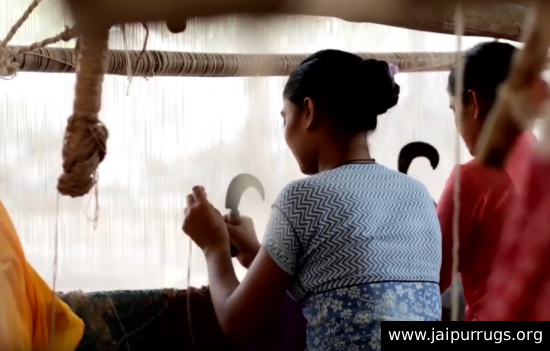 At Jaipur Rugs.
On day two, I explored the Pink City's hidden lanes during an early morning heritage walk with Jaipur Retold.
The latter part of the day was dedicated to a hands-on Rajasthani block-printing workshop with Wabisabi, where I experienced how labour-intensive this traditional craft is.
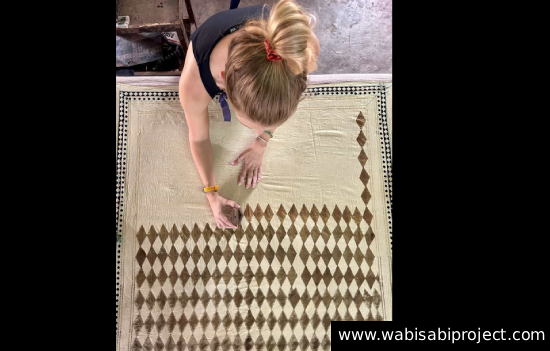 Block printing at Wabisabi.
Exploring BUNDI – Day 3
On day three, I drove to Bundi i.e. about three and a half hours and checked into Nawal Sagar Palace. Bundi's stay options are limited; there are no chain hotels, only homestays and family-run B&Bs, a model I actually prefer since it lets tourism benefit locals directly. When I asked the manager who visits Bundi, he smiled and said, “travellers like you.”
Bundi, he explained, draws a niche crowd of
art lovers and small groups, with Germans, French, Japanese, and Chinese
travellers making up much of the international footfall. Later I got to know of
a hotel run by Rajasthan Tourism. Bundi is about an hour’s drive from Kota, Rajasthan.
1. Garh Palace
Garh Palace, also known as Bundi Garh, was
built by the Hada Rajputs and is an architectural marvel. I loved the Hathi Pol gate (pic 10) and the vibrant miniature murals of the Chitrashala. Unlike the polished, restored palaces of Udaipur or Jaipur, Bundi's feels raw and untouched; a complex of smaller, interconnected palaces built over three centuries.
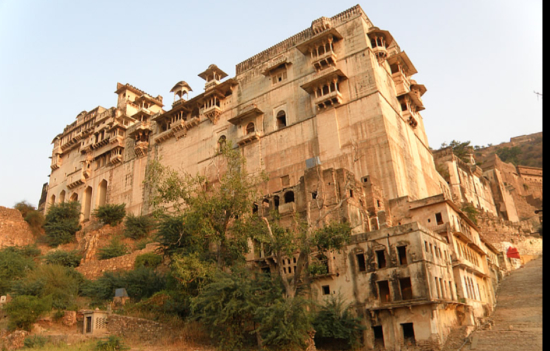 Main Palace. First high level in right and centre is Chatra Mahal. Above that what u cannot see is Badal Mahal.
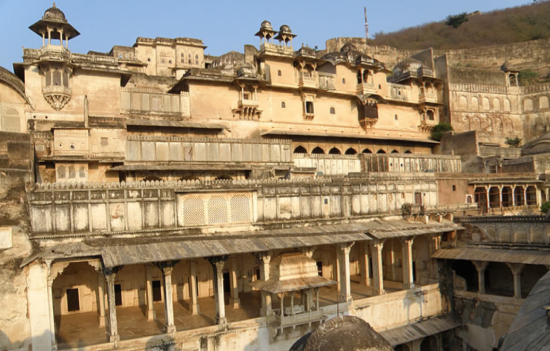 Bundi Palace with the king’s throne in the centre.
Decades of closure and ongoing legal disputes among royal descendants have left parts of it neglected, water-damaged, and even bat-infested, but it's open to visitors and now undergoing restoration. Walking through it felt like stepping into history mid-repair.
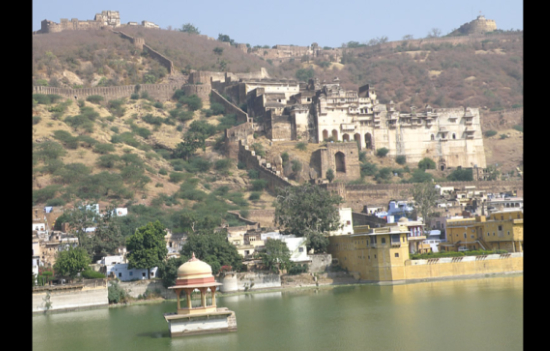 Nawal Sagar, Palace and Bhim Burj.
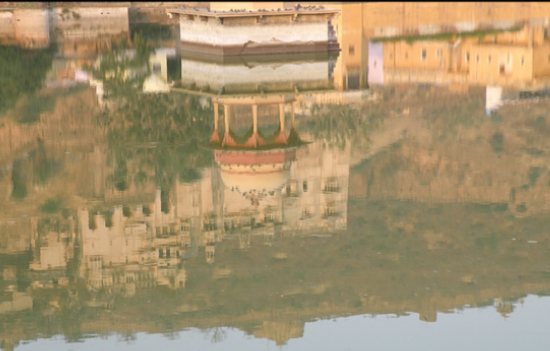 Reflection of all in Nawal Sagar.
2. Chitrashala
Chitrashala translates to “school of pictures.” It is why art lovers come to Bundi. Part of Garh Palace, it is a protected as a monument by the ASI. Often called “Rajasthan's Sistine Chapel,” this open-air gallery flourished under Hada Rajput patronage from the 17th to late 19th century, its walls and pillars blanketed in exquisite frescoes shaped by Persian influence.
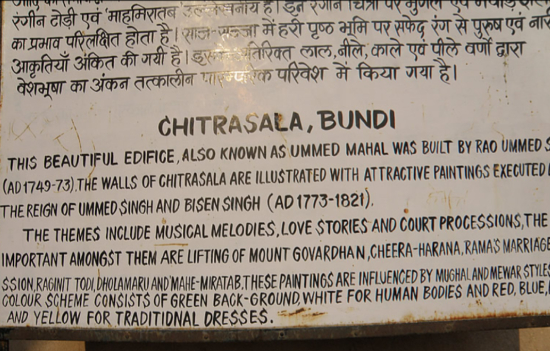 Board is self-explanatory. 2008.
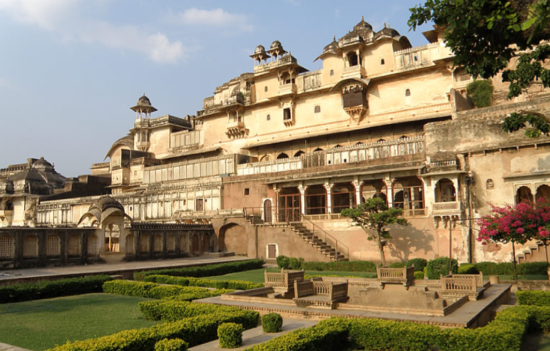 Entrance to Chitrashala. You see
in front in small kund. The Queen & friends sat around the small kund -
water body.
Entrance to Chitrashala. You see
in front in small kund. The Queen & friends sat around the small kund -
water body.
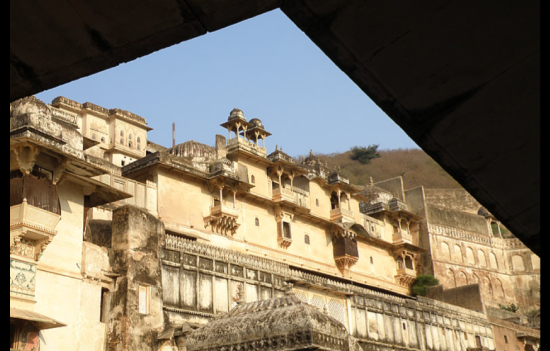 Picture taken from Chatra Mahal of
Anirduddha Mahal. 2008.
Picture taken from Chatra Mahal of
Anirduddha Mahal. 2008.
The colour palette mesmerised me: turquoise,
deep blue, and lush green against stark white skin tones, made from grounded
lapis lazuli, indigo, red ochre, and lime white. Every scene is bordered by
delicate floral panels, and the landscapes feel alive with monsoon skies.
The highlight is the Raas-Leela, Radha and Krishna's mystical dance with Krishna rendered in his signature blue. Chitrashala is an unmissable sanctuary for
any art lover.
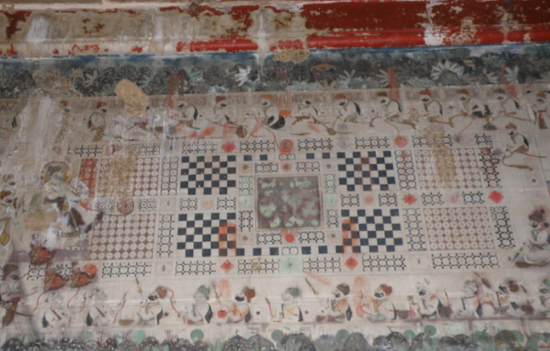 Shows old Indian games. 2008
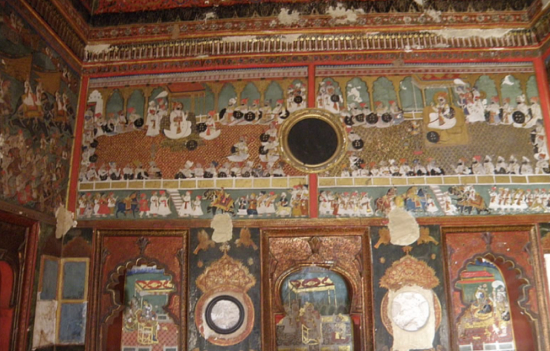 Court scene with Bundi Maharaja
with others.
Court scene with Bundi Maharaja
with others.
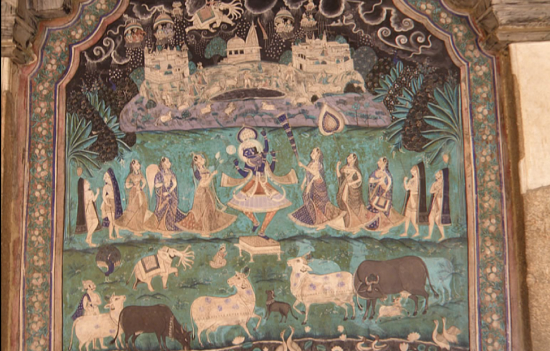 Sri Krishna lifting Govardhan Parvat
(mountain).
Sri Krishna lifting Govardhan Parvat
(mountain).
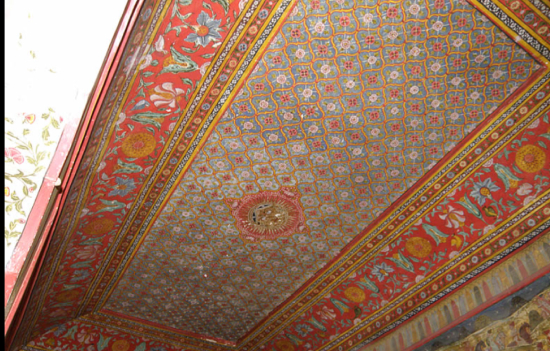 Roof in Chitrashala. 2008.
3. Taragarh Fort
Taragarh Fort sits on a steep hill in the
Aravallis, built by Hada Rajput. I was told it was built in 1354 AD. With
limited time, I decided my energy was better spent elsewhere in Bundi. It
remains on my list for a future trip, once restoration efforts catch up. The TV
tower from Garh is ubiquitous in Bundi.
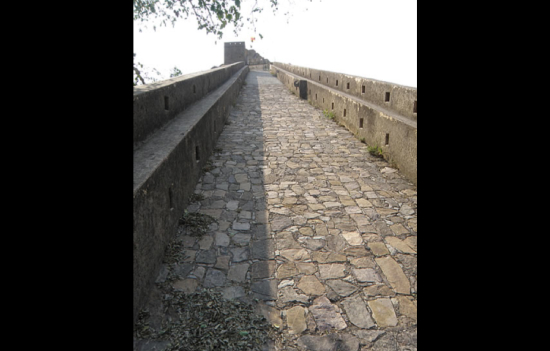 Path to Bhim Burj. Cannons were taken up this path with the help of elephants. Since Bhim Burj is the highest point in the fort it was the best place to fire from.
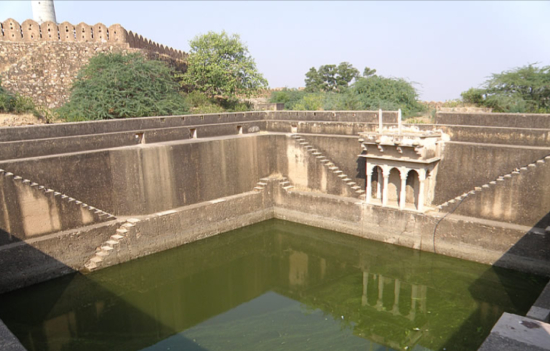 Step-well in Taragarh Fort. 2008.
4. Bundi's Stepwells
Bundi calls itself the “City of Stepwells,” with over 50 scattered across the town.
I made my way to the most celebrated, Raniji ki Baori, built in 1699 by Rani Nathavati. It's a genuine architectural masterpiece; three large arched gates, pillars carved with stone brackets called Toran, and elephant statues standing guard on the columns. Each floor holds a small shrine, which gave the whole place a quietly sacred feel even amid the crumbling stone. It once served as both a water reservoir and a social hub for the city, and the Archaeological Survey of India now maintains it.
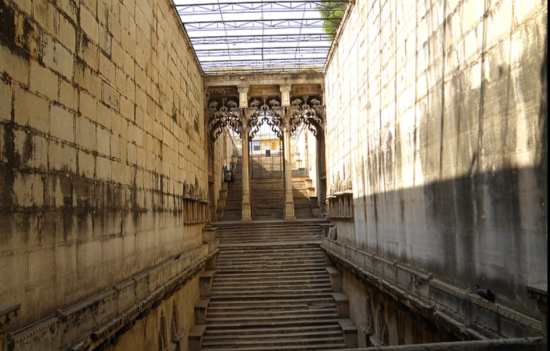 Raniji Ki Baori built by Rani Nathawati. It was made in 1699.
2008.
Raniji Ki Baori built by Rani Nathawati. It was made in 1699.
2008.
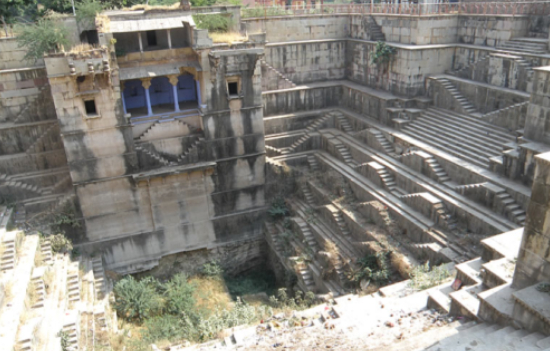 Dhabaigka Kund was built between 1821-1889 during rule of Rao Raja Ram
Singh. It is 51 feet deep. 2008. Would be restored by now.
Dhabaigka Kund was built between 1821-1889 during rule of Rao Raja Ram
Singh. It is 51 feet deep. 2008. Would be restored by now.
Not many Indians know the role on stepwells in
sustaining life then.
5. Prehistoric Caves
What I didn't expect in Bundi was 15,000-year-old rock art. Discovered by amateur archaeologist Om Prakash Sharma, known locally as Kukkiji, the site stretches 30 to 35 km along a tributary of the Chambal River and holds over 101 painted rock shelters. The paintings depict Mesolithic life, hunting scenes, dancing figures, shamanistic rituals along with animals like tigers, elephants, bison, and deer, plus symbols nobody has fully deciphered. The colours remain strikingly vivid, largely because the shelters are tucked deep into cliffs, shielded from weathering.
Standing there, it was humbling to think how
long these images have survived. The walk to these caves in wilderness was
truly magnificent. You will need a guide to visit these caves.
6. Bhimlat Waterfall
Bhimlat Waterfall was a welcome surprise, water dropping about 60 metres into a tranquil, emerald-green lake, ringed by six kilometres of unexpected greenery. Geologists trace its formation to prehistoric techtonic shift, though local folklore credits Bhim, one of the Pandava brothers, with creating it to quench his family's thirst during exile.
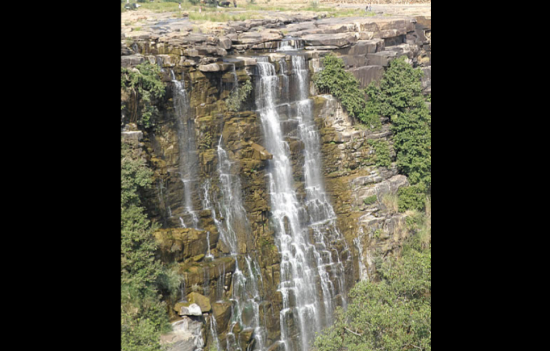 Bhimlat Waterfalls.
The ancient Bhimlat Mahadev Temple is close by
where water continuously cascades over a Shiva lingam.
Why my
Bundi and Jaipur itinerary worked for the art lover in me?
My Bundi and Jaipur itinerary felt like a fitting, quiet close to a trip built around art, history, and a few well-chosen surprises. My Jaipur experiences were wonderful, and primed me for Bundi. Jaipur Retold's tour of the old Jaipur city with Haveli frescoes was the perfect warm-up for Bundi's Chitrashala, while Jaipur Rugs took me into artisans' homes and showed me how craft runs through families. Wabisabi let me get my hands dirty and feel how labour-intensive good craft really is. My respect for craftsmen and artisan gained a new high with these
Jaipur experiences.
On the other hand Bundi was a welcome change
from crowded tourist hubs. It seemed like a different world where locals are
genuine, traditions and culture still exists, and the economy does not revolve completely
around tourism. Bundi reminded me of the Greek life-- Siga- Siga!
Bundi
is about one hour from big city of Kota. To enjoy Bundi one needs a guide. Kuki
Sharma is good, his number is 91 98284 04527.
To read
all articles on India Travel and Yatras
To see Bundi
Albums
1.
Palace and
Fort
2.
Step-wells
3.
Paintings
4.
City and
Cenotaphs
5. Menal Shiv Temple – 1.5 hour away, Good to visit.
6. Mandakini
Temple – 1 hour away
7. For
a good travelogue on Bundi
8. Bundi Fair
9. Jaipur – Block
Printing Sanganer
10. Jaipur 83 kms away Bhangarh
Fort
11. Jaipur 1.5 hours away is awesome Chand
Baori Step- well